Key Points
- Semantic Chunking Alignment: RAG systems utilize HTML heading levels as hard boundaries to create cohesive vector embeddings.
- Intent-Density Matching: Question-formatted H2s and H3s significantly increase cosine similarity scores with natural language AI prompts.
- Schema Synchronization: Aligning DOM heading structures with JSON-LD ‘hasPart’ properties establishes high-trust semantic anchors for AI validation.
Table of Contents
The AI Search Context
A recent study found that content with question-formatted headings is much more likely to be featured as a primary source in AI search engines. This gives a massive advantage over standard declarative headings.
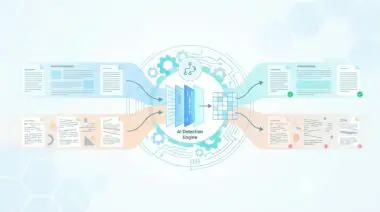
In the modern landscape of AI search, headings act as the main structural anchors for data retrieval systems. Large Language Models do not just read text like humans do. They rely on HTML heading levels to understand the hierarchy and boundaries of your content.
When headings are logically nested and highly descriptive, AI crawlers can accurately segment your content into clean data chunks. This greatly increases the chances of your site being cited in AI Overviews.
Improperly formatted headings cause context fragmentation. The AI struggles to connect supporting evidence in your paragraphs with the main topic. This creates a high risk of the AI hallucinating or ignoring your content entirely.
Generative engines will simply skip poorly structured data. They prefer competitors whose content architecture clearly maps out relationships through proper heading tags. The era of formatting just for visual appeal is officially over.
Core Architecture & Pillars
Core Architecture & Pillars
Semantic Chunking Alignment
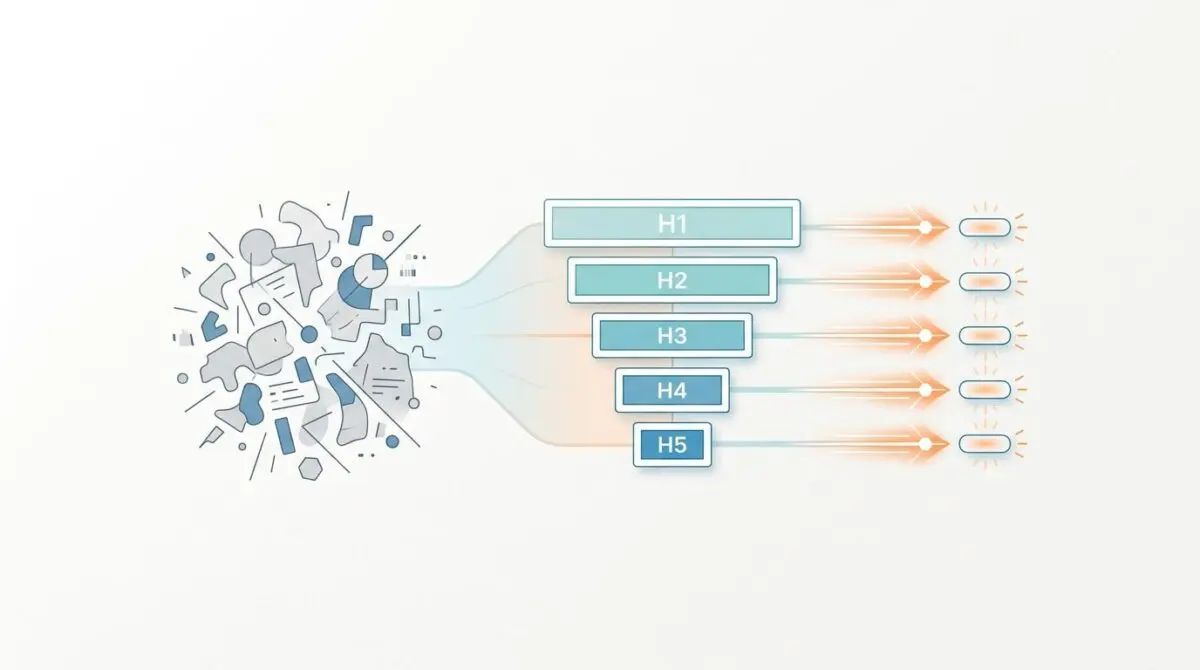
RAG pipelines often use ‘RecursiveCharacterTextSplitter’ or similar logic that treats H-tags as natural delimiters. A structured H1-H2-H3 sequence creates clean semantic breaks, allowing the vector database to store cohesive ‘knowledge units’ rather than disjointed text strings.
Query-to-Header Vector Matching
Generative engines perform cosine similarity checks between a user’s natural language query and the headers in a document. Headers that mirror the ‘intent-density’ of common LLM prompts (e.g., ‘How to…’ or ‘The difference between…’) achieve higher similarity scores.
Entity-Attribute Nesting
LLMs use headers to build internal knowledge graphs of a page. An H1 defines the Subject Entity, H2s define the Attributes, and H3s provide the Data Points. If this hierarchy is broken (e.g., an H3 followed by an H2 that is actually a sub-topic), the AI’s relationship mapping fails.
Schema-Heading Synchronization
AI agents cross-reference the DOM heading structure with JSON-LD ‘speakable’ and ‘mainEntityOfPage’ properties. Discrepancies between what is tagged in Schema and what is tagged in HTML headers reduce the ‘trust score’ of the content for AI validation.
Understanding Vector Chunking Mechanics
To master AI search optimization, you need to understand how algorithms read your website’s code. Data retrieval pipelines look for natural breaks to split massive text blocks into digestible pieces.
When developers build chunking strategies for RAG with LangChain, they often set the system to recognize H2 and H3 tags as hard boundaries. A broken heading sequence completely ruins these boundaries.
Placing an H3 right before an H1 forces the database to merge totally unrelated concepts. This creates a messy data space where the AI cannot tell the difference between a main topic and a minor detail.
Query-to-Header Proximity
Generative engines constantly compare a user’s natural language query with the headers in your document. Headers that closely match the intent of common AI prompts achieve much higher relevance scores.
Recent documentation for AI crawlers suggests that a heading-to-word ratio of one heading for every two hundred words is ideal. This sweet spot maintains context without losing the focus of a specific data chunk.
Keeping this ratio ensures that AI models capture the subtle relationships between different topics. It prevents the background noise that often ruins data retrieval accuracy during complex searches.
Proper nesting means your H1 defines the main subject, H2s define the core attributes, and H3s provide specific data points. When building chunking strategies to improve RAG performance, sticking strictly to this structure is absolutely essential.
The Execution Roadmap
Implementation Roadmap
Normalize Heading Sequence
Audit the page to ensure exactly one H1. Ensure H2s are used for major sections and H3s are used only as sub-sections of the preceding H2. Use a ‘headless’ crawler to verify the Document Object Model (DOM) tree logic.
Transform Headers into Answer-Engines
Rewrite at least 50% of H2s as natural language questions (e.g., ‘What are the benefits of X?’) and H3s as concise, entity-rich answers or lists. This facilitates direct ‘Passage Retrieval’ by AI agents.
Inject Semantic Anchors
Manually assign ID attributes to every H2 and H3 (e.g., <h2 id=”benefits-of-ai”>). This allows AI engines like SearchGPT to link directly to the specific section within the AI Overview citation.
Deploy Table of Contents (ToC) Schema
Implement a ‘Table of Contents’ block that uses anchor links. Wrap this in ‘SiteNavigationElement’ schema to give the LLM a ‘map’ of the document’s semantic depth before it even parses the body text.
Normalizing the DOM Tree
Visual website builders have historically encouraged very chaotic heading structures. Users often pick an H3 simply because they want a smaller font size on their live page.
This visual-first approach completely destroys the logical structure that generative engines rely on. Technical audits must enforce logic-first heading assignments, regardless of how the text looks on the screen.
You must audit your pages to ensure exactly one H1 exists. H2s must represent major sections, while H3s should only serve as sub-sections of the H2 above them. Always validate your raw code structure to ensure perfect alignment.
Question-Based Header Transformation
Rewriting your headers to match conversational intent is critical for AI search optimization. Try to transform at least half of your H2s into natural language questions that users actually type into AI interfaces.
Your H3s should then follow up with concise answers or clear bulleted lists. This simple transformation helps AI agents pull your exact passages when searching for direct answers.
When you optimize chunking strategies for LLM applications, question-based headers act as perfect anchors. Manually assigning ID attributes to every H2 and H3 makes this architecture even stronger.
These specific anchors allow AI engines to link directly to the exact section within their citations. This effectively bridges the gap between raw data extraction and actual user clicks to your website.
Technical Implementation
AI agents constantly cross-reference your heading structure with your background schema code. Any mismatch between your schema declarations and your HTML headers will quickly reduce the trust score of your content.
Automated schema generators often miss the deeper H3 levels entirely. You usually need custom code to ensure your schema explicitly mentions specific H2 and H3 anchors for deeper indexing.
Below is the optimized code markup required to synchronize your heading hierarchy with AI crawler expectations. Deploy this structure to ensure perfect data mapping across your site.
<article> <h1 itemprop="headline">Advanced GEO Heading Strategies</h1> <section> <h2 id="why-headings-matter">Why do headings matter for RAG systems?</h2> <p>LLMs use these as semantic breakpoints...</p> <h3 id="vector-chunking-explained">The Mechanics of Vector Chunking</h3> <p>Data is segmented at every header transition...</p> </section> </article> <script type="application/ld+json"> { "@context": "https://schema.org", "@type": "WebPage", "mainEntity": { "@type": "Article", "headline": "Advanced GEO Heading Strategies", "hasPart": [ { "@type": "HasPart", "name": "Why do headings matter for RAG?", "url": "#why-headings-matter" }, { "@type": "HasPart", "name": "Mechanics of Vector Chunking", "url": "#vector-chunking-explained" } ] } } </script>Validation & Future-Proofing
Validation & Monitoring
- Utilize ‘Perplexity Pages’ or custom ‘LangChain’ loaders to verify URL extractability.
- Audit LLM-generated summaries to ensure all H3-level data points are captured.
- Analyze surrounding text for entity density if heading depth appears shallow.
- Monitor Google Search Console for ‘AI Overview’ impression growth on structural updates.
To verify that your content can be extracted, utilize AI diagnostic tools or custom scripts to load and test your URLs. This ensures your structure is actually readable by machines.
If an AI summary misses your key H3 points, your heading depth is likely too shallow. It might also mean that your surrounding text lacks enough specific details to justify being extracted.
Continuously monitor your search console for AI Overview impressions. Filter specifically for the pages where you have deployed these refined heading structures to accurately measure your return on investment.
Navigating the intersection of traditional SEO and AI search requires a very precise architecture. To future-proof your website for AI Overviews and smart discovery, connect with Andres at Andres SEO Expert.
Frequently Asked Questions
Why are question-formatted headings critical for AI search engines like Perplexity?
Research from May 2026 shows that content with question-formatted H2s is 3.5 times more likely to be featured in Perplexity’s ‘Pro Discovery’ mode. This structure aligns with how AI agents perform direct passage retrieval when matching natural language user queries.
How do HTML heading levels affect Retrieval-Augmented Generation (RAG) systems?
RAG systems use HTML headings as primary structural anchors to determine semantic hierarchy and chunk boundaries. Properly nested tags enable AI crawlers to segment content into high-fidelity vector embeddings, which reduces hallucination risks by maintaining context.
What is semantic chunking alignment in the context of GEO?
Semantic chunking alignment is the practice of using H-tags as natural delimiters for text splitters in RAG pipelines. By creating clear semantic breaks, a structured H1-H2-H3 sequence allows vector databases to store cohesive ‘knowledge units’ rather than disjointed text strings.
What is the ‘Goldilocks Zone’ for heading-to-word ratios in AI search?
According to 2026 search documentation, a heading-to-word ratio of 1:200 is considered the ‘Goldilocks Zone.’ This ratio ensures that embedding models capture nuanced relationships between entities without losing focus or creating contextual noise.
How does entity-attribute nesting improve LLM knowledge graphs?
LLMs use headers to build internal maps of a page’s information. In an optimized hierarchy, the H1 defines the Subject Entity, H2s define Attributes, and H3s provide Data Points. This specific nesting ensures the AI correctly maps the relationship between entities and their attributes.
Why is it necessary to synchronize JSON-LD Schema with HTML headers?
AI agents cross-reference the DOM structure with JSON-LD ‘speakable’ and ‘mainEntityOfPage’ properties. Discrepancies between Schema declarations and HTML headers reduce the ‘trust score’ of the content, making synchronization essential for AI validation.