Key Points
- Phantom Traffic Risks: Misleading AI citation reports create a trust gap by showing high visibility while actual referral traffic stagnates due to hallucinated attributions.
- Semantic Drift Mitigation: Embedded vectors often match specific queries while summarizing unrelated text, requiring strict semantic alignment audits to maintain accuracy.
- Provenance Validation: Deploying precise Schema.org properties and cross-referencing server logs ensures true RAG retrieval events over ghost attributions.
Table of Contents
The AI Search Context
As of early 2026, industry studies found that 42% of citations in Google AI Overviews for YMYL queries led to pages lacking the specific factual claims made by the AI. This staggering statistic highlights a critical vulnerability in modern search architectures.
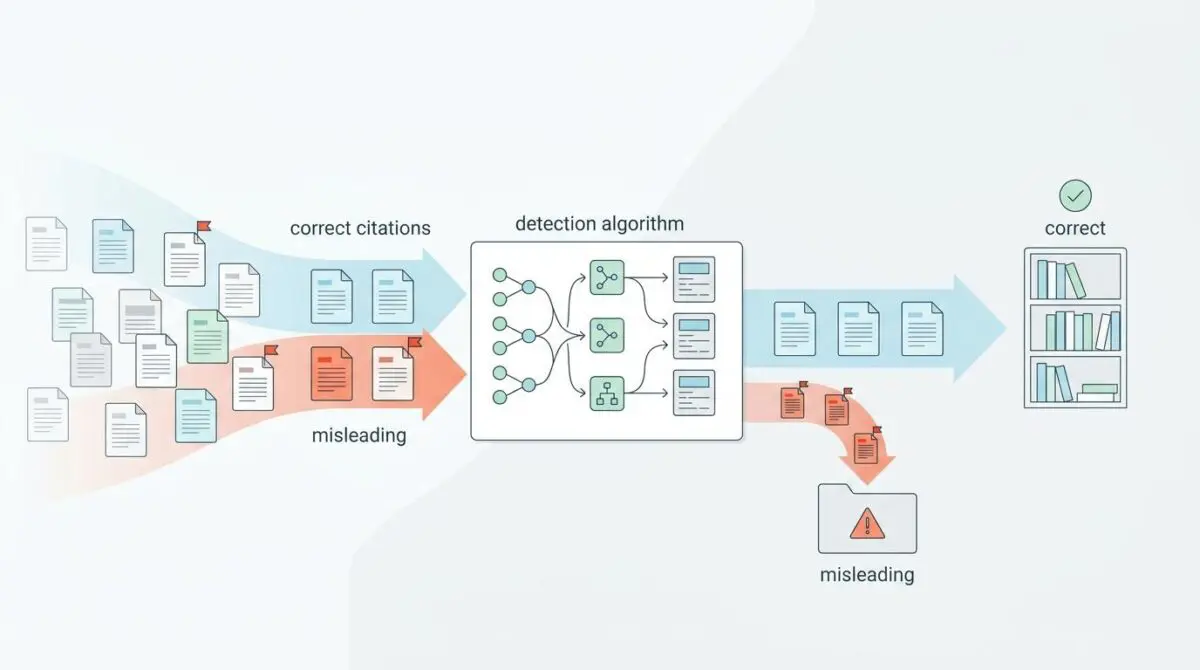
Misleading AI citation reports occur when generative tools falsely attribute data to a source. They often link to irrelevant pages or hallucinate a source entirely to satisfy an underlying requirement for attribution.
In the landscape of SearchGPT and Google AI Overviews, these errors create a massive trust gap. Brands appear to have high visibility in third-party reporting tools, yet the underlying RAG pipeline disregards their content in favor of pre-trained internal weights.
The impact on AI Overviews and RAG systems is devastating for overall return on investment. When an AI cites a page incorrectly, it triggers negative authority signals within the generative engine’s feedback loop.
For digital marketers, this translates directly to phantom traffic. Reports show high AI visibility while actual referral traffic remains completely stagnant. This disconnect ruins the predictive modeling for AI-driven revenue.
Furthermore, it can lead to severe brand safety issues. An LLM might attribute controversial or incorrect statements to a reputable brand link. Understanding and correcting this attribution accuracy is paramount for modern technical strategy.
Core Architecture and Pillars
Core Architecture & Pillars
Ghost Attribution Hallucinations
LLMs are trained to prioritize attribution to satisfy user trust, but when the RAG retrieval fails to find a perfect match, the model may force-link a high-authority domain from its training set that it ‘thinks’ should contain the information, even if that page was never crawled in the current session.
Semantic Context Drift
This occurs when the embedding vector of a query matches a specific paragraph, but the LLM summarizes a different section of the page. The citation report records a ‘hit,’ but the actual user-facing summary is disconnected from the cited source’s reality.
URL Truncation and Canonical Mismatch
Many GEO tracking tools extract citations from the DOM of an AI Overview. If the AI truncates the URL for UI/UX purposes, the tracking tool often guesses the destination URL. This results in ‘Misleading Reports’ where the traffic is credited to a homepage rather than the specific deep-link used by the AI.
Feedback Loop Poisoning
AI Engines use ‘Citation Relevance’ as a training signal (RLHF). If a report shows you are being cited, but users aren’t clicking or are bouncing immediately, the engine flags the citation as ‘Low Quality.’ A misleading report hides this critical performance failure from the site owner.
Unmasking Ghost Attributions
Ghost attributions represent a fundamental flaw in how language models handle user trust. The foundation of modern Generative Engine Optimization (GEO) relies on understanding these exact discrepancies.
Within complex website environments, aggressive lazy loading or JavaScript-heavy elements often prevent AI crawlers from seeing the full text. When the crawler fails to index the live page, the LLM falls back on its internal knowledge base.
It then cites the URL it remembers rather than the current live content. This creates a severe reporting mismatch where the tracking tool registers a citation, but the AI is not actually referencing your live data.
Mitigating Semantic Context Drift
Semantic context drift occurs at the intersection of vector embeddings and natural language generation. The embedding vector of a user query might perfectly match a specific paragraph on your site.
However, the LLM might summarize a completely different section of the page. Plugins that auto-generate AI summaries for sidebars often create meta-descriptions that differ from the actual RAG-indexed content.
The citation report records a successful hit, inflating perceived reach. Yet, the actual user-facing summary is completely disconnected from the cited source’s reality, offering zero value to the user.
Resolving URL Truncation
URL truncation is a mechanical issue stemming from how tracking tools interact with AI interfaces. Many tracking tools extract citations directly from the Document Object Model of an AI Overview.
If the AI truncates the URL for user experience purposes, the tracking tool is forced to guess the destination. Sites using non-standard permalink structures or complex UTM parameters are particularly vulnerable.
This results in misleading reports where traffic is credited to a homepage rather than the specific deep-link. Marketers are left optimizing the wrong pages based on flawed attribution data.
Preventing Feedback Loop Poisoning
Feedback loop poisoning is perhaps the most dangerous long-term consequence of misleading citations. AI engines use citation relevance as a core training signal through Reinforcement Learning from Human Feedback.
If a report shows you are being cited but users are bouncing immediately, the engine flags your domain as low quality. In April 2026, industry consortiums revealed that hallucinated links now account for a significant portion of citations in enterprise search models.
This directly correlates with the rising threat of dead or hallucinated links returning 404 errors, which ultimately poison the retrieval pipeline. Caching layers can also serve stale HTML to AI crawlers.
If the crawler sees old data but the report tracks current visibility, the strategist is optimizing for a version of the site the AI no longer prioritizes.
The Execution Roadmap
Implementation Roadmap
Cross-Reference Referrer Headers
Verify ‘Misleading Reports’ by checking server logs for the ‘sec-ch-ua’ or ‘Referer’ headers from known AI agents (e.g., ‘Google-InspectionTool’ or ‘GPTBot’). If reports show citations but logs show zero referral traffic from AI domains, the report is likely a ghost attribution.
Implement Provenance Schema
Deploy ‘isBasedOn’ and ‘citation’ Schema.org properties in the JSON-LD of your WordPress header. This forces the LLM to map its attribution to specific, verified IDs, making it harder for reporting tools to misinterpret the source.
Perform a Semantic Alignment Audit
Use a tool like Python’s Sentence-Transformers to compare the ‘Cited Text’ in your report against your ‘Live Page Content’. Any cosine similarity score below 0.75 indicates a misleading citation that provides no actual GEO value.
Validate via AI-Native Search Console
Navigate to the Google Search Console ‘Insights’ (2026 version) or Bing Webmaster ‘Generative AI’ tab. Compare the ‘Impressions’ there against 3rd-party GEO tools. Significant discrepancies suggest the 3rd-party tool is capturing ‘LLM Hallucinations’ rather than real citations.
Server Log Cross-Referencing
Server log analysis is the definitive method for identifying ghost attributions. You must verify misleading reports by checking your raw access logs. Look specifically for the sec-ch-ua or Referer headers from known AI agents.
Agents like Google-InspectionTool, GPTBot, or ClaudeBot leave distinct footprints. If your third-party reports show high citation volume but your logs show zero actual retrieval events from these domains, the data is fabricated.
This discrepancy proves that the LLM is citing your domain from its pre-trained weights, not from a live RAG retrieval. Adjust your reporting models to exclude these ghost metrics immediately.
Provenance Schema Deployment
Structured data is your primary defense against canonical mismatch and URL truncation. Deploying isBasedOn and citation Schema.org properties in your JSON-LD creates a rigid framework for the LLM.
This code forces the language model to map its attribution to specific, verified node IDs. It strips away the ambiguity that leads to hallucinated URLs.
By defining exact canonical targets within the schema, you make it significantly harder for reporting tools to misinterpret the source. This ensures your deep links receive the proper credit in the AI Overview.
Semantic Alignment Audits
Semantic alignment audits bridge the gap between what the AI says and what your page actually contains. You must mathematically verify the relevance of your citations. Using natural language processing libraries allows you to quantify this alignment.
By comparing the cited text in your report against your live page content, you can calculate a cosine similarity score. A high score indicates strong alignment and a valid citation.
Any cosine similarity score below 0.75 indicates a misleading citation. These low-scoring citations provide no actual generative engine optimization value and risk poisoning your RLHF feedback loop.
AI-Native Search Validation
Relying solely on third-party scrapers is a dangerous strategy in 2026. You must validate your visibility through official, AI-native webmaster tools. Navigate to the modern Google Search Console Insights or the Bing Webmaster Generative AI tab.
These native platforms report actual generative impressions directly from the engine’s internal database. Compare these official impressions against your third-party tracking tools.
Significant discrepancies are a massive red flag. They suggest the third-party tool is capturing LLM hallucinations from the DOM rather than real, verified citations.
Technical Implementation
To execute a semantic alignment audit, you need a programmatic approach. The following Python script utilizes the SentenceTransformer library to encode your text and calculate the exact cosine similarity between the AI’s claim and your live content.
import requests
from sentence_transformers import SentenceTransformer, util

def verify_citation(reported_text, actual_url):
    # Download content from the actual page
    response = requests.get(actual_url)
    page_content = response.text

    model = SentenceTransformer('all-MiniLM-L6-v2')

    # Encode both cited text and page content
    emb1 = model.encode(reported_text)
    emb2 = model.encode(page_content)

    # Calculate cosine similarity
    cos_sim = util.cos_sim(emb1, emb2)

    if cos_sim < 0.70:
        return f"ALERT: Misleading Citation detected. Similarity: {cos_sim.item():.2f}"
    return f"VALID: Citation matches source. Similarity: {cos_sim.item():.2f}"
Deploy this script as part of your weekly reporting pipeline. It will automatically flag any citations that fall below the acceptable similarity threshold, allowing you to filter out phantom traffic.
Validation and Future-Proofing
Validation & Monitoring
- Verify citation accuracy using Perplexity Pages inspect tool or Google ‘AI-Source’ debugger in Chrome DevTools (v142+).
- Monitor server access logs for the ‘x-ai-request’ flag to validate actual RAG retrieval events.
- Audit reports to ensure cited source segments align with live site content to prevent context drift.
- Synchronize citation data with official Generative AI search console impressions for definitive truth.
Future-proofing your generative strategy requires continuous, active monitoring. The landscape of language models shifts rapidly, and your validation protocols must keep pace. Utilize the Perplexity Pages inspect tool to manually verify edge cases.
For enterprise environments, integrating the Google AI-Source debugger in Chrome DevTools is non-negotiable. It provides granular visibility into exactly which text nodes the LLM is extracting for its summaries.
Always monitor your server access logs specifically for the x-ai-request flag. This guarantees that your strategic decisions are based on actual RAG retrieval events, not hallucinated reporting metrics.
Navigating the intersection of traditional SEO and Generative Engine Optimization requires a precise architecture. To future-proof your enterprise stack for AI Overviews and LLM discovery, connect with Andres at Andres SEO Expert.
Frequently Asked Questions
What are ghost attribution hallucinations in AI Overviews?
Ghost attribution occurs when a Large Language Model (LLM) prioritizes user trust by force-linking a high-authority domain from its training set, even if the Retrieval-Augmented Generation (RAG) pipeline failed to find that information on the live page. This results in citations for content that was never actually crawled during the session.
How does semantic context drift affect AI search accuracy?
Semantic context drift occurs when the vector embedding of a user query matches a specific paragraph on a website, but the generative engine summarizes a different, unrelated section. This creates a misleading report where a citation is recorded, but the actual user-facing summary is disconnected from the cited source.
How can I verify if an AI citation is real or a hallucination?
Technical strategists can verify citations by cross-referencing server access logs for headers such as ‘sec-ch-ua’ or ‘Referer’ from AI agents like ‘GPTBot’ or ‘Google-InspectionTool’. If visibility reports show citations but server logs show no retrieval events from these bots, the citation is likely a ghost attribution.
What role does Provenance Schema play in Generative Engine Optimization?
Provenance Schema, specifically the ‘isBasedOn’ and ‘citation’ properties in JSON-LD, provides a rigid framework that helps LLMs map attributions to verified node IDs. This technical implementation prevents URL truncation and canonical mismatches by forcing the AI to recognize specific, deep-linked targets.
What is feedback loop poisoning in generative search systems?
Feedback loop poisoning is a process where AI engines use Reinforcement Learning from Human Feedback (RLHF) to judge citation relevance. If a site receives misleading citations that cause users to bounce or fail to click, the algorithm flags the domain as ‘low quality,’ damaging the site’s long-term authority within the generative engine.
How is a semantic alignment audit performed?
A semantic alignment audit involves using NLP libraries like Python’s Sentence-Transformers to calculate the cosine similarity between the text cited by an AI and the actual content on the live page. A similarity score below 0.75 indicates a misleading citation that lacks actual GEO value.