Executive Summary
- Hreflang attributes signal the specific language and geographical targeting of a webpage to search engines.
- Correct implementation prevents duplicate content issues by clarifying the relationship between localized URLs.
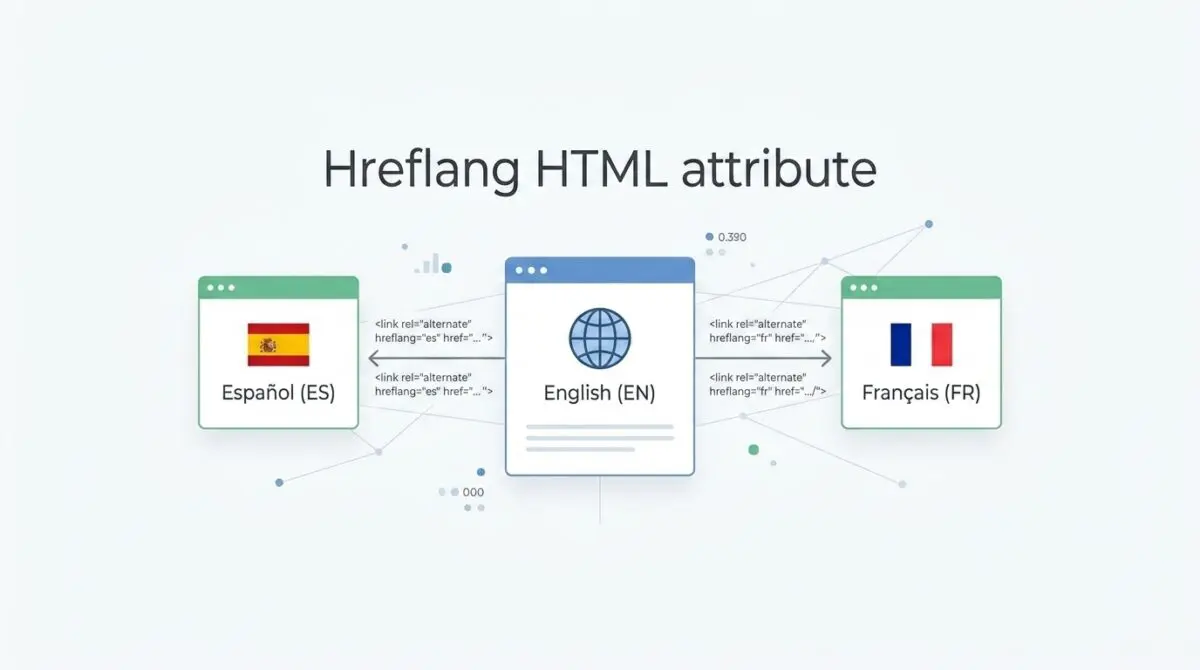
- Valid hreflang implementation requires reciprocal, bidirectional links between all language versions of a document.
What is Hreflang Tags?
Hreflang is a technical HTML attribute, specifically rel=”alternate” hreflang=”x”, used to specify the language and optional geographic targeting of a webpage. Introduced by Google in 2011, this attribute serves as a signal to search engines that a specific URL is a localized version of another page. It allows webmasters to serve the most relevant content to users based on their browser language settings and IP-based location.
Implementation of hreflang can occur through three primary methods: HTML link elements in the document head, HTTP headers for non-HTML files like PDFs, or within an XML sitemap. Regardless of the method, the attribute must use the ISO 639-1 format for languages and the ISO 3166-1 Alpha 2 format for optional region codes. This precision ensures that search engine crawlers correctly map the relationship between different language versions of the same content.
The Real-World Analogy
Imagine a global airport information desk. Instead of forcing every traveler to read a single sign written in one language, the airport provides identical signs in multiple languages. The hreflang tag acts as the language coordinator who stands at the entrance and directs a French speaker to the French sign and a Japanese speaker to the Japanese sign. This ensures every traveler receives the correct information in their native tongue immediately, preventing confusion and ensuring they reach their destination efficiently without having to translate the information themselves.
Why is Hreflang Tags Important for SEO?
Hreflang tags are vital for international SEO because they directly address the challenge of duplicate content across localized domains or subdirectories. When a website offers similar content in the same language for different regions (e.g., English for the United States and English for the United Kingdom), search engines may struggle to determine which version to rank for a specific query. Hreflang provides an explicit instruction that prevents these pages from competing against each other in the search results.
Furthermore, hreflang tags improve user experience by reducing bounce rates. When a user is automatically directed to a version of a site that matches their language and currency, they are more likely to engage with the content and complete conversions. By consolidating ranking signals across all localized versions, hreflang ensures that the authority of the global brand is shared effectively across all regional iterations of the site.
Best Practices & Implementation
- Implement Self-Referencing Tags: Every localized page must include a hreflang tag that points to itself, in addition to the tags pointing to other language versions.
- Ensure Bidirectional Linking: For hreflang to be valid, all links must be reciprocal. If page A points to page B, page B must point back to page A; otherwise, search engines may ignore the tags.
- Use the x-default Attribute: Implement rel=”alternate” hreflang=”x-default” to specify a fallback page for users whose language or region does not match any of the explicitly defined tags.
- Verify ISO Codes: Always use the correct ISO 639-1 language codes and ISO 3166-1 Alpha 2 region codes. A common error is using “uk” for the United Kingdom instead of the correct “gb”.
Common Mistakes to Avoid
One frequent error is the omission of reciprocal links, which effectively breaks the hreflang cluster and causes search engines to disregard the instructions. Another common mistake is using incorrect or non-standard language and region codes, which prevents crawlers from identifying the target audience. Finally, webmasters often fail to update hreflang tags when URLs change, leading to broken links within the hreflang set and creating crawl errors that negatively impact SEO health.
Conclusion
Hreflang tags are a fundamental component of international SEO architecture that ensure search engines serve the most relevant localized content to users. Proper implementation requires strict adherence to reciprocal linking and standardized ISO codes to maintain search visibility across multiple regions.