


Key Takeaways
- Gemini 3.6 Flash reduces token usage by 17% and costs less than 3.5 Flash while improving coding and multimodal performance.
- Gemini 3.5 Flash-Lite delivers the fastest inference at 350 tokens per second, outperforming 3 Flash on key agentic benchmarks at half the cost.
- Gemini 3.5 Flash Cyber, exclusive to CodeMender, targets cybersecurity vulnerabilities with competitive frontier performance through a limited-access pilot.
Google ‘s Trio of Flash Models Targets Agent Efficiency, Speed, and Security
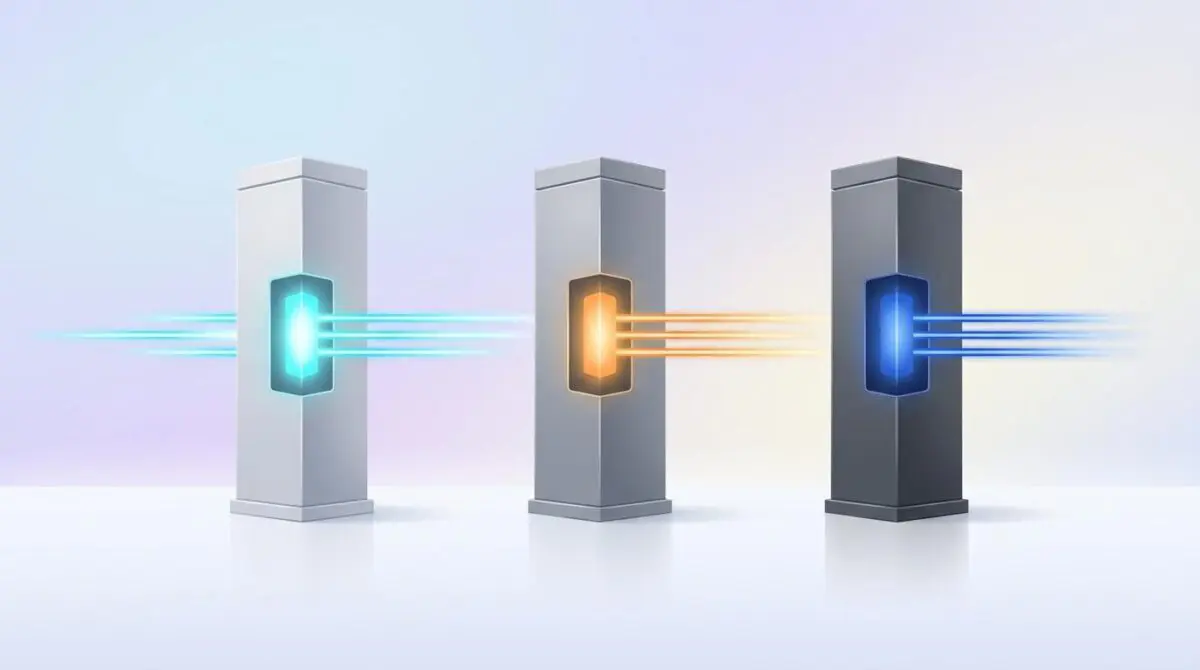
Google DeepMind has launched three new Gemini models—3.6 Flash, 3.5 Flash-Lite, and 3.5 Flash Cyber—aimed at making AI agents more efficient, faster, and secure. Announced on July 21, 2026, these models target developers and enterprises scaling agentic workflows, offering lower costs, higher throughput, and specialized cybersecurity capabilities.
Table of Contents
Core Breakdown: The New Gemini Trio
Gemini 3.6 Flash: Efficiency Leap
Gemini 3.6 Flash builds directly on developer feedback to deliver better coding, knowledge work, and multimodal performance while cutting token usage. According to the Artificial Analysis Index, it consumes 17% fewer output tokens than 3.5 Flash. On the DeepSWE benchmark by Datacurve, it achieves 49% accuracy versus 37% for the previous version, and on MLE Bench it jumps to 63.9% from 49.7%.
The model also shows improved computer use abilities, scoring 83% on OSWorld-Verified compared to 78.4% for 3.5 Flash. Priced at $1.50 per million input tokens and $7.50 per million output tokens, it undercuts its predecessor while reducing overall cost per agentic task. Early customers like Hebbia and Harvey report strong gains in document parsing, chart analysis, and report drafting.
As detailed in the announcement from Google DeepMind, safety enhancements include upgraded Frontier Safety safeguards against CBRN and cyber offense misuse, making the model more resistant to jailbreaks while minimizing refusals for beneficial uses.
Gemini 3.5 Flash-Lite: Speed at Scale
Designed for low-latency and high-throughput workloads, 3.5 Flash-Lite is the fastest model in the 3.5 series at 350 output tokens per second, as measured by Artificial Analysis. At just $0.30 per million input tokens and $2.50 per million output tokens, it offers a compelling price-to-performance ratio for production traffic.
Despite its speed, it significantly outperforms 3.1 Flash-Lite and even matches or beats 3 Flash on benchmarks: SWE-Bench Pro (54.2% vs 49.6%) and OSWorld-Verified (74% vs 65.1%). It now includes computer use as a built-in tool, enabling reliable agentic tasks across surfaces.
Gemini 3.5 Flash Cyber: Security Focus
Gemini 3.5 Flash Cyber is fine-tuned from 3.5 Flash to detect, validate, and patch cybersecurity vulnerabilities at scale. Within the CodeMender agent infrastructure, multiple Cyber agents collaborate to produce combined reports, achieving competitive frontier performance on the CyberGym benchmark.
Due to dual-use concerns, the model will be exclusively available to governments and trusted partners through a limited-access pilot program via CodeMender, giving frontline defenders a head start against critical vulnerabilities.
Strategic Analysis: Competitive Cracks and Opportunities

Google ‘s aggressive pricing and specialization come as the AI agent race heats up. According to a recent benchmark comparison on BenchLM.ai, Gemini 3.6 Flash holds its own against GPT-4o mini across nine shared evaluations, covering reasoning, coding, and multimodal tasks—supporting its position as a cost-effective workhorse for agent workflows.
However, OpenAI‘s July 9 announcement of GPT-5.6 signals a different strategic path, emphasizing greater intelligence per token and on-demand capability scaling. The GPT-5.6 Sol variant, rumored to compete with Gemini 3.5 Pro, could challenge Google ‘s upcoming high-end offering. Google, in contrast, is betting on tiered efficiency: 3.5 Flash-Lite undercuts competition at the low end, while 3.6 Flash optimizes midrange cost-per-task, and 3.5 Flash Cyber carves a niche in security.
This triplet approach gives developers granular control over latency, cost, and safety, potentially giving Google an edge in high-volume, mission-critical deployments where every millisecond and penny counts.
Conclusion: Agentic Scale Hinges on Choice
With this release, Google is betting that the future of AI agents will be defined not by raw intelligence alone but by efficiency, latency, and domain specialization. By pairing workhorse and lite models with a security-focused variant, the company gives developers a toolkit to match model capability to task complexity without breaking the budget.
Staying ahead in the rapidly shifting landscape of AI requires precision. To future-proof your digital strategy and scale effortlessly, you need a foundation built on precision. Optimize your site with advanced speed engineering, secure your infrastructure in high-performance hosting environments, and streamline your entire workflow through autonomous AI pipelines. If you are ready to elevate your systems, Connect with Andres at Andres SEO Expert to build your ultimate architecture.
Frequently Asked Questions
What are the three new Gemini models announced by Google DeepMind?
Google DeepMind launched Gemini 3.6 Flash, Gemini 3.5 Flash-Lite, and Gemini 3.5 Flash Cyber. The trio targets agent efficiency, speed, and security, respectively, offering lower costs, higher throughput, and specialized cybersecurity capabilities for developers and enterprises scaling agentic workflows.
How does Gemini 3.6 Flash improve upon Gemini 3.5 Flash?
Gemini 3.6 Flash delivers better coding, knowledge work, and multimodal performance while consuming 17% fewer output tokens. It achieves 49% accuracy on DeepSWE (vs 37%) and 63.9% on MLE Bench (vs 49.7%). Pricing is $1.50 per million input tokens and $7.50 per million output tokens, undercutting its predecessor and reducing overall cost per agentic task.
What is the speed and pricing of Gemini 3.5 Flash-Lite?
Gemini 3.5 Flash-Lite is the fastest model in the 3.5 series at 350 output tokens per second. It costs $0.30 per million input tokens and $2.50 per million output tokens, offering a compelling price-to-performance ratio. It outperforms 3.1 Flash-Lite and matches or beats 3 Flash on key benchmarks like SWE-Bench Pro and OSWorld-Verified.
What is Gemini 3.5 Flash Cyber and who can access it?
Gemini 3.5 Flash Cyber is fine-tuned from 3.5 Flash to detect, validate, and patch cybersecurity vulnerabilities at scale. Due to dual-use concerns, it is exclusively available to governments and trusted partners through a limited-access pilot program via the CodeMender agent infrastructure, giving frontline defenders a head start against critical vulnerabilities.
How does the new Gemini trio compare to OpenAI’s GPT-5.6?
According to BenchLM.ai, Gemini 3.6 Flash holds its own against GPT-4o mini across reasoning, coding, and multimodal tasks. OpenAI’s GPT-5.6 emphasizes greater intelligence per token, with a rumored Sol variant targeting high-end competition. Google’s tiered approach—Flash-Lite for low-end, 3.6 Flash for midrange, and Cyber for security—gives developers granular control over latency, cost, and safety for high-volume deployments.
What are the safety enhancements in Gemini 3.6 Flash?
Gemini 3.6 Flash includes upgraded Frontier Safety safeguards against CBRN and cyber offense misuse, making the model more resistant to jailbreaks while minimizing refusals for beneficial uses. This addresses developer feedback for improved security without over-blocking legitimate requests.