



Key Takeaways
- NVIDIA Rubin GPU delivers up to 10x more agentic throughput per unit energy versus Blackwell, targeting the demanding inference patterns of always-on AI agents.
- Architecture includes 336 billion transistors, 224 SMs, 896 Tensor Cores, 288 GB HBM4 with 22 TB/s bandwidth, and a third-generation Transformer Engine supporting up to 50 petaflops NVFP4.
- Hardware innovations such as enhanced Tensor Memory Accelerator with inline descriptor updates, activation sparsity for attention acceleration, and fine-grained dependent kernel triggering reduce overhead for MoE and long-context workloads.
- At rack scale, the Vera Rubin NVL72 integrates liquid cooling, power smoothing, and DSX MaxLPS to provision up to 40% more GPUs within the same power envelope, with hot-swappable NVLink switch trays for resilient operation.
Rubin GPU: The Engine for Always-On Agentic Inference
NVIDIA has pulled back the curtain on its Rubin GPU architecture, the compute core of the Vera Rubin platform purpose-built for agentic AI workloads. The company claims the new design delivers up to 10 times more agentic throughput per unit of energy compared to the previous-generation Blackwell architecture. With 336 billion transistors, 224 streaming multiprocessors, and 896 Tensor Cores, the Rubin GPU aims to sustain the continuous reasoning, tool use, and multistep generation that define modern AI agents.
Table of Contents
How Rubin GPU Architecture Redefines Agentic Inference
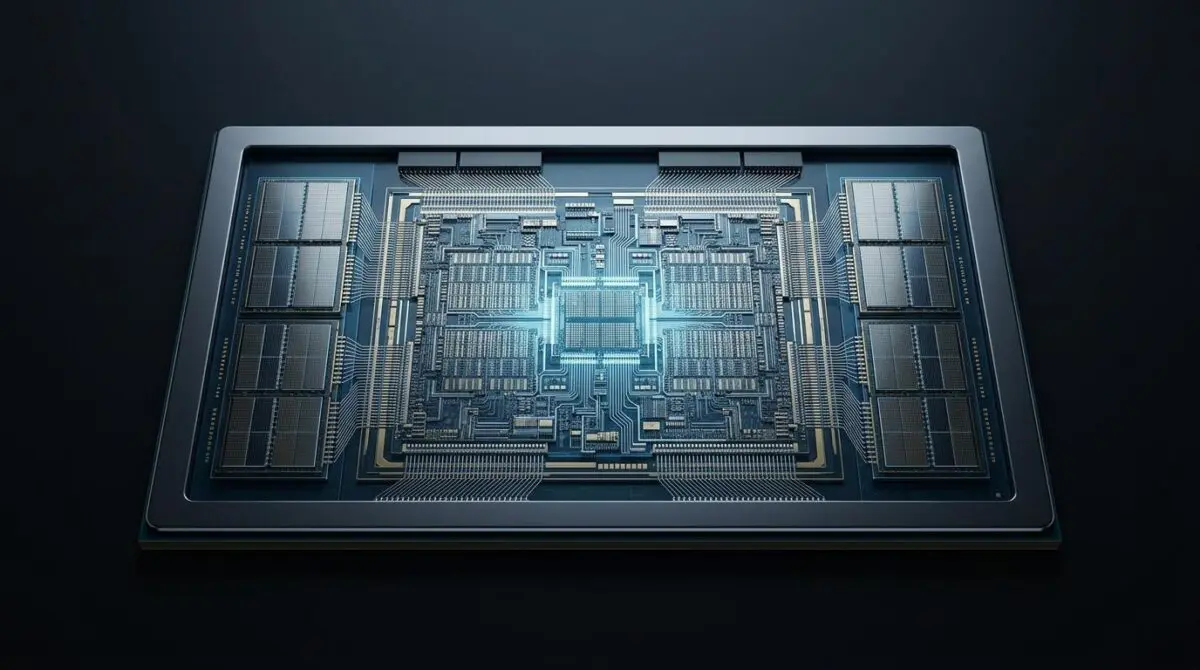
The Rubin GPU is built from two reticle-limited compute dies unified via the NVIDIA High-Bandwidth Interface (NV-HBI). This package houses 336 billion transistors, 224 SMs, and 896 Tensor Cores, supported by a third-generation Transformer Engine that delivers up to 50 petaflops of NVFP4 inference performance. The engine adapts precision across numerical formats, balancing throughput with accuracy for agentic workloads that shift between reasoning, generation, and retrieval.
Memory architecture plays a critical role. Rubin integrates up to 288 GB of HBM4 memory across 12-Hi stacks, providing 22 TB/s of peak bandwidth. The enhanced Tensor Memory Accelerator (TMA) manages efficient data movement across complex layouts, while NVLink 6 offers 3,600 GB/s scale-up bandwidth per GPU for all-to-all communication. NVLink-C2C adds 1,800 GB/s for coherent CPU-GPU links, and PCIe Gen 6 supplies 256 GB/s host connectivity. Confidential Computing with TEE-I/O secures data in transit and at rest.
Key Inference Accelerations
Beyond raw specifications, Rubin introduces several features to eliminate bottlenecks in agentic inference. For mixture-of-experts (MoE) models, the enhanced TMA supports inline descriptor updates, allowing kernels to share unified tensor descriptors and override fields like memory pointer at runtime. This reduces metadata overhead and improves throughput as expert counts grow.
For matrix operations, Rubin doubles the K-dimension instruction throughput relative to Blackwell. This means fewer K-loop iterations in GEMM operations, reducing loop overhead and improving Tensor Core utilization at high tensor-parallel scales—a direct benefit for distributed model execution across many GPUs.
Long-context attention is another focus area. Rubin combines activation sparsity with adaptive compression to reduce intermediate data volume. The pipeline loads dense QK^T results from Tensor Memory into a structured 2:4 sparse compressed form, reducing write cost and storage requirements. Softmax then operates only on nonzero values, and the subsequent V-matrix multiplication uses sparse MMA with the compressed metadata. This cuts compute and data movement in the most expensive part of attention. Additionally, exponential throughput per clock increases by up to 2x for FP32 and 4x for BF16/FP16 versus Blackwell, helping softmax keep pace with faster Tensor Cores.
Fine-grained dependent kernel triggering enables earlier consumer-kernel start as soon as required input data becomes available, rather than waiting for a larger set of producer work to complete. This reduces idle gaps in the GPU timeline and is especially valuable for sequential activation flows in agentic inference.
Rack-Scale Efficiency
The Vera Rubin NVL72 extends these GPU capabilities to the rack level. It integrates compute, networking, liquid cooling, and Intelligent Power Smoothing with energy storage to absorb transient power demands. According to NVIDIA, this reduces average power consumption by about 10% compared to previous smoothing techniques and cuts 50ms peak power by roughly 20%. The DSX MaxLPS system further optimizes across GPUs, racks, and workloads, enabling operators to provision up to 40% more GPUs within the same power budget without sacrificing performance.
Hardware design emphasizes serviceability: the third-generation MGX rack architecture eliminates cables, fans, and hoses in compute trays, reducing tray assembly time from hours to one minute. Hot-swappable NVLink switch trays and improved RAS capabilities support resilient operation at scale.
From Benchmarks to Deployment: Real-World Implications
NVIDIA is not waiting for benchmarks to validate its claims. Production of the Vera Rubin NVL72 is ramping, with racks already running at CoreWeave, Google Cloud, Microsoft Azure, and Oracle Cloud Infrastructure. CoreWeave published early results showing the Vera Rubin NVL72 delivering 10x more throughput per megawatt compared to the Grace Blackwell NVL72 on the DeepSeek-R1 model. While independent verification is still pending, the figure aligns with NVIDIA’s internal projections.
The Vera Rubin platform consists of seven chips across five rack trays, including the Vera CPU with custom Olympus cores claiming 2x single-threaded performance and 40% lower memory latency versus competing chiplet designs. DeepInfra benchmarked the Vera CPU and reported up to 1.6x more concurrent AI agents at the same quality of service, and up to 2.2x faster orchestration relative to alternative CPUs, while processing nearly 5 trillion tokens per week (30% agentic).
Networking advances include sixth-generation NVLink providing 260 TB/s all-to-all bandwidth per rack, enabling the 72-GPU domain to act as a single accelerator. NVIDIA claims 2x throughput, 3x lower latency, and 10x higher packet rates versus off-the-shelf Ethernet. Spectrum-X Ethernet with 102.4T Spectrum-6 switches and 1.6T ConnectX-9 SuperNICs boosts RDMA bandwidth by 1.6x. Photonics with co-packaged optics enters volume manufacturing, boasting 5x lower power and 10x higher mean time between interruptions compared to pluggable transceivers. Early adopters include CoreWeave, Lambda, and Oracle Cloud Infrastructure.
NVLink Fusion opens the scale-up stack to third-party XPUs, a move that could reshape the accelerator interconnect landscape. Meanwhile, the Tom’s Hardware snippet notes that NVIDIA considered an alternative two-rack copper design called NVL72x2, suggesting the company continues to evaluate trade-offs between optical and copper connectivity.
However, as a Medium analysis points out, peak NVFP4 petaflops are not directly comparable across precisions and must be validated under real workload conditions. The publication also warns that full-rack allocation is recommended for large tensor-parallel and latency-sensitive collectives, and that fragmentation, health-gate failures, and firmware drift pose operational risks. Schedulers must treat a single NVL72 as a high-bandwidth placement island, complicating multitenant deployments.
Despite these caveats, enterprise adoption is accelerating. Microsoft and Mistral AI formed a partnership committing tens of thousands of Vera Rubin GPUs to power European sovereign AI infrastructure. Google Cloud announced the A5X instance, a bare-metal Vera Rubin NVL72, with startup Ineffable Intelligence using it for reinforcement-learning-based superlearner systems.
The message is clear: the era of agentic AI demands hardware co-designed from transistor to rack. NVIDIA’s Rubin GPU and the Vera Rubin platform represent a holistic approach to maximizing tokens per watt, but real-world success will hinge on software maturity, ecosystem adoption, and operational discipline at scale.
The Road Ahead for Agentic AI Infrastructure
The road ahead for agentic AI infrastructure is paved with deep architectural co-design. The Rubin GPU’s focus on inference-specific bottlenecks—MoE routing, long-context attention, kernel transition latency, and memory bandwidth utilization—reflects a maturation of the AI accelerator market. As AI agents move from prototypes to production systems handling billions of tokens daily, the winners will be those that can sustain high utilization across diverse, dynamic workloads within fixed power envelopes.
NVIDIA’s aggressive roadmap, including the future Vera Rubin Ultra NVL576, signals that scale-out challenges are far from solved. But with production deployments already live at major cloud providers and early benchmarks supporting the 10x efficiency claim, the Rubin architecture is positioned to power the next generation of AI factories.
To stay ahead in this rapidly evolving landscape, enterprises must align their AI infrastructure strategy with the latest hardware and software innovations. Whether you are architecting a new AI factory or optimizing an existing deployment, partnering with experts who understand both the technical depth and the operational realities is critical. Explore AI-driven automation pipelines that can help you maximize the return on your AI investments, then connect with Andres to discuss your specific needs. And if you want to learn more about how Andres SEO Expert can support your AI infrastructure journey, we are here to help.
Frequently Asked Questions
What is the NVIDIA Rubin GPU and how does it differ from Blackwell?
The Rubin GPU is the core of the Vera Rubin platform, designed for agentic AI workloads. It features 336 billion transistors, 224 streaming multiprocessors, and 896 Tensor Cores. Compared to Blackwell, it delivers up to 10x more agentic throughput per unit of energy, thanks to a third-generation Transformer Engine, enhanced Tensor Memory Accelerator, and support for NVFP4 precision. Key improvements include doubled K-dimension instruction throughput, advanced long-context attention with activation sparsity, and fine-grained dependent kernel triggering.
What memory and bandwidth specifications does the Rubin GPU offer?
The Rubin GPU integrates up to 288 GB of HBM4 memory across 12-Hi stacks, providing 22 TB/s of peak bandwidth. It uses NVLink 6 for 3,600 GB/s scale-up bandwidth per GPU, NVLink-C2C for coherent CPU-GPU links (1,800 GB/s), and PCIe Gen 6 for 256 GB/s host connectivity. The enhanced Tensor Memory Accelerator (TMA) manages efficient data movement, and Confidential Computing with TEE-I/O secures data in transit and at rest.
How does the Rubin GPU improve inference for mixture-of-experts (MoE) models?
For MoE models, the enhanced TMA supports inline descriptor updates, allowing kernels to share unified tensor descriptors and override fields like memory pointer at runtime. This reduces metadata overhead and improves throughput as expert counts grow. Additionally, the doubled K-dimension instruction throughput reduces loop overhead in GEMM operations, improving Tensor Core utilization at high tensor-parallel scales.
What is the Vera Rubin NVL72 and how does it improve rack-scale efficiency?
The Vera Rubin NVL72 integrates compute, networking, liquid cooling, and Intelligent Power Smoothing with energy storage. It reduces average power consumption by about 10% and cuts 50ms peak power by roughly 20% compared to previous methods. The DSX MaxLPS system allows operators to provision up to 40% more GPUs within the same power budget. The rack also features a cable-less, fan-less design with hot-swappable NVLink switch trays for improved serviceability.
What real-world performance benchmarks are available for the Rubin platform?
CoreWeave published early results showing the Vera Rubin NVL72 delivering 10x more throughput per megawatt compared to the Grace Blackwell NVL72 on the DeepSeek-R1 model. DeepInfra benchmarked the Vera CPU and reported up to 1.6x more concurrent AI agents at the same quality of service, and up to 2.2x faster orchestration. However, independent verification is still pending, and NVFP4 petaflops must be validated under real workload conditions.
What are the operational challenges of deploying the Rubin platform?
Operational challenges include fragmentation, health-gate failures, and firmware drift. Full-rack allocation is recommended for large tensor-parallel and latency-sensitive collectives, complicating multitenant deployments. Schedulers must treat a single NVL72 as a high-bandwidth placement island. Additionally, peak performance metrics need validation under real workloads, and the software ecosystem must mature to fully leverage the hardware capabilities.