Key Takeaways
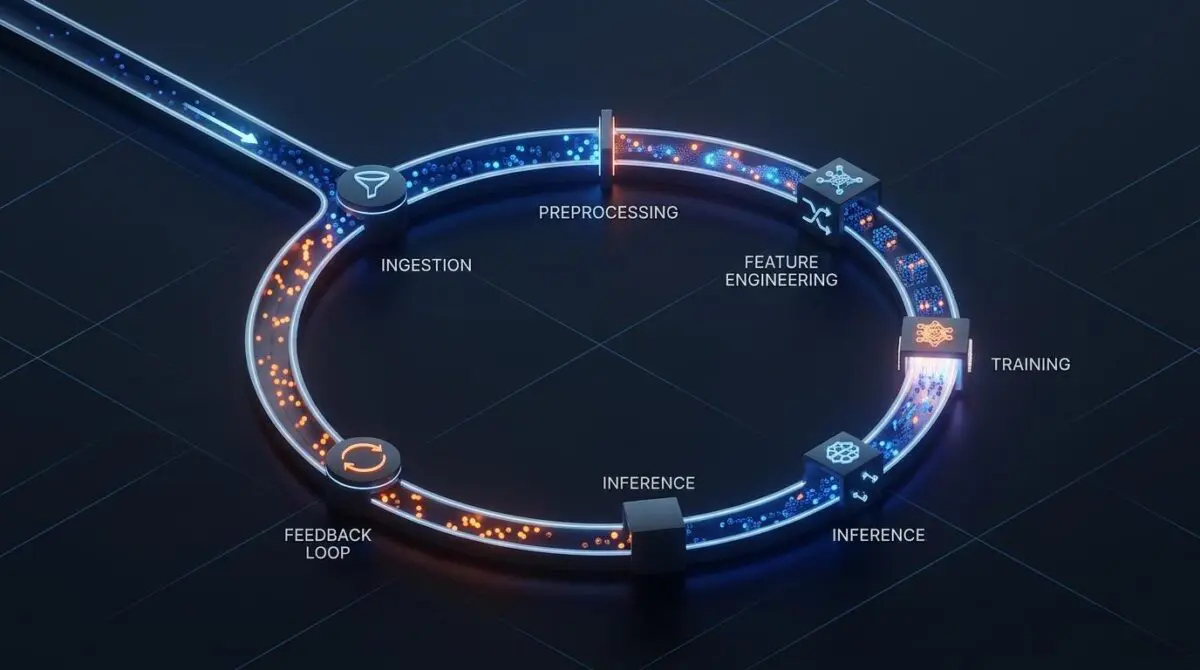
- AI data pipelines require a six-stage iterative loop (ingestion, preprocessing, feature engineering, training, inference, monitoring) unlike traditional ETL.
- The data pipeline tools market is projected to reach $42B by 2036, driven by AI-readiness and cloud adoption.
- Without proper orchestration and validation, AI models suffer from data quality issues, drift, and unreliable outputs.
The $42 Billion Architecture Shift: Inside the AI Data Pipeline Revolution
As enterprises pivot from static batch processing to continuous model training, a fundamental transformation is reshaping the automation landscape. Today, the engineering team at n8n published a deep technical analysis dissecting how AI data pipelines have diverged from conventional extract-transform-load workflows, and why dedicated orchestration is no longer optional. At stake is a data pipeline tools market that analyst firm Fact.MR calculates was already valued at 12.0 billion dollars in 2025, with a trajectory set to reach 42.0 billion dollars by 2036.
The analysis unpacks the entire lifecycle — from raw data ingestion through feature engineering and model training to continuous inference — and argues that reliable AI output depends on a distinct architecture, not a patched-up ETL legacy. For automation architects and data engineers, the message is clear: the infrastructure layer that feeds algorithms must become as iterative and intelligent as the models it serves.
Table of Contents
The Six-Stage Blueprint That Outpaces Traditional ETL
Where Traditional ETL Falls Short
Conventional ETL pipelines terminate at a data warehouse, running on predictable batch schedules with structured SQL tables and CSV files. Their monitoring scope rarely extends beyond job completion and row-count reconciliation. This linear, backward-looking model breaks when the goal is to fuel a production AI system that must detect drift, retrain autonomously, and act on unstructured streams.
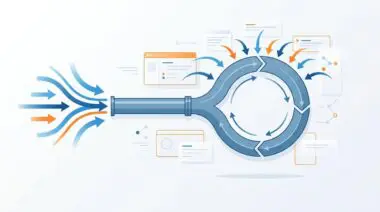
An AI data pipeline, by contrast, forms an iterative loop. N8n’s breakdown highlights that the workflow flows from ingestion to training, testing, and deployment, then feeds fresh observations back into the model for retraining. The data types span structured tables, semi-structured JSON logs, and raw images or IoT telemetry. Processing juggles batch and real-time streaming simultaneously, while the destination is not a static dashboard but a live inference engine that delivers predictions or alerts.
Data Ingestion: Tapping into Unstructured Streams
The pipeline’s first stage pulls raw signals from unstructured logs, APIs, and streaming sources. Engineers manage these integration points at the ingestion layer because format inconsistencies here cascade into downstream corruption. The ability to handle high-velocity real-time feeds directly determines whether an AI application can act on the most recent telemetry.
Preprocessing and Validation at Scale
Once data lands in cloud storage or a data warehouse, automated transformation and validation kick in. The system must reconcile multimodal records, align schemas under data governance rules, and scrub malformed entries before they reach training sets. N8n’s analysis observes that strict manual rules collapse under the scale of unstructured data; automated baselines that catch statistical anomalies become essential.
Feature Engineering: The Alchemy for Models
This stage converts processed data into machine-readable variables using techniques such as one-hot encoding and feature scaling. Automated loops for feature selection and extraction reduce dimensionality, ensuring that only high-signal predictors enter the model. Without centralized feature engineering, teams risk a mismatch between training transformations and production inference — a fast track to model decay.
Model Training and the Critical Validation Split
The curated dataset splits into training, validation, and testing subsets, with an optional fine-tuning partition. N8n notes that this phase prepares models for specific business use cases — fraud detection at a bank, for example — rather than generic benchmarks. The quality of that split directly shapes the reliability of the final ML output.
Inference and Continuous Improvement
Production deployment is not the end; it is the start of a monitoring loop. Teams track model drift, accuracy degradation, and bias propagation, triggering automatic retraining when predictive performance slips. This closed-feedback cycle is what separates a self-correcting AI pipeline from a report-delivery mechanism.
Market Forces and the Imperative for Clean Pipelines
The dollars flowing into data pipeline infrastructure reflect more than a technology upgrade; they signal a structural reallocation of IT budgets toward AI-readiness. Fact.MR’s data pipeline tools report pegs the compound annual growth rate at 12.1 percent through 2036 and cites cloud analytics adoption and the drive for cleaner data lineage as primary accelerants. The United States alone is growing at 15.7 percent CAGR, outpacing the global average as large enterprises migrate analytics workloads to the cloud and embed AI into core operations.
Cloud-based deployments already command 56 percent of the market, and batch pipelines still hold the largest single pipeline type share at 38 percent. Yet the report’s opportunity impact analysis plainly states that AI-readiness programs are what will force the next wave of investment into data quality checks, lineage tracking, and orchestration control planes.
That urgency crystallizes when viewed through the lens of a complementary source. A 2026 guide to AI analytics published by Qlik delivers a blunt warning:
If your data pipelines feed disorganized or dirty data into the models, the system will produce inaccurate outputs.
The guide connects the dots between governance gaps, opaque AI systems, and the skill shortages that compound pipeline fragility. In practical terms, when an automation stack cannot validate data at the ingestion scale or monitor model drift in real time, the output becomes unreliable — and the cost of failure scales with the size of the market. The challenges n8n identifies — data quality collapses, observability blind spots, and feature-training skew — are not hypothetical. They are the very risks that the expanding 42-billion-dollar environment will expose if pipelines remain a collection of disconnected scripts.
For the automations sector, the implication is that the orchestration layer is now a strategic asset. The ability to route data between Kafka events, trigger retraining jobs, and fail over gracefully is what turns a brittle sequence of batch commands into a resilient AI operating fabric.
Orchestrating the Future of AI Automation Infrastructure
The migration from static ETL shells to living AI loops is not merely a technical evolution; it redefines the expectations placed on every automation professional. Pipelines that once ended in a warehouse now feed decisions that impact revenue, safety, and customer trust. Mastering the six-stage cycle — and embedding automated validation, monitoring, and retraining triggers — will separate the systems that deliver consistent intelligence from those that drift into noise.
For organizations building the next generation of AI-powered automations, the underlying infrastructure — from cloud environments to pipeline orchestration — determines success. Andres SEO Expert’s programmatic SEO and AI automation services help teams architect intelligent workflows that scale, while managed WordPress cloud hosting solutions ensure that even the most data-intensive applications run without bottlenecks. To explore how technical excellence can drive your automation strategy, get in touch and learn more about Andres SEO Expert’s approach.
Frequently Asked Questions
What is the difference between a traditional ETL pipeline and an AI data pipeline?
Traditional ETL pipelines terminate at a data warehouse, run on predictable batch schedules, and handle structured SQL tables. AI data pipelines form an iterative loop that feeds fresh observations back into the model for retraining, handle both batch and real-time streaming, and deliver outputs to live inference engines rather than static dashboards.
What are the six stages of an AI data pipeline?
The six stages are: data ingestion (tapping into unstructured streams), preprocessing and validation at scale, feature engineering (converting processed data into machine-readable variables), model training and validation split, inference (deployment), and continuous improvement through monitoring and automatic retraining.
Why is data quality critical for AI pipelines?
If data pipelines feed disorganized or dirty data into models, the system will produce inaccurate outputs. Poor data quality leads to model decay, bias propagation, and unreliable AI outputs. Automated baselines that catch statistical anomalies are essential to maintain pipeline health.
How is the AI data pipeline market expected to grow?
The data pipeline tools market was valued at 12 billion dollars in 2025 and is projected to reach 42 billion dollars by 2036, with a CAGR of 12.1 percent. Cloud-based deployments already command 56 percent of the market, and AI-readiness programs are key drivers of further investment.
What role does orchestration play in AI pipeline management?
Orchestration is a strategic asset that routes data between events, triggers retraining jobs, and ensures graceful failover. It transforms a brittle sequence of batch commands into a resilient AI operating fabric, enabling self-correcting loops that maintain model accuracy over time.
What is feature engineering in the context of AI pipelines?
Feature engineering converts processed data into machine-readable variables using techniques like one-hot encoding and feature scaling. Automated loops for feature selection and extraction reduce dimensionality and ensure high-signal predictors enter the model, preventing mismatch between training transformations and production inference.
How does continuous improvement work in an AI pipeline?
After deployment, teams track model drift, accuracy degradation, and bias propagation. When predictive performance slips, the system triggers automatic retraining using new observations, creating a closed-feedback cycle that keeps the model self-correcting and reliable.