



Executive Summary
- CPA serves as a primary KPI for evaluating the financial efficiency of paid media and organic acquisition channels.
- Integration with LTV (Lifetime Value) allows for granular ROAS (Return on Ad Spend) optimization and budget reallocation.
- Accurate CPA calculation requires robust multi-touch attribution models to account for complex cross-channel conversion paths.
What is Cost Per Acquisition?
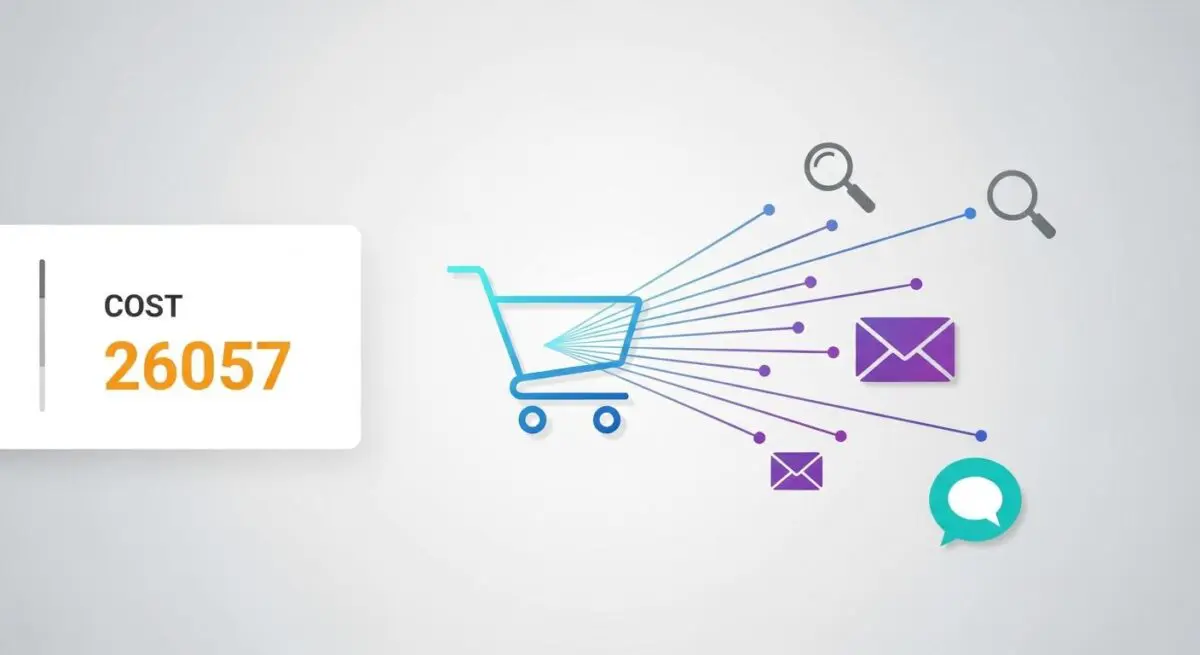
Cost Per Acquisition (CPA) is a fundamental financial metric in digital marketing that measures the total cost incurred to acquire a single paying customer or a specific conversion action. Within a modern MarTech stack, CPA is calculated by dividing the total marketing expenditure—including ad spend, overhead, and creative costs—by the number of acquisitions generated within a defined period. Unlike Cost Per Click (CPC), which measures engagement, CPA focuses on the bottom-funnel result, providing a direct link between marketing investment and revenue generation.
In the context of Search Engine Optimization (SEO) and Generative Engine Optimization (GEO), CPA represents the amortized cost of organic growth. While organic traffic does not carry a direct per-click cost, the investment in content engineering, technical SEO, and AI-search visibility must be measured against the volume of conversions to determine the channel’s long-term viability. We at Andres SEO Expert utilize CPA to calibrate multi-channel attribution, ensuring that capital is allocated to the highest-performing touchpoints across the customer journey.
The Real-World Analogy
Consider a commercial orchard operation. To harvest a single bushel of apples, the owner must account for the cost of seeds, irrigation, fertilizers, specialized labor, and the machinery used for the harvest. If the total seasonal expenditure is $10,000 and the orchard yields 500 bushels, the “Cost Per Acquisition” for each bushel is $20. A business that only looks at the cost of the seeds (analogous to CPC) ignores the infrastructure required to bring the product to market. Just as the orchard owner must ensure the market price of a bushel exceeds the $20 acquisition cost to remain profitable, a digital marketer must ensure the CPA remains significantly lower than the Customer Lifetime Value (LTV).
How Cost Per Acquisition Impacts Marketing ROI & Data Attribution?
CPA is the primary lever for determining the scalability of marketing campaigns. In performance marketing, particularly within programmatic environments and AI-driven bidding systems like Google Ads’ Target CPA (tCPA), the metric dictates how aggressively an algorithm competes for ad placements. When CPA is integrated with robust data attribution models—such as data-driven or linear attribution—marketers can identify which specific keywords, landing pages, or referral sources are driving the most cost-effective conversions. This prevents the “last-click” fallacy, where top-of-funnel awareness efforts are undervalued despite their role in lowering the eventual CPA.
Furthermore, CPA directly influences the Customer Acquisition Cost (CAC) and the overall Return on Investment (ROI). By maintaining a granular view of CPA across different segments, enterprise brands can identify inefficiencies in their conversion funnels. For instance, a high CPA in a specific geographic region may indicate a need for localized content or improved technical performance to reduce friction. Data integrity is paramount here; without server-side tracking and clean API connectivity between the CRM and the analytics platform, CPA figures may be skewed by bot traffic or duplicate conversions, leading to suboptimal strategic decisions.
Strategic Implementation & Best Practices
- Implement Server-Side Tracking: Move beyond client-side cookies to ensure accurate conversion data, especially in the era of ITP (Intelligent Tracking Prevention) and ad-blockers, to maintain CPA data integrity.
- Align CPA with LTV: Establish a maximum allowable CPA based on the Lifetime Value of different customer segments to ensure that high-acquisition costs are justified by long-term profitability.
- Utilize Negative Keyword Lists and Audience Exclusions: Refine targeting parameters to eliminate low-intent traffic, thereby reducing wasted spend and lowering the aggregate CPA.
- Optimize Post-Click Experience: Use A/B testing and Conversion Rate Optimization (CRO) to increase the conversion rate of existing traffic, which mathematically reduces the CPA without requiring additional ad spend.
Common Pitfalls & Strategic Mistakes
One frequent error is the over-reliance on “Blended CPA,” which aggregates all channels into a single figure. This often masks underperforming paid channels that are being subsidized by high-performing organic or direct traffic. Another critical mistake is failing to account for the sales cycle duration; in B2B environments, an acquisition may occur months after the initial touchpoint, leading to misattribution if the lookback window is too short. Finally, enterprise brands often optimize for the lowest possible CPA at the expense of volume or lead quality, potentially stifling growth by ignoring high-value segments that require a higher initial investment.
Conclusion
Cost Per Acquisition is a vital metric for balancing marketing efficiency with scalable growth, requiring precise attribution and integration with LTV modeling. Mastering CPA allows data-driven organizations to optimize their MarTech stacks for maximum financial performance and sustainable market positioning.