Executive Summary
- Mitigation of ad fatigue and banner blindness through precise impression thresholds at the user level.
- Optimization of media spend by reallocating budget from over-exposed segments to net-new reach.
- Integration with Cross-Device Tracking and Identity Resolution for a unified and non-intrusive user experience.
What is Frequency Capping?
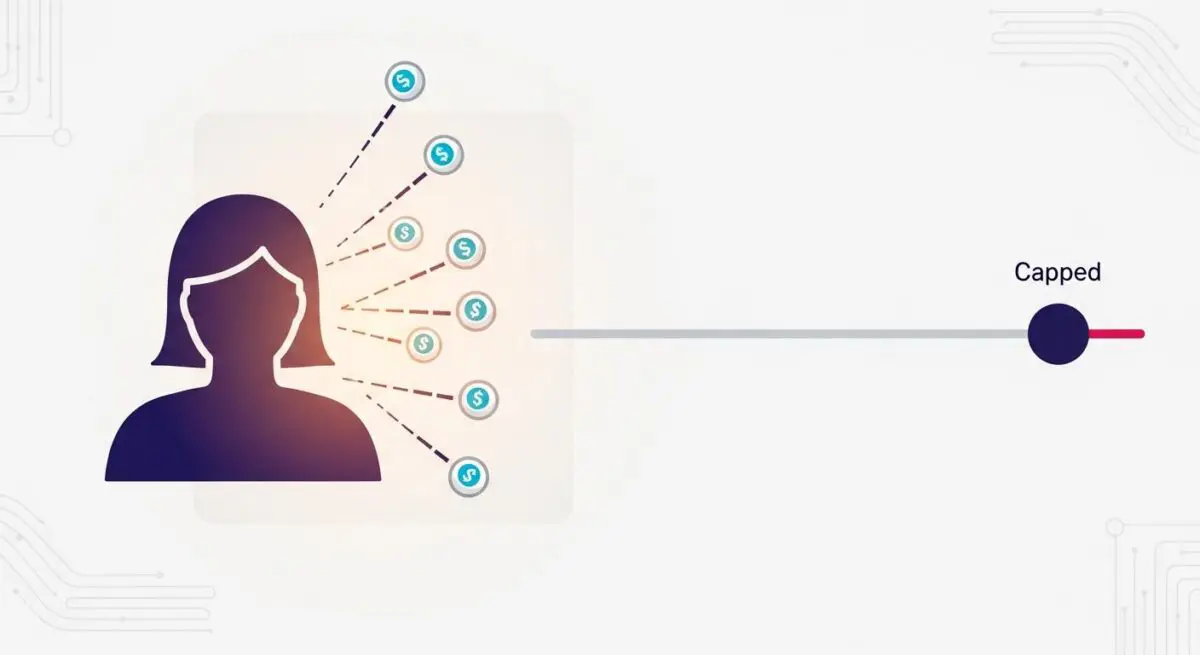
Frequency capping is a technical configuration within programmatic advertising and Demand-Side Platforms (DSPs) that restricts the number of times a specific visitor is exposed to a particular creative or campaign within a predetermined timeframe. In the modern MarTech stack, this mechanism is essential for managing the delivery of digital assets across display, video, and social channels. By utilizing unique identifiers such as first-party cookies, Mobile Advertising IDs (MAIDs), or increasingly, privacy-preserving signals like the Privacy Sandbox Topics API, systems can track impression counts per user profile to prevent over-saturation.
From a data analytics perspective, frequency capping serves as a critical control variable in econometric modeling and media mix optimization. It ensures that the distribution of impressions follows a strategic curve rather than a random or clustered pattern. In the era of Search Engine Optimization (SEO) and Generative Engine Optimization (GEO), understanding frequency is vital because excessive ad exposure can lead to negative brand sentiment, which indirectly influences user engagement signals—metrics that search engines and AI models use to evaluate brand authority and trust.
The Real-World Analogy
Consider a professional networking event where a representative is attempting to build relationships. A strategic representative (the frequency-capped ad) introduces themselves, provides value, and then moves on to other prospects, perhaps checking back in after a few hours or days to see if there is further interest. This maintains professional decorum and keeps the brand top-of-mind without being intrusive. Conversely, an individual who follows a single prospect around the room, repeating the same pitch every two minutes, becomes a nuisance. In this scenario, the prospect will eventually leave the room or actively avoid the representative. Frequency capping is the social intelligence of a digital campaign, ensuring the brand remains a welcome guest rather than an avoided intruder.
How Frequency Capping Impacts Marketing ROI & Data Attribution?
The primary impact of frequency capping on Marketing ROI is the mitigation of diminishing returns. In digital advertising, the relationship between impression frequency and conversion probability is rarely linear; it typically follows an inverted U-curve or a plateau. Beyond a certain threshold—often referred to as the “effective frequency”—additional impressions yield zero or negative incremental lift while continuing to consume the media budget. By implementing strict caps, marketers can redirect that wasted spend toward reaching new unique users, thereby lowering the overall Customer Acquisition Cost (CAC).
Furthermore, frequency capping is integral to maintaining data integrity within attribution models. Without caps, a single highly-exposed user who eventually converts might be over-weighted in a last-touch or even a multi-touch attribution model, masking the fact that the first five impressions were effective while the subsequent fifty were redundant. By controlling frequency, data scientists can more accurately measure the “incremental lift” of a campaign, ensuring that the attribution logic reflects genuine behavioral shifts rather than brute-force exposure. This leads to more precise budget allocation and a clearer understanding of the customer journey.
Strategic Implementation & Best Practices
- Align Caps with the Buyer’s Journey: Implement higher frequency caps for retargeting campaigns where the user has already shown high intent, and lower caps for top-of-funnel awareness campaigns to maximize reach.
- Utilize Cross-Device Identity Links: Ensure frequency caps are applied at the household or identity level rather than just the browser level to prevent a single user from being over-exposed across their mobile, desktop, and CTV devices.
- Monitor Creative Wear-out: Use data visualization tools to track the correlation between frequency and Click-Through Rate (CTR). When CTR begins to decay as frequency rises, it is a technical signal to either refresh the creative or tighten the cap.
- Implement Global Frequency Caps: Beyond individual campaign caps, set global account-level caps to ensure that a single user is not being bombarded by multiple different product lines from the same parent brand simultaneously.
Common Pitfalls & Strategic Mistakes
One frequent error in enterprise marketing is the failure to account for “cross-channel leakage.” If a brand runs independent campaigns on Google, Meta, and a separate DSP without a unified identity layer, a user may be hit with the maximum frequency cap on every single platform, leading to a cumulative exposure that is far beyond the intended limit. This results in significant budget waste and potential brand damage. Another pitfall is setting caps based on arbitrary industry “best practices” rather than empirical data. Every audience segment and product category has a different saturation point; failing to perform A/B testing on frequency limits can result in either missed conversion opportunities or excessive spend on disinterested users.
Conclusion
Frequency capping is a fundamental technical pillar for any data-driven marketing architecture, balancing the need for brand presence with the necessity of capital efficiency. By mastering this control, organizations can optimize their media spend, protect their brand reputation, and ensure that their attribution data remains a reliable source for strategic decision-making.