Executive Summary
- Wildcard SSL certificates utilize the asterisk (*) notation to secure an unlimited number of first-level subdomains under a single base domain, significantly reducing administrative overhead for WordPress Multisite networks.
- Implementation requires the DNS-01 challenge for automated issuance via the ACME protocol, as standard HTTP-01 challenges are insufficient for validating entire namespaces.
- While simplifying certificate management, Wildcard SSLs introduce a single point of failure; a compromised private key exposes the entire subdomain infrastructure, necessitating rigorous server-level security protocols.
What is Wildcard SSL?
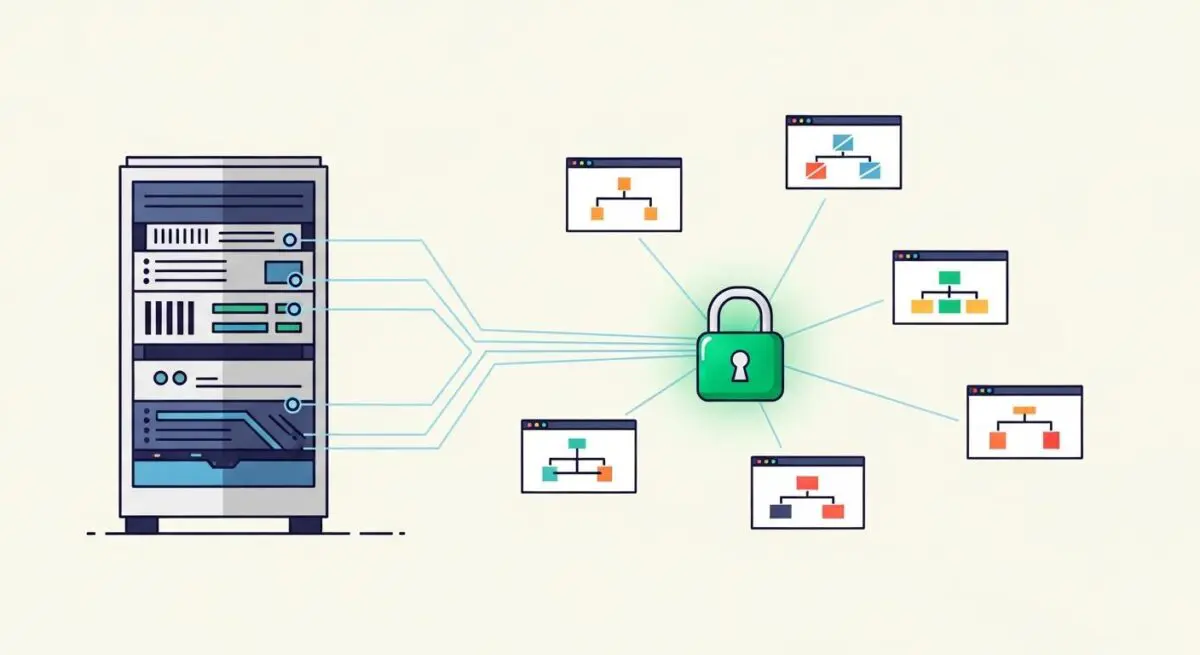
A Wildcard SSL (Secure Sockets Layer) certificate is a specialized digital certificate that allows a single certificate to secure a primary domain and an unlimited number of its immediate subdomains. Technically defined by the inclusion of an asterisk in the Common Name (CN) or Subject Alternative Name (SAN) field (e.g., *.example.com), this certificate type is governed by Public Key Infrastructure (PKI) standards. In the context of WordPress hosting, a Wildcard SSL eliminates the need for individual certificates for every subdomain, such as blog.example.com, shop.example.com, or dev.example.com.
From a technical standpoint, Wildcard SSLs operate on the same encryption principles as standard certificates, utilizing asymmetric encryption (RSA or ECC) to establish a secure tunnel between the client browser and the web server. However, their architectural value lies in their scope. While a standard certificate is bound to a Fully Qualified Domain Name (FQDN), a Wildcard certificate covers the entire namespace at a specific level. It is important to note that Wildcards are not recursive; a certificate for *.example.com will secure sub.example.com but will not secure fourth.level.example.com unless specifically configured with additional SAN entries.
The Real-World Analogy
Imagine a large corporate office building with a single master key. Instead of the security team carrying a massive ring with 500 individual keys—one for every office on the third floor—they carry one master key that is engineered to open every door on that specific floor. In this analogy, the third floor represents your primary domain, and each office represents a subdomain. The master key (Wildcard SSL) provides the same level of security for every room, but it is much easier to manage than 500 individual keys. However, if that master key is lost or stolen, every office on that floor is potentially compromised, which is why the security of that single key is paramount.
How Wildcard SSL Impacts Server Performance & Speed Engineering?
The impact of Wildcard SSL on server performance is primarily observed in the reduction of computational overhead during the TLS handshake process and the simplification of server configuration files. In high-density WordPress environments, such as those hosting hundreds of subdomains via WordPress Multisite, the web server (Nginx or Apache) must load SSL certificates into memory. If the server were forced to manage hundreds of individual certificates, the memory footprint and the complexity of the configuration would increase, potentially leading to slower reload times and increased resource consumption during the initial TLS negotiation.
By utilizing a Wildcard SSL, the server only needs to reference a single certificate and private key pair for all subdomain requests. This streamlines the Server Name Indication (SNI) process. SNI allows the server to present the correct certificate based on the hostname requested by the client. With a Wildcard, the matching logic is simplified, as the server identifies the wildcard match immediately rather than searching through a large database of individual certificate files. Furthermore, for Edge Network integration and Content Delivery Networks (CDNs), a Wildcard SSL simplifies the deployment of HTTPS across global PoPs (Points of Presence), ensuring consistent Time to First Byte (TTFB) across the entire subdomain ecosystem.
Best Practices & Implementation
- Automate Issuance via DNS-01: For Managed WordPress environments using Let’s Encrypt, always use the DNS-01 challenge. Unlike the HTTP-01 challenge, which requires a file to be placed on the web server, the DNS-01 challenge proves ownership of the entire DNS zone, which is a requirement for issuing Wildcard certificates.
- Implement Strict Private Key Permissions: Since a single private key secures your entire subdomain infrastructure, ensure that the key file is owned by the root user and has 600 permissions (read/write only for the owner). This prevents unauthorized processes or users from accessing the key.
- Use ECC (Elliptic Curve Cryptography): When generating the Certificate Signing Request (CSR) for your Wildcard SSL, opt for ECC keys over traditional RSA. ECC provides equivalent security with smaller key sizes, resulting in faster handshakes and reduced CPU load on the server.
- Monitor for Subdomain Takeover: Because a Wildcard SSL makes it easy to spin up new subdomains, ensure that your DNS records are tightly managed. Stale CNAME records pointing to external services can lead to subdomain takeovers, which the Wildcard SSL would inadvertently validate as secure.
- Centralize Certificate Management: Use tools like Certbot or specialized hosting panels that support automated renewal and deployment. Wildcard certificates often require manual DNS updates if not integrated with a DNS provider’s API, so automation is critical to avoid expiration.
Common Mistakes to Avoid
One of the most frequent errors is the assumption that a Wildcard SSL covers multiple levels of subdomains. A certificate for *.example.com will not secure test.dev.example.com. Developers often encounter SSL mismatch errors when they attempt to use a single-level wildcard for nested architectures. Another critical mistake is failing to secure the private key. Because the key is valid for any subdomain, its theft allows an attacker to perform man-in-the-middle (MITM) attacks on any current or future subdomain you create. Finally, many organizations overlook the need for a dedicated IP address or modern SNI support on older legacy systems, though this is becoming less common in modern WordPress hosting environments.
Conclusion
Wildcard SSL certificates are an essential component of enterprise WordPress architecture, particularly for Multisite deployments and complex staging workflows. By balancing administrative efficiency with robust encryption, they enable scalable, secure growth across an entire domain namespace.