



Executive Summary
- Implementation of cryptographic authentication protocols (SPF, DKIM, and DMARC) is the baseline requirement for establishing sender identity and mitigating spoofing risks.
- Sender reputation is a multi-dimensional metric calculated by ISPs based on IP health, domain history, and granular recipient engagement signals.
- High deliverability is a prerequisite for accurate data attribution and maximizing the Lifetime Value (LTV) of a CRM database.
What is Email Deliverability?
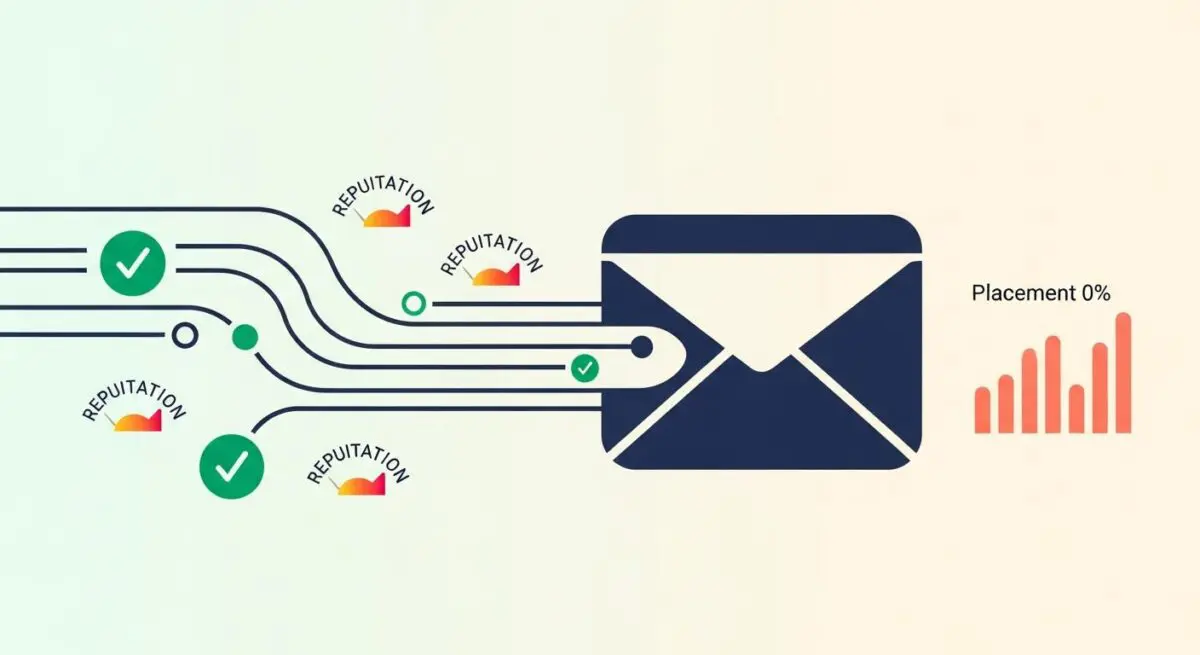
Email deliverability is the technical measure of a sender’s ability to successfully transport electronic mail to a recipient’s primary inbox, rather than being redirected to a spam folder or rejected by a Mail Transfer Agent (MTA). While often confused with the “delivery rate,” which merely confirms that the receiving server accepted the packet, deliverability focuses on the final placement within the user interface. It represents the culmination of technical infrastructure, domain authority, and behavioral data science. In the modern MarTech stack, deliverability is the critical pipe through which all lifecycle marketing and retention efforts flow.
The mechanics of deliverability are governed by the interaction between the sending infrastructure and the receiving Internet Service Provider (ISP) or Mailbox Provider (MBP), such as Gmail, Outlook, or Yahoo. These providers utilize sophisticated machine learning algorithms and reputation systems to filter incoming traffic. These systems evaluate the Sender Policy Framework (SPF), DomainKeys Identified Mail (DKIM), and Domain-based Message Authentication, Reporting, and Conformance (DMARC) records. Beyond these DNS-level checks, ISPs monitor real-time engagement metrics—such as open rates, click-through rates, and complaint rates—to determine the trustworthiness of the sender. For enterprise organizations, maintaining high deliverability is a continuous process of infrastructure monitoring and list hygiene.
The Real-World Analogy
To understand email deliverability, imagine a high-security corporate headquarters. Your email is a courier attempting to deliver a sensitive document directly to an executive’s desk. The “delivery rate” is simply the courier getting through the front gate of the building. However, “deliverability” is the courier successfully passing through the lobby security, being verified by the biometric scanner (SPF/DKIM), and finally being allowed into the executive’s private office. If the courier lacks proper identification, has a history of bringing junk mail, or if the executive has previously told security they don’t want to see this courier, the document will be diverted to the mailroom’s shredder (the spam folder) or kicked out of the building entirely (a bounce).
How Email Deliverability Impacts Marketing ROI & Data Attribution?
Email deliverability is a primary driver of Marketing ROI because it directly dictates the reach of the most cost-effective channel in the digital mix. When deliverability rates drop, the Customer Acquisition Cost (CAC) effectively increases because the investment in content creation and platform fees is distributed across a smaller pool of reached users. Furthermore, poor deliverability compromises the integrity of data attribution models. If a significant segment of the audience never receives the communication, the resulting lack of conversion data can lead to the false conclusion that a specific campaign or segment is underperforming, resulting in suboptimal budget allocation.
From a data attribution perspective, deliverability issues create “dark” segments in the marketing funnel. When emails land in the spam folder, they are rarely opened, leading to a decay in engagement signals. This creates a negative feedback loop: lower engagement signals to the ISP that the content is unwanted, which further degrades deliverability. For data-driven organizations, this means that the Lifetime Value (LTV) modeling becomes skewed, as the system cannot distinguish between a customer who is disinterested and a customer who is simply not receiving the messages. Ensuring high deliverability preserves the clarity of the customer journey and ensures that every dollar spent on CRM automation yields measurable results.
Strategic Implementation & Best Practices
- Deploy Advanced Authentication: Ensure that SPF, DKIM, and DMARC are not only implemented but strictly configured. Move DMARC policies from “none” to “quarantine” or “reject” to prevent domain spoofing and build maximum trust with ISPs.
- Execute a Rigorous IP Warming Strategy: When migrating to a new dedicated IP, gradually increase sending volume over 4-6 weeks. This allows ISPs to observe your sending patterns and establish a baseline reputation without triggering automated rate-limiting or spam blocks.
- Automate List Hygiene: Implement real-time validation at the point of capture to prevent “fat-finger” errors and malicious bot signups. Use automated workflows to prune inactive subscribers who have not engaged with an email in 90-180 days, as high inactivity levels signal poor list quality to MBPs.
- Monitor Feedback Loops (FBLs): Register with all major ISP feedback loops to receive notifications when a user marks an email as spam. This data must be immediately synced with the CRM to suppress those users and prevent further reputation damage.
- Optimize for Technical Engagement: Ensure all emails are mobile-responsive and have a low image-to-text ratio. High-latency loading or broken HTML can lead to low engagement, which indirectly informs the ISP’s deliverability algorithms.
Common Pitfalls & Strategic Mistakes
One of the most frequent errors in enterprise marketing is the utilization of purchased or third-party lists. These lists are often riddled with “spam traps”—email addresses specifically designed to catch unscrupulous senders. Hitting a single pristine spam trap can lead to immediate blacklisting by organizations like Spamhaus, causing a catastrophic drop in deliverability across the entire domain. Another common mistake is inconsistent sending frequency; sudden spikes in volume, such as during a holiday sale, can look like a compromised server to an ISP, leading to temporary blocks or greylisting.
Furthermore, many brands fail to distinguish between transactional and promotional traffic. Mixing high-priority transactional emails (like password resets) with bulk marketing blasts on the same IP or sub-domain is a strategic failure. If the marketing campaign suffers a reputation hit, the critical transactional emails will also be delayed or blocked, severely impacting the user experience and operational efficiency.
Conclusion
Email deliverability is the technical backbone of digital communication, requiring a rigorous blend of DNS security, reputation management, and data-driven list hygiene. By treating deliverability as a core engineering and strategic priority, organizations can ensure their marketing architecture remains resilient and their ROI remains measurable.