

Executive Summary
- Agentic Financial Integration: Autonomous AI operators now handle R&D tax credits and grant compliance by pulling live data directly from electronic lab notebooks.
- IP Liquidity via DeSci: The rise of IP-NFTs allows researchers to fractionalize ownership of early-stage assets, turning patents into liquid, investable instruments.
- Regulatory Arbitrage: Modern stacks leverage the 2025 OBBBA legislation to achieve immediate R&D expensing, converting engineering costs into massive payroll tax offsets.
The Great Decoupling of Science and Scarcity
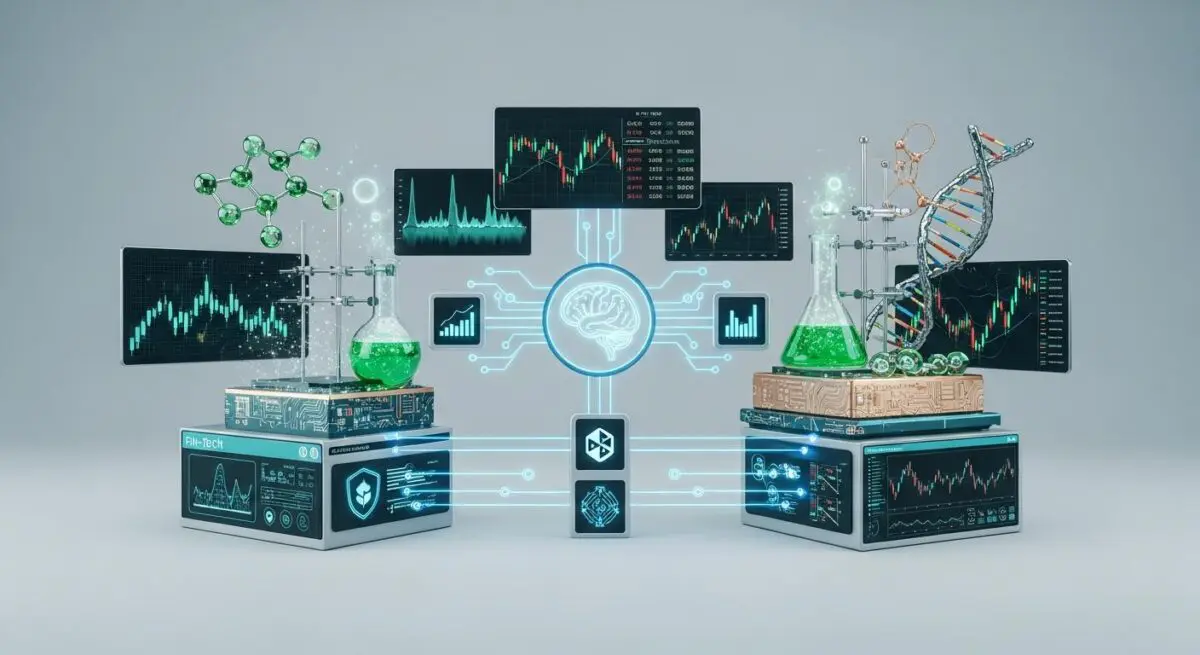
For decades, the path from a breakthrough laboratory discovery to a commercialized product was known as the Valley of Death. Scientists were often trapped in a cycle of begging for grants, navigating opaque university transfer offices, and watching their intellectual property gather dust while they waited for the slow machinery of venture capital to turn. But as we move into 2026, a seismic shift has occurred. The scientific fintech stack has evolved from a collection of disconnected accounting tools into a sophisticated, AI-driven ecosystem that treats research data as liquid collateral.
This transformation isn’t just about better software; it is about a fundamental change in how we value the intangible. We are witnessing the convergence of Decentralized Science (DeSci), agentic financial automation, and a new class of specialized lenders who understand that a protein structure or a clinical data set is just as valuable as a piece of real estate. The 2026 stack allows a scientist to be more than a researcher; it turns them into a sophisticated asset manager of their own intellectual output.
The Rise of the Agentic Financial Operator
The foundation of the modern scientific stack is no longer a human accountant, but what we now call Agentic Financial Operators. In the past, managing the financial side of a lab meant hours of manual data entry, reconciling receipts for reagents, and trying to prove to the government that your work qualified for R&D tax credits. Today, platforms like Arden and Benchling AI have moved beyond simple automation into true agency. These AI agents live inside the researcher’s workflow, autonomously pulling evidence from Electronic Lab Notebooks (ELNs) to produce audit-ready workpapers.
When a scientist logs a successful experiment in 2026, the stack doesn’t just record the result. It identifies the labor hours involved, the cost of the materials used, and the specific technical uncertainty addressed. It then maps this data directly to grant compliance requirements or tax credit filings without a human ever touching a spreadsheet. This reduces the administrative burden by thousands of hours, allowing the focus to remain on the bench rather than the ledger.
IP-NFTs: Turning Research into Liquid Assets
Perhaps the most radical component of the 2026 stack is the normalization of the IP-NFT. Through platforms like Molecule and Catalyst, scientists are now minting their research as on-chain assets. This isn’t about digital art; it is about creating a legal and technical wrapper around intellectual property that allows for fractionalized ownership. This allows a researcher to sell 10% of the future royalties of a drug candidate to a global pool of investors to fund the next stage of trials.
Imagine a scientific discovery as a massive, high-speed rail network. In the old world, you had to build the entire track, the stations, and the engines before you could sell a single ticket. With the 2026 fintech stack, IP-NFTs allow you to sell individual seats on the train while the tracks are still being laid, providing the liquidity needed to finish the journey without giving away the whole company.
This model bridges the gap between academia and commercialization. By turning early-stage research into an investable asset class before it ever reaches a patent office, scientists can bypass the traditional gatekeepers of innovation. This is the heart of the DeSci movement: the democratization of discovery through financial engineering.
The Infrastructure of Smart Capital Flow
The middle layer of the stack is dominated by DeSci coordination layers like Bio Protocol. Acting as a meta-layer, these protocols coordinate funding across specialized DAOs, such as VitaDAO for longevity research or PsyDAO for neuro-medicines. This represents a shift toward smart money that is actually smart about the science. These DAOs aren’t just writing checks; they are providing peer review, regulatory guidance, and a community of early adopters.
Furthermore, generalist banks are being disrupted by a new breed of Lab-Fin lenders. Firms like Avon River Ventures and Quantum Analytics have developed models that value laboratory hardware based on scientific throughput rather than simple book value. In 2026, a high-end Agilent GC/MS system is seen as a revenue-generating asset that can be financed through rent-to-own models or equipment-equity credits. This allows cash-strapped startups to access world-class equipment without the massive upfront capital expenditures that used to sink early-stage ventures.
Monetizing the Invisible: Data Marketplaces
Data has always been the byproduct of science, but in 2026, it is a primary revenue stream. Ocean Protocol’s Compute-to-Data feature has become a killer app for the scientific community. It allows researchers to monetize private datasets for AI training—used by giants like DeepMind or Scale AI—without the data ever leaving the researcher’s secure environment. This preserves privacy and IP while creating a recurring revenue stream that can fund further research.
This is often referred to as Data Farming. Scientists contribute raw, anonymized results to open-source Knowledge Graphs like OriginTrail. In exchange, they receive governance tokens or stablecoin rewards. This creates a financial buffer that doesn’t depend on the whims of publication cycles or the slow grind of traditional grant approvals.
Navigating the Regulatory Winds: The OBBBA Impact
The financial viability of the 2026 stack was solidified by the One Big Beautiful Bill Act (OBBBA) of July 2025. This legislation corrected a long-standing crisis in R&D amortization, restoring the ability for companies to immediately expense 100% of their research and development costs. For a scientific founder, this is a game-changer. By using tools like Warp and TaxRobot, startups can now convert engineering salaries and cloud computing costs into immediate cash savings of up to $500,000 annually through payroll tax offsets.
This legislative shift has turned the fintech stack into a survival tool. Companies that fail to integrate their lab workflows with their tax strategy are effectively leaving millions on the table. The modern stack ensures that every pipette tip used and every line of code written is captured and categorized for maximum fiscal efficiency. We are also seeing the rise of GrantOps platforms like Instrumentl, which use machine learning to match researchers with over 5,500 government programs, reducing the proposal-to-payout cycle by over 60%.
The Central Nervous System: Fintech-Integrated ELNs
The final piece of the puzzle is the integration of the Electronic Lab Notebook (ELN) with the financial ledger. Systems like Labii and Labguru now feature native API hooks to accounting software. This creates a just-in-time inventory system for the laboratory. When a researcher consumes a specific reagent, the stack automatically triggers a reorder, updates the financial ledger, and, if necessary, draws from a pre-approved line of credit. This level of integration ensures that the science never has to stop for a lack of supplies or a bureaucratic bottleneck.
The Expert Outlook: The Era of the Sovereign Researcher
From my perspective at Andres SEO Expert, the next 24 months will be defined by the rise of the Sovereign Researcher. We are moving away from a world where scientists are employees of large institutions and toward a world where they are independent operators of their own intellectual capital. The fintech stack is the infrastructure that makes this independence possible.
Expect to see the rise of Programmable Science Payments within the next 18 months. We will see grants released in real-time via smart contracts as verifiable milestones—such as a specific protein structure upload—are recorded on an immutable ledger. This will eliminate the six-month wait for reimbursements and create a truly frictionless scientific economy. Furthermore, the trend of Structural Separation will allow founders to start as decentralized community projects and later spin out into traditional corporate entities with a clear, compliant path for token holders to convert into equity. This is the ultimate hedge against the volatility of both the crypto markets and the traditional venture landscape.
The scientists who succeed in this new era will be those who view their lab as a business and their data as an asset. The technology is no longer the barrier; the barrier is the legacy mindset of how science should be funded. In a world where research is liquid, the most important experiment you can run is the one that optimizes your financial stack. At Andres SEO Expert, we believe that a strong strategic foundation is the only way to navigate this fast-moving digital landscape, and we invite you to connect with us to build a future-proof strategy for your innovation.