Key Points
- Crawl Budget Preservation: Eliminating non-canonical hreflang targets prevents redundant crawl loops and significantly reduces server load.
- Server-Level Alignment: Enforcing trailing slash and protocol consistency via NGINX or Apache prevents edge-layer indexation conflicts.
- Generative Search Optimization: Clean localized clusters ensure LLMs correctly attribute regional authority without entity-relationship dilution.
The Core Conflict: Logical Paradoxes in Indexation
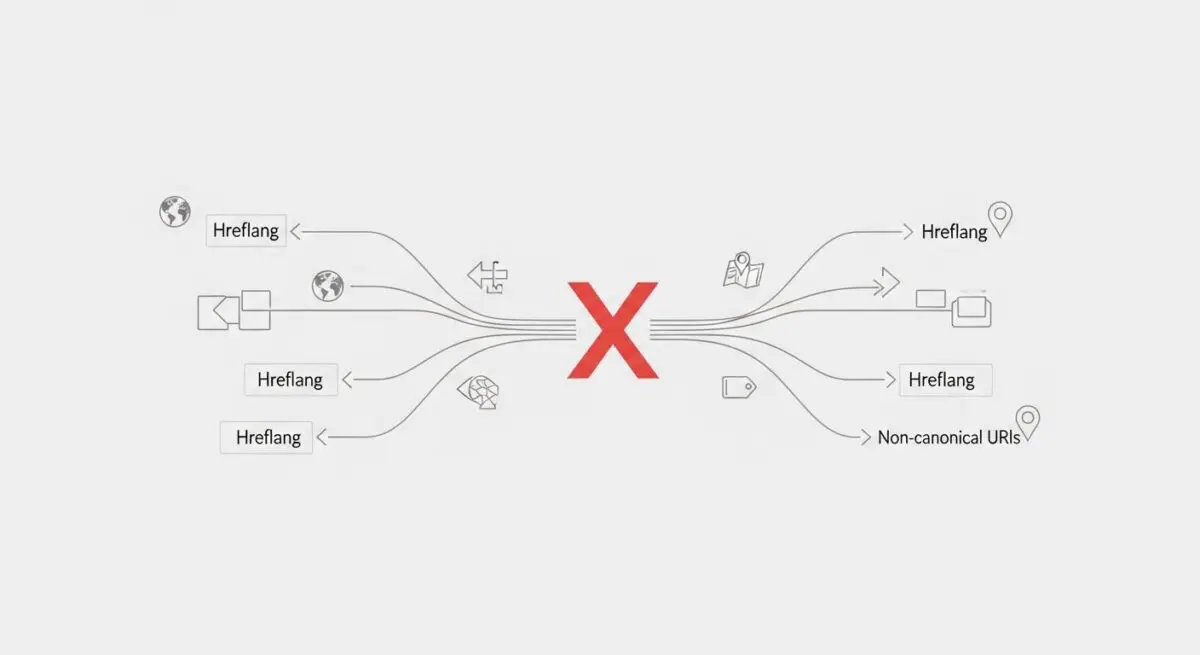
A Hreflang to non-canonical URL conflict occurs when the rel alternate hreflang annotations within a site point to a URL that is not recognized as the authoritative version. This creates a logical paradox for search engine crawlers. The hreflang signal instructs the engine to serve that specific URL to a localized audience, while the canonical signal simultaneously declares that URL to be a duplicate of a different master page.
This contradiction forces search engines to choose one signal over the other. In Google Search Console, this manifests as Duplicate, Google chose different canonical than user errors within the Page Indexing report for regional subdirectories. Server logs typically show Googlebot-Image or Googlebot-Mobile agents hitting 3xx redirects immediately after requesting a URL found in a hreflang attribute.
In terms of Crawl Budget, this error is highly destructive as it triggers redundant crawl loops. Googlebot must crawl the non-canonical localized page, discover the redirect, and then crawl the target canonical. This effectively doubles the resources required to index a single language version.
For Generative Engine Optimization, this ambiguity dilutes the entity-relationship mapping. LLMs and Generative Search Engines rely on clean, localized clusters to provide contextually relevant answers. When hreflang points to non-canonical targets, the AI may fail to attribute regional authority correctly, resulting in hallucinated locale relevance.
Diagnostic Checkpoints: Identifying the Desynchronization
Diagnostic Checkpoints
Protocol and Subdomain Discord
Server-forced redirects conflict with hardcoded hreflang URLs.
Trailing Slash Inconsistency
Server trailing slash rules conflict with plugin permalink logic.
Passive Parameter Inclusion
Non-canonical query parameters incorrectly mapped into hreflang tags.
Plugin Logic Desynchronization
Translation plugins and SEO canonical filters querying database differently.
This error is fundamentally a desynchronization across your technology stack. It typically originates at the server layer, the edge layer, or within the application logic itself. Modern web servers are often configured to append or strip trailing slashes for SEO consistency.
If the hreflang logic generates a URL without a slash, but the server forces a trailing slash, a non-canonical conflict is triggered at the edge layer. This is frequently observed in WordPress environments where custom permalink structures apply global filters, but SEO plugins continue to fetch raw database permalinks.
Passive parameter inclusion is another frequent culprit. Hreflang tags generated via dynamic scripts may accidentally include session IDs or tracking parameters. Since canonical tags are usually stripped of these parameters, the hreflang points to a dirty URL while the canonical points to a clean one.
The Engineering Resolution: Realigning the Stack
Engineering Resolution Roadmap
Audit Hreflang vs. Canonical Mapping
Run a site-wide crawl using Screaming Frog or Lumar. Configure the crawl to ‘Extract Hreflang’. Use a VLOOKUP or JOIN to compare the ‘Hreflang URL’ column with the ‘Canonical URL’ column. Identify any rows where these do not match 1:1.
Enforce Canonical Logic in SEO Framework
Access the SEO plugin settings (Yoast/RankMath/SQUIRRLY) and ensure that ‘Enforce Canonical’ is enabled. If using a multisite or translation plugin, verify that the ‘X-Default’ and localized hreflang tags are hooked into the ‘wp_get_canonical_url’ filter rather than the default ‘get_permalink’.
Normalize Server-Level Redirects
Modify the .htaccess or NGINX config to ensure that all redirects (HTTPS, WWW, Trailing Slash) occur BEFORE the SEO metadata is rendered. This ensures that the crawler never sees a non-canonical URL in the HTML source.
Purge Edge and Object Caches
Flush the WordPress Object Cache (Redis/Memcached) and the Global CDN cache (Cloudflare/Fastly). Stale cached versions of the HTML head often contain old hreflang URLs even after the CMS settings have been corrected.
Executing this resolution requires a synchronized approach across your infrastructure. You must first map the exact scale of the discrepancy using enterprise crawling tools. Extracting the hreflang URLs and comparing them against the declared canonicals will isolate the specific architectural layer causing the mismatch.
Once identified, enforcing canonical logic within your SEO framework is critical. Translation plugins and SEO canonical filters often query the database differently. You must ensure that localized hreflang tags are hooked into the canonical URL filter rather than the default permalink generation function.
Finally, purging edge and object caches is a mandatory step that is frequently overlooked. Stale cached versions of the HTML head will continue to serve old, non-canonical hreflang URLs to Googlebot even after CMS settings are corrected. Flush Redis, Memcached, and your global CDN to force a clean render.
Server-Side and Application-Layer Code Implementations
Fixing via NGINX Configuration
This configuration block forces a trailing slash and ensures canonical alignment at the server level. It prevents edge-layer indexation conflicts by standardizing the URL structure before the application processes the request.
if ($request_uri !~ "^/wp-json") { rewrite ^([^.]*[^/])$ $1/ permanent; }Fixing via Apache .htaccess
This Apache rule enforces HTTPS and WWW consistency. It guarantees that search engine crawlers do not encounter protocol-level discrepancies when following hreflang directives.
RewriteEngine On RewriteCond %{HTTPS} off [OR] RewriteCond %{HTTP_HOST} !^www\. [NC] RewriteCond %{HTTP_HOST} ^(?:www\.)?(.+)$ [NC] RewriteRule ^ https://www.%1%{REQUEST_URI} [L,NE,R=301]Fixing via WordPress functions.php
This PHP snippet hooks into the translation plugin logic to force the hreflang output to match the canonical URL. It resolves desynchronization between WPML and popular SEO plugins.
add_filter('wpml_hreflang_url', function($url, $lang_code) { $post_id = url_to_postid($url); if ($post_id) { $canonical = get_post_meta($post_id, '_yoast_wpseo_canonical', true) ?: get_permalink($post_id); return $canonical; } return $url; }, 10, 2);Validation Protocol and Edge Case Scenarios
Validation Protocol
- Run CLI curl -I -L -H “User-Agent: Googlebot” to verify final 200 OK matches hreflang exactly.
- Execute GSC Live Test and compare Detected Canonical with the hreflang tags in rendered HTML.
- Perform multi-country crawl simulation using Merkle Hreflang tool to confirm all return tags are canonical.
Validation is non-negotiable before deploying these changes to production. Utilizing command-line interfaces allows you to simulate Googlebot behavior and verify that the final HTTP 200 OK status matches the hreflang source exactly. This confirms that no hidden redirects are intercepting the crawl path.
Headless WordPress setups present a unique edge case where the frontend is completely decoupled from the backend. The WordPress REST API might provide the internal canonical link, but the frontend renders the hreflang pointing to the user-facing URL. If the frontend fails to override the API-provided canonical, a permanent conflict occurs.
This specific headless anomaly cannot be fixed within WordPress settings alone. It requires a middleware rewrite in the Node.js layer to intercept and rewrite the canonical headers before they are served to the client. Always verify API responses independently of the frontend render.
Autonomous Monitoring and Entity Integrity
To prevent regression, implement an automated continuous integration pipeline. Use a script that checks a sample of localized URLs for hreflang and canonical parity before any deployment. This ensures that new code commits do not silently break your international SEO architecture.
Setting up log file monitoring using the ELK stack or Graylog is highly recommended. You can configure alerts to trigger whenever Googlebot encounters a 3xx status code on any URL pattern containing alternate relational tags. This proactive approach allows you to catch desynchronization before it impacts your indexation.
Managing entity integrity at the enterprise level requires advanced automation. By utilizing custom API alerts and pipeline integrations, you can monitor your entire server environment autonomously. This level of technical rigor is what separates robust enterprise architectures from fragile setups.
Conclusion
Resolving non-canonical hreflang conflicts is a foundational requirement for international search visibility. By aligning your server rules, application logic, and caching layers, you eliminate crawl waste and restore logical clarity for search engines.
Navigating the intersection of technical SEO, server architecture, and generative search requires a precise roadmap. If you need to future-proof your enterprise stack, resolve deep-level crawl anomalies, or implement AI-driven SEO automation, connect with Andres at Andres SEO Expert.