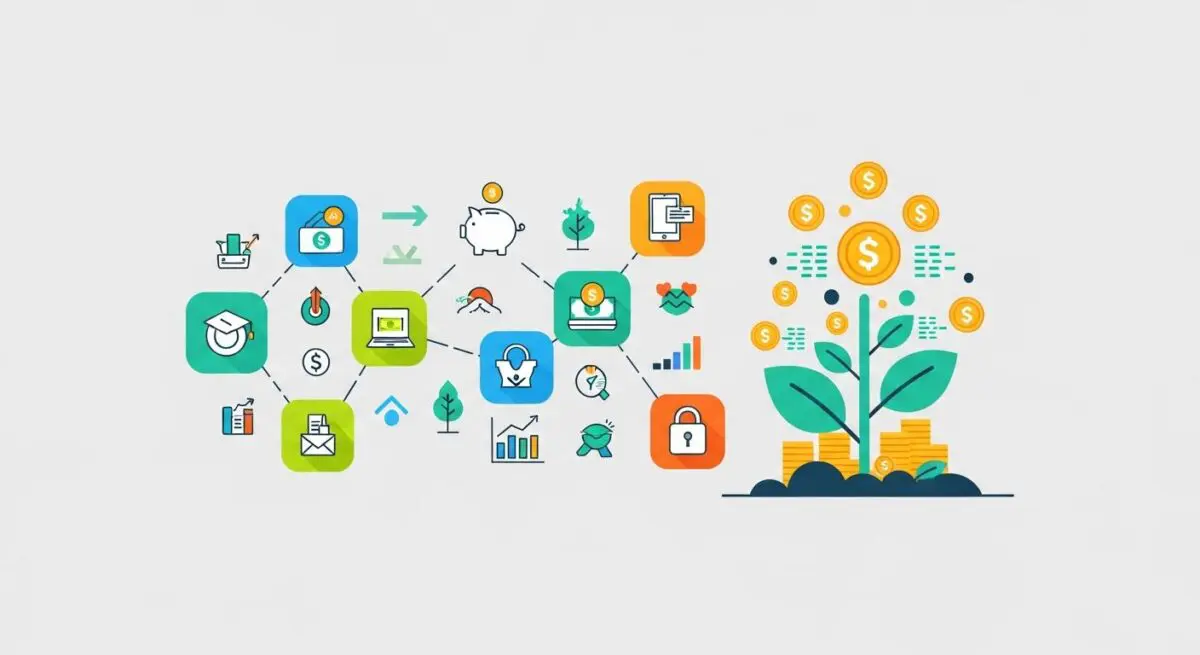
Executive Summary
- Agentic AI Integration: The market has shifted from simple tracking to autonomous agents that proactively manage spending friction and provide real-time financial coaching.
- Asset Tokenization: New platforms are bypassing traditional brokerages, allowing teens to own fractional, blockchain-backed shares of global companies to drive early investment literacy.
- Strategic Credit Building: Leading apps are now prioritizing credit-score optimization as a core feature, enabling Gen Alpha to enter adulthood with significantly higher credit ratings than previous generations.
The Death of the Allowance and the Birth of the Financial OS
The traditional image of a child dropping coins into a ceramic pig is officially a relic of the past. As of mid-2026, the kid and teen fintech sector has undergone a radical transformation, evolving from simple digital wallets into sophisticated financial operating systems.
This is no longer a niche market for early adopters. The sector was valued at $3.92 billion in 2026 and is on a trajectory to reach a staggering $10.67 billion by 2034.
We are witnessing the primary entry point for Gen Alpha into the global capital markets. These apps are no longer just about managing an allowance; they are about teaching the next generation how to navigate a complex, tokenized, and AI-driven economy.
The Rise of Agentic AI: Your Teen’s Invisible Financial Coach
The most significant shift in 2026 is the move toward Agentic AI. Startups like Whistl and Origin are leading the charge by deploying what industry insiders call invisible infrastructure.
Unlike the static budgeting tools of the past, these AI agents don’t just record what happened. They proactively intercept financial decisions before they are finalized.
Imagine a teen attempting to make a non-essential purchase that exceeds their monthly limit. Instead of a simple “debit declined” notification, an AI agent initiates a conversational verification.
This creates a moment of spending friction, forcing the user to justify the purchase to their digital coach. This real-world application of behavioral economics is proving far more effective than any classroom lecture on fiscal responsibility.
Tokenization and the Democratization of Global Markets
In regions like Southeast Asia and India, the barrier to entry for global investing has been completely dismantled. Fintech apps are now utilizing fractional tokenized assets to bypass traditional, high-fee brokerages.
Through blockchain-backed digital tokens, a thirteen-year-old can now own 0.0001% of a major tech giant like Tesla or Apple. This isn’t just a gimmick; it is a fundamental shift in how youth perceive ownership.
Data shows that this accessibility has driven a 67% increase in youth investment activity over the last two years. By turning the stock market into a digital collection game, these platforms are building a generation of investors who understand market volatility before they even have a driver’s license.
Think of these fintech ecosystems like a high-end GPS for a first-time driver. It doesn’t just show the destination; it gently nudges the steering wheel when you drift toward a financial ditch, recalculates the route when you hit a spending roadblock, and ensures you arrive at adulthood with a vehicle—your credit score—that is already finely tuned and ready for the highway.
The $1.2B Consolidation: Who Owns the Future Customer?
The market is currently in a state of rapid consolidation as legacy financial institutions realize they must “own” the customer from age six to ensure long-term loyalty. The strategic flows of capital are telling a clear story of market maturity.
Greenlight continues to lead the United States market with a valuation of $2.3 billion and over 6.5 million users. However, the competition is fierce, with Step capturing the teen demographic through its zero-fee, credit-building model.
We are also seeing massive M&A activity, such as Acorns’ acquisition of GoHenry. Even traditional giants are moving in, with Chase First Banking serving as a defensive moat against the encroachment of agile fintech startups.
The business model has also evolved. Venture capital is no longer funding pure growth; they are prioritizing startups with robust unit economics driven by a mix of subscriptions, interchange fees, and B2B licensing.
Solving the Invisible Credit Score Problem
Historically, young adults entered the workforce with a blank credit history, making it nearly impossible to secure housing or reasonable interest rates. Modern fintech apps have solved this “invisible credit score” problem through innovative technology.
Step’s Smart Pay technology is a prime example. It treats a secured card like a debit card for the user but reports the activity as positive payment history to credit bureaus.
The results are transformative. Step users are entering adulthood with credit scores that are, on average, 125 points higher than the national average. Many are surpassing a score of 700 before they even turn eighteen.
This provides a massive head start in the modern economy, allowing Gen Alpha to bypass the predatory lending cycles that often trap young adults who lack established credit.
Integrating the Gig Economy and Side Hustles
The modern teen is often an entrepreneur, earning income through social media, gaming, or local side hustles. 2026 fintech platforms have adapted to this by offering autonomous tax-saving buckets.
For the “FinTok” earner who spends hours consuming financial content, these apps reduce the administrative friction of running a micro-business. The apps automatically set aside percentages for taxes and savings, mirroring the professional workflows of adult freelancers.
The Power of Merchant-Specific Controls
Parental anxiety has always been a barrier to digital spending. To counter this, apps have introduced granular merchant-level whitelisting.
Parents can now restrict spending to specific retailers like Starbucks or Nike. This level of control has increased in-store card usage by 67%, as parents feel more comfortable allowing digital spending when they know exactly where the money can be used.
The Future Trajectory: From Apps to Household Wealth Units
As we look toward 2027 and beyond, the very interface of these apps will begin to disappear. We are moving toward a period of invisible banking and agentic commerce.
The next evolution will involve voice-enabled AI agents integrated into the Metaverse and gaming platforms like Roblox. These agents will manage a teen’s virtual economy budget across multiple digital and physical worlds simultaneously.
Furthermore, we will see the rise of hyper-personalization. These apps won’t just suggest a savings goal; they will autonomously negotiate and purchase items by optimizing interest yields and cashback in real-time.
Finally, global interoperability is on the horizon. Driven by real-time payment corridors like Singapore’s PayNow, a teen in London will soon be able to pay a street vendor in Singapore instantly using their local app’s tokenized balance.
The Andres Expert Outlook: A Strategic Pivot for Businesses
The transformation of youth fintech is a signal for every digital strategist and business owner. We are no longer looking at “kids’ apps”; we are looking at the foundational layer of the future global economy.
In the next two years, the distinction between a “teen bank” and a “family office” will blur. Businesses that fail to integrate with these autonomous financial agents will find themselves locked out of the Gen Alpha market entirely.
Preparing for this shift requires a move away from traditional marketing and toward algorithmic compatibility. Your brand needs to be recognizable not just to the teen, but to the AI agent managing that teen’s budget.
Navigating this fast-moving digital landscape requires a strategic foundation that looks beyond the next quarter. If you are looking to future-proof your digital strategy and understand how these shifts impact your market position, let’s connect at Andres SEO Expert to build your path forward.