


Key Points
- Agentic FinTech Integration: Autonomous systems utilizing LLM-based agents are executing triple-entry accounting and real-time reconciliation, effectively eliminating the traditional net-30 liquidity gap.
- Invisible Tax Layers: Embedded finance solutions are deploying programmable smart contracts to automate multi-jurisdictional VAT and GST remittance, mathematically guaranteeing compliance at the point of sale.
- Predictive Liquidity Engines: The future of the CFO role relies on generative AI forecasting that autonomously secures credit lines and optimizes cash flow, establishing a frictionless Zero-Touch finance model.
Table of Contents
The Financial Tech Friction
According to a 2026 Deloitte FinTech Report, AI-driven autonomous invoicing systems have successfully reduced the average B2B payment cycle from 28 days in 2024 to just 4.2 days in early 2026. This metric is not just a triumph of software engineering. It is a profound recalibration of global liquidity velocity.
For decades, the standard B2B transaction has been paralyzed by fragmented workflows. Companies generated invoices in one system, collected payments in another, and reconciled taxes in a third. This disjointed architecture created a massive administrative drag on enterprise growth.
Historically, this friction consumed up to 15-20% of a small or medium-sized business’s operational capacity. Human capital was wasted on data entry, manual reconciliation, and chasing down late payments. The traditional financial back-office was essentially a cost center built on latency.
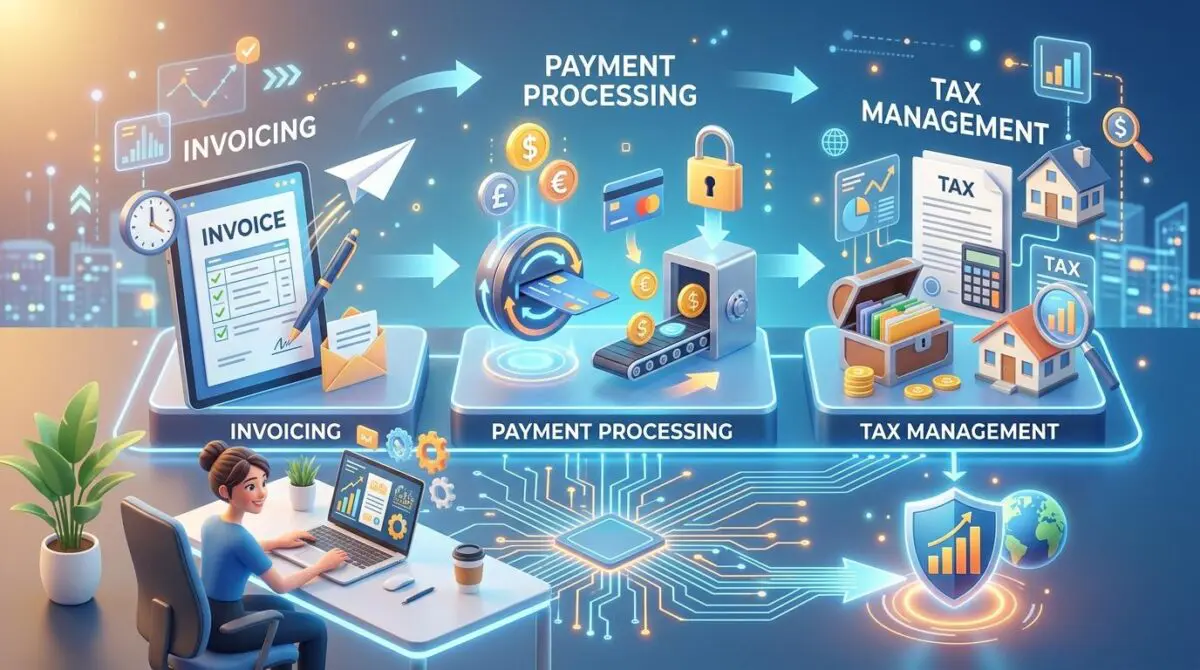
Enter Autonomous Financial Operating Systems. These platforms represent the apex of financial engineering, designed to eradicate latency entirely. They are not merely digital ledgers; they are intelligent, self-executing financial brains.
The architecture of modern business is fundamentally changing. We are moving away from software that requires human inputs toward systems that operate with independent agency. The financial stack is the central nervous system of this transformation.
By unifying invoicing, payments, and tax compliance into a single autonomous layer, businesses are experiencing a massive reduction in audit risk. The human error associated with manual data entry is mathematically eliminated. More importantly, these systems unlock trapped liquidity that was previously held hostage by archaic accounting workflows.
Market Intelligence & Capital Flow
Market Intelligence & Data
Autonomous Processing Rate
According to Accenture, 88% of invoices in the global SaaS sector are now processed and reconciled without human intervention as of Q1 2026.
Monthly Blockchain B2B Volume
Data from SWIFT’s 2026 report shows that blockchain-integrated payment apps now facilitate $450 billion in monthly B2B transaction volume.
Reduction in Tax Filing Errors
A KPMG 2026 study reveals that AI-integrated tax modules have reduced filing errors by 72% for platforms operating in the gig economy.
Embedded Finance VC Inflow
PitchBook reports that venture capital investment into ‘Embedded Tax and Accounting’ startups reached $18.5 billion in the first half of 2026.
The data presented above reveals a definitive pivot in where institutional capital is placing its bets. Market dominance is no longer about building better user interfaces or colorful reporting dashboards. The new battleground is deeply infrastructural.
Embedded finance giants like Stripe and Brex are leading this charge by integrating deep-tier tax automation directly into their payment stacks. They understand that whoever controls the reconciliation layer controls the financial heartbeat of the enterprise. This is a winner-take-all race for the back office.
The venture capital ecosystem is aggressively funding the next wave of this disruption. Firms like Andreessen Horowitz and Sequoia are pouring billions into startups that treat taxation and reconciliation as code. This massive influx of smart money signals the imminent death of legacy Enterprise Resource Planning systems.
When blockchain B2B volume reaches hundreds of billions monthly, it becomes clear that decentralized financial infrastructure is the new global standard. The smart money is not betting on incremental improvements. It is betting on the complete automation of the corporate treasury.
The FinTech Deep Dive: Agentic FinTech & Tax-as-Code
The current frontier of financial technology is defined by what industry insiders call Agentic FinTech. This is a radical departure from the passive software of the past decade. In this new paradigm, LLM-based agents perform autonomous, triple-entry accounting in the background.
These AI agents act as tireless digital CFOs. They execute real-time reconciliation without requiring a human operator to match invoices against bank feeds. Every transaction is instantly verified, categorized, and recorded across a distributed ledger.
Agentic FinTech represents the convergence of machine learning and decentralized finance. These systems do not just read data; they understand financial context. When an anomaly occurs, the LLM-based agent investigates, resolves, and documents the discrepancy autonomously.
This level of automation ensures that the financial data is always pristine. There is no end-of-month scramble to close the books. The books are perpetually closed and perfectly balanced, second by second.
Innovation has fundamentally shifted away from static reporting toward dynamic, programmable money. Modern Autonomous Financial Operating Systems now leverage advanced payment rails to move capital at the speed of thought. This includes deep integrations with FedNow 2.0 and various stablecoin networks.
This robust infrastructure ensures that the moment an invoice is generated, the underlying payment settlement and tax routing occur simultaneously. There is no waiting for batch processing or overnight clearing. The transaction is atomic, absolute, and instantaneous.
Decentralized Infrastructure and Programmable Payments
By executing invoicing and settlement concurrently, these platforms effectively eliminate the traditional net-30 liquidity gap. Businesses no longer have to float capital while waiting for checks to clear across fragmented banking networks. The money moves instantly, and the corporate ledger updates autonomously.
This eradication of the net-30 gap is a monumental victory for cash flow optimization. It means that capital can be redeployed into growth initiatives weeks faster than before. The velocity of money within the enterprise is dramatically accelerated.
The integration of stablecoin rails is particularly disruptive. By bypassing traditional correspondent banking networks, cross-border payments become as simple as sending an email. The autonomous system handles the foreign exchange routing, ensuring the lowest possible slippage.
This global liquidity network empowers SMBs to operate like multinational conglomerates. The geographical barriers to trade are dissolved by the underlying code. Capital flows to wherever it is treated best, instantly and securely.
This is where the concept of Continuous Accounting becomes a reality for modern enterprises. Traditional accounting was a retrospective exercise, looking backward at the end of the month. Continuous Accounting is a live, breathing financial reality.
CEOs and founders can now view real-time, tax-adjusted profitability at any given second of the day. The autonomous treasury management capabilities of these AI-native platforms optimize cash flow dynamically. They route excess capital into yield-bearing instruments without human intervention.
Continuous Accounting and the Invisible Tax Layer
Tax compliance has historically been the most friction-heavy component of global commerce. Navigating multi-jurisdictional tax codes requires immense resources and carries severe penalty risks. A recent analysis by Gartner indicates that by the end of 2026, 40% of mid-market enterprises will utilize ‘Invisible Tax’ layers that automate real-time VAT and GST remittance at the point of sale via programmable smart contracts.
This technological shift transforms tax remittance from a quarterly nightmare into a silent, background process. The smart contracts ensure that the exact tax amount is calculated, withheld, and routed to the appropriate authority instantly. The enterprise never even holds the tax liability on its balance sheet.
While regulatory frameworks continue to evolve, the underlying technology ensures that compliance is mathematically guaranteed at the moment of transaction. This proactive approach drastically reduces audit risk. It also frees up vital capital that would otherwise be reserved for administrative overhead or legal defense.
The Tax-as-Code movement is fundamentally altering how global businesses scale. By abstracting the complexity of international tax law into a programmable layer, companies can enter new markets instantly. The financial operating system handles the local compliance autonomously.
The Strategic Action Plan
Strategic Trajectory
- Prepare for the 12-24 month emergence of Predictive Liquidity Engines.
- Integrate generative AI to forecast tax liabilities and cash flow shortages months in advance.
- Implement autonomous systems to secure pre-approved credit lines or liquidate micro-investments to cover gaps.
- Pivot toward a ‘Zero-Touch’ finance model to remove transactional friction.
- Realign the CFO role from transactional oversight to pure strategic capital allocation.
The roadmap for the next two years is dominated by the integration of Predictive Liquidity Engines. Founders and institutional investors must prepare for a landscape where reactive finance is obsolete. Generative AI will forecast tax liabilities and cash flow shortages months in advance with pinpoint accuracy.
This predictive foresight allows businesses to navigate cash flow valleys before they materialize on the balance sheet. If the AI detects a potential shortfall, it does not just send an alert. It takes autonomous action to bridge the gap.
Implementing these autonomous systems means your financial stack can secure pre-approved credit lines on its own. Alternatively, it can liquidate micro-investments or rebalance the treasury to cover upcoming liabilities. This self-healing financial architecture is the ultimate competitive advantage.
To capitalize on this trajectory, executives must audit their current financial stack immediately. Identify the manual bottlenecks in your invoicing and reconciliation processes. These are the prime candidates for autonomous disruption.
Begin by piloting Tax-as-Code solutions in a single jurisdiction. Once the invisible tax layer proves its efficacy, scale it across your entire operational footprint. The goal is to build a modular, AI-native financial architecture that can adapt to future regulatory shifts.
This is the foundation of the Zero-Touch finance model. As transactional friction drops to absolute zero, human capital is liberated from the back office. The days of manual invoice approval and tax filing are rapidly coming to an end.
Consequently, the role of the CFO will permanently evolve. The modern financial leader will transition from operational oversight to pure strategic capital allocation. Their mandate will be to direct the AI, optimize the algorithms, and drive exponential enterprise value.
Conclusion: The Zero-Touch Future
The convergence of AI, programmable money, and embedded tax layers is rewriting the rules of corporate finance. Autonomous Financial Operating Systems are not just solving the invoicing problem; they are creating frictionless engines for limitless scaling. The administrative drag of the past is being replaced by the predictive liquidity of the future.
The businesses that adopt this architecture today will command the liquidity of tomorrow. They will operate with leaner teams, lower risk, and unprecedented financial agility. In the era of Agentic FinTech, your operating system is your ultimate alpha.
Navigating the intersection of financial technology, institutional capital, and market psychology requires a sharp strategy. To future-proof your FinTech architecture and scale with precision, connect with Andres at Andres SEO Expert.