Key Points
- Elimination of the Fragmentation Tax: AI-driven Cross-Border Financial Orchestration completely bypasses legacy correspondent banking, saving billions in hidden FX spreads and intermediary fees.
- Rise of the Autonomous Treasury: Unified Ledgers and Atomic Settlement have replaced the archaic T+2 model, enabling zero-balance accounts funded at the exact millisecond of transaction.
- Hyper-Local FinTech Abstraction: Future-proof corporate structures are deploying self-optimizing wallets that automatically navigate local compliance, tax laws, and currency volatility via AI interfaces.
Table of Contents
- The Financial Tech Friction: Breaking the Fragmentation Tax
- Market Intelligence & Capital Flow
- The FinTech Deep Dive: Architecting the Autonomous Treasury
- The Psychology of Liquidity: Why Smart Money is Moving
- The Strategic Action Plan: Deploying Hyper-Local Abstraction
- Conclusion: The Future of Global Capital
The Financial Tech Friction: Breaking the Fragmentation Tax
Historically, managing finances across multiple currencies and countries was a labyrinth of hidden fees and trapped liquidity. Today, the rules of global finance have been rewritten by algorithmic precision and programmable money. According to a May 2026 report by Goldman Sachs, AI-driven cross-border liquidity orchestration has reduced global corporate FX hedging costs by a staggering $45 billion over the last 12 months.
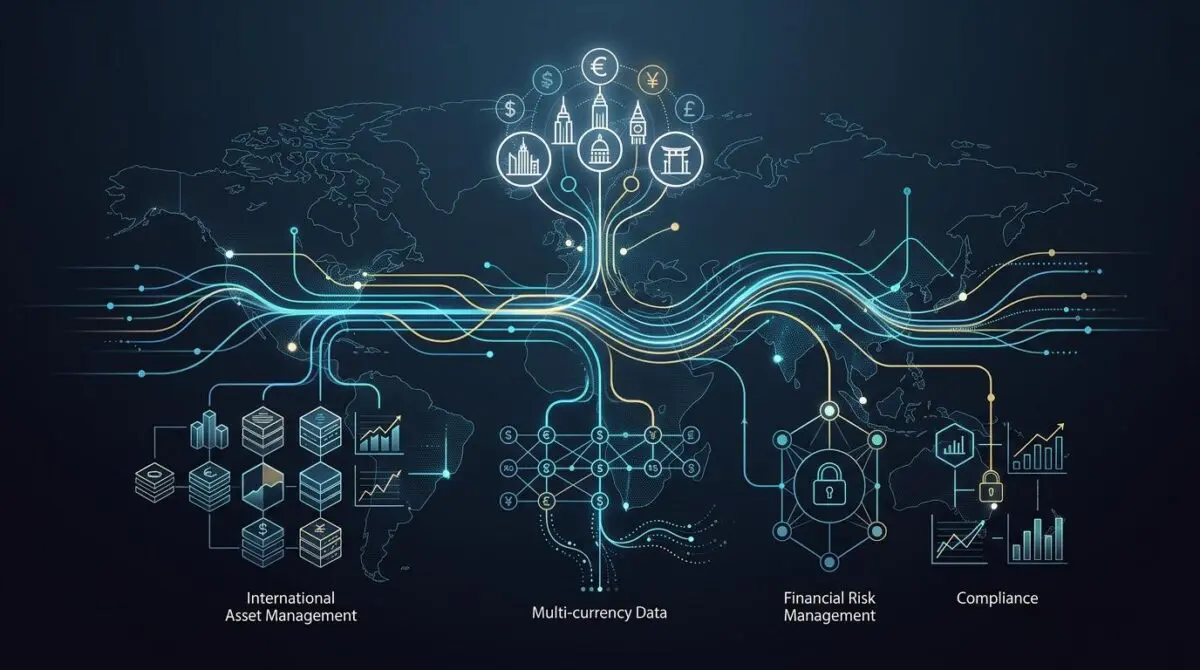
This massive reduction in overhead is not a byproduct of better banking relationships. It is the direct result of a technological paradigm shift known as Cross-Border Financial Orchestration. This framework treats global liquidity not as a static ledger, but as a dynamic, programmable network.
For decades, multinational corporations and borderless founders suffered under the fragmentation tax. This hidden 3-5% loss was historically incurred through intermediary bank fees, high FX spreads, and idle capital trapped in regional accounts. Cross-Border Financial Orchestration eliminates this friction entirely by bypassing the legacy choke points of international finance.
By utilizing AI agents and real-time data pipelines, businesses can bypass traditional correspondent banking networks. Capital is no longer subject to the arbitrary delays of legacy clearinghouses. Instead, it flows instantaneously to where it is needed most, maximizing yield and minimizing exposure to currency volatility.
In the legacy financial system, moving capital from London to Tokyo required a convoluted chain of correspondent banks, each extracting a toll. This archaic architecture was built for the analog age, inherently incompatible with the demands of modern digital commerce. Today, we are witnessing the complete unbundling of these legacy systems in favor of algorithmic efficiency.
Market Intelligence & Capital Flow
Market Intelligence & Data
Global Cross-Border Volume
The World Bank’s 2026 Migration and Development Brief highlights this record volume, fueled by the mass adoption of decentralized settlement rails.
Median Settlement Speed
According to 2026 performance metrics from SWIFT, the integration of ‘Instant Solo’ AI rails has dropped median settlement times for 90% of global transactions to under one second.
AI Treasury Investment
PitchBook’s Q1 2026 FinTech report notes that institutional capital into AI-managed multi-currency treasury platforms has doubled since 2024.
CBDC Interoperability
The International Monetary Fund (IMF) 2026 tracker confirms this many nations now support multi-lateral digital currency bridges for real-time trade.
The data above illustrates a clear trajectory: the era of manual treasury management is officially dead. Smart money is aggressively flooding into autonomous treasury startups. Companies such as Arca and Flux have collectively raised over $1.2B in Series C rounds as of Q1 2026.
Institutional investors are pivoting away from simple payment processors. They are now backing Orchestration Layers, which are sophisticated platforms that sit above bank APIs to find the cheapest, fastest route for global capital in real-time. This capital rotation signals a fundamental shift in how markets value liquidity infrastructure.
Tech giants are also capitalizing on this decentralized momentum. Industry leaders like Stripe and Alphabet have massively expanded their Treasury-as-a-Service offerings. This strategic expansion is effectively turning every global SaaS company into a multi-currency bank capable of holding, routing, and yielding capital.
When an enterprise software company can instantly issue localized virtual cards in 120 countries, the traditional bank loses its monopoly on corporate finance. This democratization of treasury services fundamentally redistributes financial power. The implications for global commerce are profound, as the velocity of money increases exponentially.
This rapid capital turnover allows businesses to scale into emerging markets without the traditional capital requirements that previously bottlenecked international expansion. The barrier to entry for global trade has been effectively lowered to zero by these intelligent routing protocols.
The FinTech Deep Dive: Architecting the Autonomous Treasury
Multi-currency management has evolved into an entirely automated process governed by algorithmic intelligence. AI agents now utilize real-time FX hedging bots and predictive analytics to move capital into the most cost-effective jurisdictions before market volatility hits. This predictive capability is the cornerstone of the modern autonomous treasury.
These AI-led hedging bots operate with a level of foresight that human traders cannot replicate. By analyzing millions of data points, from geopolitical news feeds to options market sentiment, they can preemptively shift liquidity to safe-haven assets. This proactive defense mechanism shields corporate treasuries from sudden currency devaluations.
Unified Ledgers and Atomic Settlement
The underlying architecture of this financial revolution relies heavily on the transition away from archaic settlement systems. By mid-2026, the traditional T+2 settlement model has been largely replaced by Unified Ledger technology. This infrastructure allows for the near-instantaneous movement of value across sovereign borders.
Data from the Bank for International Settlements (BIS) indicates that as of early 2026, 85% of global central banks have successfully integrated their commercial banking APIs into ‘Unified Ledger’ pilots, effectively ending the era of siloed national finance. This institutional adoption provides the necessary liquidity backbone for private orchestration layers to function at scale.
Atomic settlement represents the holy grail of financial engineering. It guarantees that the transfer of an asset and the corresponding payment occur simultaneously, eliminating counterparty risk. This instantaneous exchange of value is the bedrock upon which Cross-Border Financial Orchestration is built.
Imagine a unified ledger as a global, decentralized operating system for money. Instead of reconciling disparate databases across multiple time zones, all participants share a single, cryptographically secure source of truth. This eliminates the massive reconciliation costs that have historically burdened international banks.
Furthermore, high-speed Liquidity Bridges now seamlessly connect traditional fiat systems with Central Bank Digital Currencies. This interoperability creates a programmable flow of money that can be directed by smart contracts rather than human intervention. The result is a frictionless financial ecosystem where capital moves at the speed of data.
Orchestration Layers Over Legacy APIs
This predictive capability allows businesses to maintain zero-balance accounts in secondary markets. These accounts are only funded at the exact millisecond of a transaction, completely eliminating the need to park idle capital in depreciating local currencies. Consequently, this unlocks massive amounts of working capital that was previously stagnant.
The concept of trapped capital is rapidly becoming obsolete. In a hyper-optimized orchestration model, every dollar, euro, or yen is actively deployed in money market protocols until the very microsecond it is required for settlement. This ensures that corporate balance sheets are constantly generating yield, regardless of geographic location.
By providing a single pane of glass for global liquidity, Orchestration Layers empower CFOs to visualize and deploy capital with unprecedented precision. The complexity of managing multiple banking portals is abstracted away. In its place, a unified dashboard provides actionable intelligence on global cash positions.
Navigating the legal intricacies of borderless finance historically required armies of compliance officers. However, the recent brief regulatory alignment through the 2025 Global Digital Asset Framework has provided the necessary legal certainty for this technological expansion. This framework establishes a unified standard for digital asset classification and cross-border data flow, allowing engineers to focus purely on innovation.
The Psychology of Liquidity: Why Smart Money is Moving
Beyond the raw technological advancements, there is a profound psychological shift occurring within institutional boardrooms. The realization that liquidity can be programmed has fundamentally altered how executives perceive capital efficiency. Money is no longer viewed as a static asset sitting in a vault, but as dynamic data that must be continuously optimized.
This shift in mindset is driving the aggressive deployment of capital into Orchestration Layers. Investors recognize that the platforms controlling the routing logic of global finance will capture immense value. They are not merely investing in software; they are acquiring real estate on the next-generation financial internet.
Venture capital is no longer interested in incremental improvements to the legacy SWIFT network. The prevailing investment thesis centers on complete architectural replacement. By funding autonomous treasury solutions, institutional capital is effectively betting against the survival of traditional correspondent banking.
Furthermore, the risk models used by traditional banks are being rendered obsolete by real-time predictive analytics. Autonomous treasury systems do not rely on historical quarterly reports to assess currency risk. They continuously ingest live market data to adjust hedging strategies dynamically, providing a level of security previously thought impossible.
The Strategic Action Plan: Deploying Hyper-Local Abstraction
Strategic Trajectory
- Implement Hyper-Local FinTech abstraction to automate the management of local tax laws, compliance, and currency volatility through AI.
- Transition toward Self-Optimizing Wallets for both consumers and corporations to enable automated swaps based on risk profiles.
- Integrate real-time global economic indicators to prioritize holdings in high-yielding or stable currencies automatically.
- Capitalize on the 2025 Global Digital Asset Framework to establish legal certainty and regulatory alignment for multi-currency expansion.
The next 12-24 months will be defined by the rapid rise of Hyper-Local FinTech abstraction. This concept envisions a financial ecosystem where the immense complexity of local tax laws, compliance, and currency volatility is entirely hidden behind an intuitive AI interface. Executives must prepare their infrastructure for this inevitable abstraction to remain competitive.
A critical component of this transition is the adoption of Self-Optimizing Wallets for both corporate treasuries and consumer applications. These intelligent wallets automatically swap holdings into the highest-yielding or most stable currency based on individual risk profiles. They constantly ingest real-time global economic indicators to execute these swaps with zero human latency.
Implementing this level of automation requires a fundamental rethinking of corporate financial architecture. CFOs must transition from backward-looking reporting to forward-looking, algorithmic liquidity provisioning. This requires integrating API-first orchestration platforms that can seamlessly communicate with both legacy banks and decentralized liquidity pools.
The Self-Optimizing Wallet will soon become the standard interface for all economic interaction. Whether it is a multinational corporation managing payroll across 50 countries or a digital nomad optimizing their personal savings, the underlying technology remains identical. It is an intelligent agent working tirelessly to preserve and expand purchasing power.
For founders and institutional investors, the mandate is clear. You must upgrade your financial stack to integrate these autonomous orchestration layers or risk being outmaneuvered by more agile competitors. The ability to programmatically route capital is no longer a luxury; it is a fundamental requirement for global survival.
Conclusion: The Future of Global Capital
The convergence of artificial intelligence, unified ledgers, and decentralized liquidity networks has fundamentally altered the physics of global finance. Managing finances across multiple currencies is no longer about mitigating loss. It is about aggressively optimizing capital velocity through Cross-Border Financial Orchestration.
The future of money is programmable, autonomous, and instantly global. Those who cling to the manual processes of the past will find their margins eroded by the relentless efficiency of algorithmic orchestration. The financial tech friction that defined the last century has been permanently engineered out of the system.
As the global economy becomes increasingly borderless, the financial institutions and tech disruptors that control the orchestration layers will dictate the flow of international commerce. The fragmentation tax has been abolished. The era of the autonomous treasury has officially arrived.
Navigating the intersection of financial technology, institutional capital, and market psychology requires a sharp strategy. To future-proof your FinTech architecture and scale with precision, connect with Andres at Andres SEO Expert.