




Key Points
- Agentic Orchestration: Modern financial stacks leverage AI agents to autonomously navigate multi-cloud ledgers and decentralized identity protocols.
- Atomic Settlements: Replacing archaic T+2 cycles with real-time T+0 atomic settlements reclaims trillions in trapped capital and eliminates liquidity drag.
- Autonomous Treasury: AI-driven bots now manage corporate cash across multiple protocols, significantly outperforming traditional manual cash management strategies.
Table of Contents
According to the Q1 2026 FinTech Pulse report by Gartner, 68% of enterprise-level financial institutions have now migrated to modular, API-first stacks to accommodate the 400% surge in AI-driven transaction volumes. This is not merely a software upgrade for legacy banks. It is a fundamental rewiring of how global liquidity moves across the digital economy.
For years, traditional financial systems have operated like rusted plumbing. Capital gets trapped in archaic settlement cycles, while monolithic banking architectures suffocate corporate agility. Historically, companies had to build entirely new compliance and ledger systems from scratch. This process took years and cost millions in venture capital.
The advent of Banking-as-a-Service provided a temporary band-aid. However, these platforms quickly became bottlenecks themselves, suffering from the same monolithic constraints as their partner banks. The solution to this systemic friction lies in the Modular FinTech Infrastructure Stack.
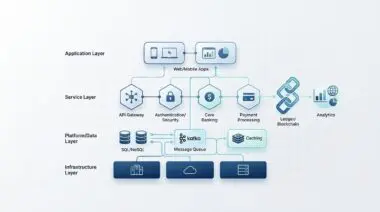
This architecture transforms static banking services into a dynamic, programmable engine. It allows enterprises to hot-swap ledgers, card issuers, and compliance providers in real-time. By leveraging this modular approach, founders and institutions are eliminating catastrophic integration debt.
They are no longer tethered to a single, sluggish banking partner. Instead, they operate on a fluid matrix of decentralized protocols and serverless architecture. This is where the smart money is placing its bets. The future of finance is not about building better apps; it is about architecting entirely new financial ecosystems from the ground up.
Market Intelligence & Capital Flow
Market Intelligence & Data
Autonomous Finance TAM
McKinsey & Co. projects the total addressable market for AI-orchestrated financial infrastructure will hit $145 billion by the end of 2026.
Average Settlement Speed
The 2026 SWIFT Innovation Report highlights that stacks utilizing ISO 20022 messaging and modular ledgers have achieved sub-second cross-border settlement.
API-First Dominance
The 2026 FinTech Survey by Deloitte reveals that 88% of new financial unicorns are built on fully modular, provider-agnostic architectures.
AI Compliance Spend
Research from Juniper Research shows that global enterprise spending on AI-integrated KYC and AML tools reached $12.4 billion in the first half of 2026.
The data above paints a clear picture of where institutional capital is flowing. Venture capital is currently saturating the Infrastructure-as-Code sector at an unprecedented rate. Heavyweights like Sequoia and Andreessen Horowitz are leading billion-dollar rounds into AI-native core banking providers.
We are witnessing a generational wealth transfer from legacy institutions to agile infrastructure providers. When venture firms deploy capital at this scale, they are not just funding startups. They are actively terraforming the financial landscape, understanding that the next trillion-dollar company will be the invisible orchestration layer powering global finance.
This immense capital influx signals the definitive death of legacy Banking-as-a-Service models. Market leaders such as Stripe and Adyen are facing severe disruption from emergent stack orchestrators. These orchestrators allow platforms to bypass traditional bottlenecks entirely.
They enable enterprises to deploy hyper-personalized financial products instantly across global markets. Institutional investors recognize that the true value lies in the infrastructure layer. He who controls the orchestration layer controls the future of transaction flow.
The shift toward API-first dominance ensures that the next generation of financial unicorns will be entirely provider-agnostic. They will not rely on a single point of failure. Instead, they will route capital through the path of least resistance.
The FinTech Deep Dive: Agentic Orchestration
In mid-2026, the fintech stack has officially shifted from static infrastructure to Agentic Orchestration layers. Modern stacks now utilize advanced AI agents that autonomously navigate multi-cloud ledgers. They seamlessly interact with decentralized identity protocols to assemble financial products in real-time.
This architecture leverages serverless environments and zero-knowledge proofs. The result is absolute privacy combined with sub-millisecond transaction speeds across global liquidity pools. The software layer has been effectively decoupled from the underlying licensed financial institution.
This decoupling is the holy grail of financial technology. It transforms financial services into composable primitives that can be rearranged on demand. Capital becomes kinetic energy, moving instantly to where it is needed most.
Decoupling Software from the Ledger
When enterprises decouple their user experience from the core ledger, they unlock immense scalability. A single unified API now routes transactions to the most efficient provider available. If one partner bank faces downtime, the system automatically routes around the failure without dropping a single transaction.
This routing intelligence is where autonomous treasury management becomes a massive competitive advantage. A 2026 deep-dive by Bain & Company found that ‘Autonomous Treasury’ bots, which manage corporate cash across multiple protocols, are currently generating an average 2.1% yield improvement over traditional manual cash management strategies.
This yield generation happens entirely in the background. The bots analyze global interest rates, liquidity needs, and risk profiles in milliseconds. They then deploy capital across various digital and fiat instruments to maximize returns without human intervention.
Corporate treasurers are no longer executing trades manually. They are simply setting the risk parameters for the machines. The AI handles the execution with ruthless efficiency.
Solving Liquidity Drag with Atomic Settlements
The modular stack also solves the crippling liquidity drag of legacy financial networks. By replacing archaic T+2 settlement cycles with real-time T+0 atomic settlements, businesses are reclaiming trillions in trapped capital. Money moves instantly, unlocking operational velocity that was previously impossible to achieve.
Capital is no longer sitting idle in correspondent banking networks. It is constantly deployed, earning yield, or facilitating global commerce. This velocity of money is the defining characteristic of the modern digital economy.
On the regulatory front, AI-integrated compliance layers have reduced false-positive fraud alerts by 75%. This allows for a friction-free onboarding experience that previously took days but now completes in seconds. The technology ensures rigorous security without sacrificing the user experience, satisfying both regulators and consumers.
Decentralized Identity and ZK-Proofs
A critical component of this new architecture is the integration of Decentralized Identity protocols. In the past, identity verification was a siloed, redundant process that introduced massive friction. Modern stacks utilize these protocols to create portable, verifiable credentials that move seamlessly with the user.
This is paired with zero-knowledge proofs to ensure absolute privacy. These cryptographic proofs allow the stack to verify a user’s financial status without ever exposing the underlying data. This breakthrough solves the ultimate paradox of digital finance.
It provides total regulatory compliance without sacrificing consumer privacy. Institutions can now share verified liquidity profiles across borders instantly. This eliminates the need for redundant checks when moving capital between jurisdictions.
The Rise of Self-Healing Architectures
The ultimate evolution of the modular stack is the concept of self-healing architecture. Traditional financial systems are brittle, relying on singular points of failure that can cascade into catastrophic outages. Self-healing stacks operate like biological organisms, constantly monitoring their own health.
If a specific payment gateway begins to experience latency, the stack detects it instantly. It then shifts transaction volume to a secondary gateway before the user even notices a delay. This level of resilience is non-negotiable for enterprise-scale applications.
It ensures that the flow of capital remains uninterrupted, regardless of external market shocks or vendor failures. The system is designed to survive and adapt in real-time.
The Strategic Action Plan: Autonomous Finance
Strategic Trajectory
- Capitalize on the transition to ‘Autonomous Finance’ systems within the next 18 months.
- Implement automated treasury management to autonomously rebalance funds across CBDCs and private stablecoins.
- Eliminate human input requirements to optimize yield and minimize systemic risk.
- Adopt ‘Self-Healing Stacks’ to facilitate automatic provider switching during bank downtime or regulatory scrutiny.
- Guarantee 100% uptime for consumer-facing applications through modular provider-agnostic architecture.
The next 18 months will see the explosive rise of Autonomous Finance across all sectors. The ultimate fintech stack will manage its own treasury, rebalancing funds across central bank digital currencies and private stablecoins. This will optimize yield and minimize risk completely autonomously.
Founders must immediately begin architecting these Self-Healing Stacks. These systems automatically switch providers if a bank partner faces downtime or regulatory scrutiny. This redundancy guarantees 100% uptime for consumer-facing applications, which is critical for maintaining market trust.
Transitioning from a legacy system to a modular stack is not a simple migration. It requires a complete teardown of existing technical debt. Executives must begin by auditing their current API dependencies and identifying single points of failure.
The first phase of implementation should focus on decoupling the ledger from the user interface. Once the software layer is isolated, institutions can begin integrating autonomous treasury bots. These bots will serve as the vanguard of the new autonomous finance strategy.
Implementing this architecture requires a fundamental shift in engineering philosophy. You are no longer building a static application; you are deploying an autonomous financial organism. Executives must prioritize modularity, AI orchestration, and provider-agnostic APIs to ensure long-term survival in this hyper-competitive landscape.
Conclusion: Architecting the Future
The Modular FinTech Infrastructure Stack is the ultimate weapon in the modern financial arena. It transforms trapped capital into kinetic energy, powered by AI agents and real-time settlement networks. Those who cling to monolithic systems will inevitably be outpaced by agile, self-healing architectures.
The financial institutions that survive the next decade will not look like traditional banks. They will look like high-frequency trading firms, operating entirely on code and algorithmic trust. The Modular FinTech Infrastructure Stack is the blueprint for this transformation.
The era of manual treasury management and static banking partnerships is officially over. The future belongs to autonomous, orchestrated financial engines that adapt in real-time to shifting market conditions. Leaders who embrace this paradigm shift will capture unprecedented market share and define the next decade of digital finance.
Navigating the intersection of financial technology, institutional capital, and market psychology requires a sharp strategy. To future-proof your FinTech architecture and scale with precision, connect with Andres at Andres SEO Expert.