Key Points
- Eradicating Bottlenecks: Programmable ledgers are replacing the $190 trillion correspondent banking system with near-instant, T+0 finality and fractional transaction costs.
- Agentic AI Integration: The convergence of autonomous AI agents and Zero-Knowledge proofs is enabling secure, high-speed automated payments across institutional Layer-2 hyper-chains.
- Autonomous Treasuries: Corporate finance is pivoting toward 24/7 autonomous treasury management, utilizing smart contracts to dynamically allocate capital into yield-bearing tokenized assets.
Table of Contents
The Financial Tech Friction
According to a16z Crypto research, stablecoin transfer volume hit a record $4.5 trillion in the first quarter of 2026, as Wall Street begins pricing the sector as a structural risk to traditional credit-card networks. This staggering metric is not merely a reflection of retail speculation. It represents a fundamental rewiring of global liquidity through programmable blockchain infrastructure. The era of analog money movement is rapidly drawing to a close.
For decades, the global economy has been choked by the correspondent banking bottleneck. This archaic financial architecture represents a $190 trillion market burdened by severe inefficiencies. Cross-border payments routed through legacy wire networks suffer from unpredictable three-to-five-day settlement times. Furthermore, these transactions are heavily taxed by intermediary fees ranging from two to seven percent.
Today, programmable blockchain infrastructure is eradicating this friction entirely. We are transitioning from a delayed-settlement world to an ecosystem defined by near-instant, T+0 finality. Transaction costs are simultaneously being slashed to a mere 0.1 to 0.5 percent. This is unlocking unprecedented capital efficiency for multinational corporations.
By embedding stablecoin settlement rails directly into enterprise ERP systems, businesses are bypassing legacy wire networks altogether. This technological leap eliminates the need for manual reconciliation of cross-border B2B payments. Corporate treasurers no longer have to guess when funds will arrive or how much will be deducted by routing banks. The ledger acts as a single, immutable source of truth.
This disruption is shifting the paradigm of corporate finance from reactive to proactive. Capital that was previously trapped in transit can now be deployed instantly to capture yield or fund operations. Programmable blockchain infrastructure is not just upgrading the plumbing of finance. It is transforming money into highly efficient, programmable data.
Market Intelligence & Capital Flow
To truly understand the magnitude of this shift, we must analyze the data driving this massive capital migration. Institutional money is no longer merely observing digital asset markets from the sidelines. Smart capital is actively deploying into tokenized architecture at a breathtaking pace.
Market Intelligence & Data
Institutional Tokenization Demand
A January 2026 survey by Coinbase and EY-Parthenon found that 64% of asset managers are now actively seeking to tokenize their assets, up from 40% in 2025.
Quarterly Transaction Volume
Data from RootData indicates that total stablecoin transaction volume surpassed $28 trillion in Q1 2026, marking a 51% increase over the previous quarter.
Algorithmic Bot Activity
According to Stablecoin Insider, 76% of all stablecoin transaction volume in early 2026 was driven by autonomous bots, representing the highest level of automated finance on record.
RWA On-Chain Value
As of May 2026, the real-world asset (RWA) tokenization market has surpassed $31 billion in total value excluding stablecoins, according to reports from the Consensus 2026 summit.
This market intelligence reveals a seismic shift in how institutional investors view digital assets. The gap between traditional finance and decentralized finance is vanishing rapidly. Asset managers are realizing that holding analog, illiquid assets is a massive competitive disadvantage in a digitized economy.
The surge in algorithmic bot activity is particularly telling. It proves that programmable money is becoming the foundational layer for automated, high-frequency commerce. Machines are now executing complex financial strategies at speeds no human treasury team could ever match. This automated liquidity is the lifeblood of the new digital economy.
Furthermore, the explosion of on-chain real-world asset value signals a permanent departure from legacy custody models. Financial institutions are moving away from centralized transfer agents. They are embracing decentralized ledgers to track ownership, distribute dividends, and manage collateral in real-time.
The FinTech Deep Dive: Architecting Programmable Infrastructure
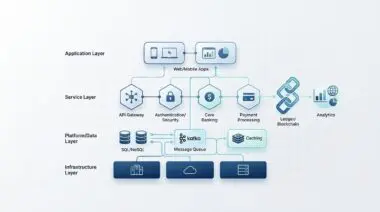
The technological foundation of modern FinTech is undergoing a radical transformation. We are witnessing the death of siloed banking databases and the birth of interoperable value networks. Programmable blockchain infrastructure is the catalyst driving this evolution.
The Rise of Unified Ledgers and Institutional Yield
Institutional money is flooding into unified ledgers at an unprecedented pace. Giants like BlackRock with its BUIDL fund and Franklin Templeton with BENJI have moved far beyond experimental pilots. These tokenized assets are now core treasury instruments actively managed on-chain.
This transition represents a massive pivot by crypto and TradFi giants toward owning traditional transfer agent and ownership record infrastructure. A prime example is Bullish’s massive $4 billion acquisition of Equinity. The lines between a traditional clearinghouse and a blockchain protocol are becoming entirely indistinguishable.
Simultaneously, Stripe is dominating the stablecoin-to-fiat gateway market following its $1.1 billion acquisition of Bridge. This strategic move allows merchants to accept programmable dollars globally without touching legacy banking rails. The sheer scale of this disruption is staggering when compared to legacy payment processors.
A 2026 analysis by J.P. Morgan and Artemis reveals that monthly stablecoin transfer volume averaged $3.8 trillion in Q1, surpassing the monthly processing volume of Visa ($1.3 trillion) and Mastercard ($850 billion) combined. This metric proves that push-based cryptographic payments are structurally superior to pull-based credit card networks. The market has spoken, and it prefers the efficiency of the blockchain.
Agentic AI and the Zero-Knowledge Settlement Layer
The 2026 innovation landscape is defined by the powerful convergence of Agentic AI and decentralized ledgers. Financial institutions are moving far beyond simple tokenization. We are entering the era of agentic payments, where autonomous AI agents initiate, route, and settle transactions entirely on-chain.
These AI fiduciaries require a financial network that operates at the speed of software. To support this, cutting-edge programmable blockchain infrastructure now focuses heavily on Zero-Knowledge proofs. This cryptographic breakthrough ensures institutional privacy while maintaining verifiable cryptographic truth across the network.
Furthermore, Layer-2 hyper-chains are revolutionizing how banks interact with public blockchains. These specialized networks allow institutions to run private, high-speed settlement layers. Crucially, these bespoke networks remain perfectly interoperable with deep public liquidity pools like Ethereum and Solana.
While global regulatory frameworks continue to evolve around digital asset classifications, the technology itself is outpacing legislative friction. Institutions are building compliance-by-design directly into smart contracts. This ensures that identity verification and anti-money laundering checks execute autonomously at the protocol level.
The Strategic Action Plan: Autonomous Treasury Management
The next 24 months will separate the architects of the new financial system from the obsolete legacy players. The rise of autonomous treasury management is no longer a theoretical concept. It is an immediate operational imperative for any forward-thinking enterprise.
Strategic Trajectory
- Prepare for the rise of Autonomous Treasury Management within the 24-month horizon.
- Transition corporate treasuries toward 24/7 autonomous operations to eliminate manual friction.
- Deploy AI infrastructure to dynamically shift idle capital across yield-bearing tokenized money market funds.
- Strategize for the full integration of Central Bank Digital Currencies (CBDCs) with regulated stablecoins.
- Architect a global Internet of Value where currency is treated as programmable data.
Executing this strategy requires a fundamental shift in how executives view capital. Money is no longer a static asset sitting in a vault waiting to be deployed. It is dynamic, programmable data that can be optimized continuously by machine intelligence.
By deploying AI infrastructure, institutions can dynamically shift idle capital across yield-bearing tokenized money market funds. This eliminates weekend risk and ensures that every dollar is working around the clock. The corporate treasury of the future will not have trading hours.
The next logical evolution is preparing for the full integration of Central Bank Digital Currencies with regulated stablecoins. This hybrid model will provide the ultimate bridge between sovereign fiat and decentralized finance. Forward-thinking leaders must begin integrating these tokenized rails into their ERP systems immediately.
Conclusion: The Internet of Value
We are rapidly architecting a global Internet of Value. In this new paradigm, currency moves at the speed of information, governed by immutable code rather than rent-seeking intermediaries. Programmable blockchain infrastructure is the definitive bedrock of this financial revolution.
The institutions that adopt these decentralized ledgers today will command the global liquidity networks of tomorrow. Delaying integration is no longer a cautious strategy; it is a direct path to obsolescence. The smart money has already made its move.
Navigating the intersection of financial technology, institutional capital, and market psychology requires a sharp strategy. To future-proof your FinTech architecture and scale with precision, connect with Andres at Andres SEO Expert.