



Key Points
- The transition to ‘Continuous Reality Capture’ utilizing AI drone swarms has increased site surveying efficiency by 60x, updating BIM models hourly to eliminate costly structural deviations.
- Heavy equipment manufacturers are pivoting to Software-as-a-Service models, allowing contractors to license Agentic AI capabilities rather than purchasing depreciating hardware assets.
- General Contractors must evolve into ‘System Orchestrators’ to manage decentralized fleets of autonomous robotics, solving the critical 499,000 labor deficit while executing complex generative designs.
Table of Contents
The Core Friction: A Breaking Point in the Built World
The construction industry is bleeding efficiency, and traditional remedies are no longer masking the symptoms. According to a 2026 strategic report from Silicon Valley Bank, venture capital investment in construction technology surged by 63% year-over-year to reach a record $2.6 billion in 2025, marking a definitive capital shift toward autonomous hardware. This is not a speculative tech bubble.
It is a calculated, desperate response to a systemic collapse in labor supply and project predictability. For decades, the built world has relied on an archaic model of brute human force and fragmented communication. Today, that legacy model is fundamentally broken.
Enter the Autonomous Construction Technology (ACT) Ecosystem. This is not merely a collection of fancy gadgets or isolated point solutions. It is a fundamental restructuring of how physical assets are brought into existence.
We are witnessing a paradigm shift from manual execution to algorithmic orchestration. The friction of human error, weather delays, and communication breakdowns is being systematically engineered out of the equation. Construction productivity has flatlined for nearly fifty years while manufacturing efficiency skyrocketed.
The ACT Ecosystem is the first viable solution to this historical stagnation. It replaces fragility with a synchronized network of AI, drones, and robotics. The built environment is the physical manifestation of our economic progress.
Yet, the methods used to construct it have remained stubbornly primitive. The ACT Ecosystem shatters this historical complacency. It forces a complete reimagining of the construction site as an advanced manufacturing floor.
Market Intelligence: Follow the Smart Money
Market Intelligence & Data
VC Investment Peak
Venture capital funding for construction robotics and autonomy reached $2.6 billion in 2025, a 63% YoY increase according to Silicon Valley Bank.
Labor Supply Deficit
The construction industry requires approximately half a million new workers in 2026 to meet current project demands, according to Bridgit and the ABC.
AI Business Impact
As of Q2 2026, 38% of contractors report measurable business impact from AI implementation, up from just 17% in 2025 according to ServiceTitan.
Autonomous Equipment Market
The global market for autonomous construction machinery is projected to reach $18.16 billion in 2026, according to Research and Markets.
The data reveals a stark reality for legacy operators who refuse to adapt. Institutional capital is flowing aggressively away from general-purpose robotics. Instead, the smart money is hunting for specialized retrofit platforms and site-wide automation hubs.
This pivot is driven by the brutal economics of the 2026 labor crisis. With a staggering gap of 499,000 missing skilled workers in North America alone, automation is no longer a luxury. It is a basic survival mechanism for any firm looking to bid on tier-one infrastructure projects.
Venture funds are capitalizing on this desperation by pouring late-stage financing into companies that can prove immediate ROI. To understand the magnitude of this transition, one must look at how autonomous vehicle talent is shifting into construction robotics to rewrite the industry’s DNA. The market is exclusively rewarding solutions that eliminate the massive information silo between the field and the back office.
By bridging this gap, autonomous systems are reducing rework by an average of 25 percent. This directly attacks the 2.8 percent of global GDP historically lost to construction waste and fraud. We are talking about trillions of dollars in recovered capital.
Previous venture capital cycles failed because they focused purely on project management software. Today’s investments recognize that true disruption must happen in the physical dirt. Software alone cannot pour concrete or move earth.
The Strategic Deep Dive: Rewiring Enterprise Infrastructure
The Era of Continuous Reality Capture
The foundation of the ACT Ecosystem is built on data, specifically spatial intelligence. In 2026, the industry has fully transitioned to what insiders call Continuous Reality Capture. This signals the absolute death of the static blueprint.
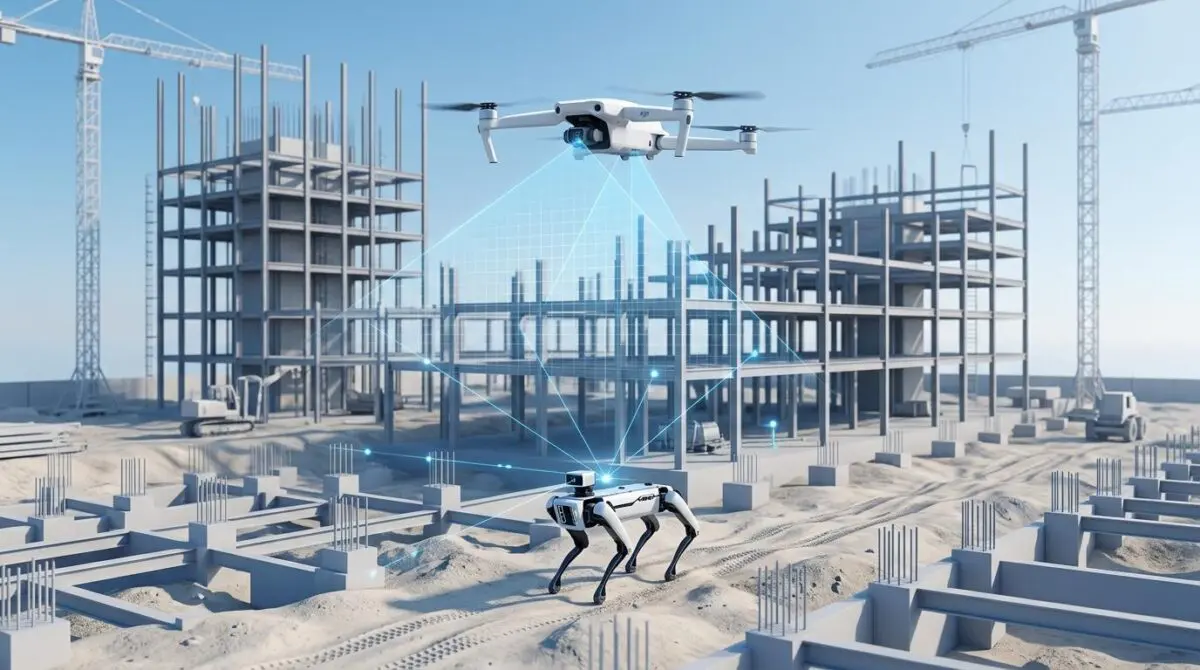
Autonomous drone swarms now patrol job sites constantly, generating hyper-accurate digital twins in real time. These digital replicas are not just passive visual records. They are active, intelligent datasets that update Building Information Modeling software on an hourly basis.
The efficiency gains here are mathematically staggering. Analysis from a 2026 UAV Coach report reveals that AI-equipped drones now perform site surveying at a rate of 120 acres per hour. This represents a 60-fold increase in efficiency over traditional manual methods, which average a mere five acres per hour.
This velocity of information completely changes the risk profile of a mega-project. Project managers no longer wait for end-of-week progress reports to identify structural deviations. AI-verified progress reporting catches millimeter-level errors before the concrete is even poured.
The legal implications are equally profound for enterprise contractors. Objective, algorithmic truth replaces the traditional he-said-she-said disputes between contractors and developers. Payment schedules are now triggered automatically by verified robotic milestones.
Agentic AI and the Death of Information Silos
Data capture is only half the equation for the modern builder. The true disruption lies in how that data is weaponized by Agentic AI. We are moving rapidly past automated machines that simply follow pre-programmed paths.
Today’s heavy machinery possesses the cognitive architecture to navigate complex, rapidly changing environments without human intervention. These machines utilize advanced edge computing to process environmental variables instantly. They are making safety-critical decisions in milliseconds, entirely bypassing cloud latency.
Specialized retrofit platforms like Built Robotics are turning legacy excavators into autonomous earthmoving fleets. Meanwhile, autonomous finishing systems like Canvas are taking over the highly repetitive, physically destructive tasks of drywall finishing. This represents a massive shift in market psychology and operational risk management.
General contractors are realizing that they no longer need to hire unpredictable labor to move dirt. They are simply deploying sophisticated algorithms that control heavy steel. The physical site becomes a programmable environment.
From Heavy Metal to Software-as-a-Service
The financial architecture of heavy equipment is also undergoing a radical transformation. Heavy equipment giants like Caterpillar and Komatsu are pivoting aggressively away from one-off hardware sales. They are transitioning into highly lucrative Software-as-a-Service models.
In this new paradigm, contractors are essentially subscribing to autonomous capabilities. You are not buying a bulldozer to sit idle on your balance sheet. You are licensing the neural network that operates the bulldozer flawlessly for 24 hours a day.
This shift democratizes access to enterprise-grade robotics across the industry. Mid-sized firms can now leverage the same autonomous firepower as global conglomerates without crippling capital expenditures. ConTech-specific venture funds like Zacua Ventures are accelerating this trend by funding the critical middleware.
This middleware connects disparate machines into a single, unified hive mind. The record VC investment in hardware autonomy proves that the market believes the future of construction is highly decentralized. The hardware itself is rapidly becoming commoditized.
The proprietary value now lives entirely in the autonomous software layer. Firms that control the software will ultimately control the margins of the entire built world. The physical machines are merely vessels for the code.
The Psychology of Algorithmic Trust
Adopting the ACT Ecosystem requires a fundamental rewiring of executive psychology. Construction has historically been a high-trust, relationship-based business. Project managers relied on gut instinct and personal relationships with foremen to gauge site progress.
Autonomy strips away this subjective human element entirely. Trust is no longer placed in a handshake, but in the cryptographic verification of spatial data. Executives must learn to trust edge-computing algorithms to make safety-critical decisions.
This psychological friction is the primary barrier to entry for legacy firms. However, the firms that conquer this cognitive hurdle unlock unprecedented scalability. When trust is algorithmic, you can manage a project in Dubai from a control room in Silicon Valley.
This geographic decoupling is the ultimate prize of the autonomous revolution. It allows top-tier firms to scale their operations globally without scaling their human headcount. The talent bottleneck is permanently bypassed.
The Executive Action Plan: Orchestrating the Future
The trajectory is clear, but execution requires a ruthless strategic pivot. The industry is rapidly moving toward Generative Construction. In this model, AI-driven swarm-robotics will execute complex, topology-optimized designs.
These organic, hyper-efficient structures are mathematically impossible for human crews to build. They mimic biological forms to save massive amounts of material while maintaining structural integrity.
Strategic Trajectory
- Pivot toward ‘Generative Construction’ models to leverage AI-driven swarm-robotics.
- Implement complex, topology-optimized designs beyond the technical capacity of manual labor crews.
- Facilitate the evolution of the General Contractor into a ‘System Orchestrator’ role.
- Orchestrate decentralized fleets of 3D printers and autonomous earthmovers as core assets.
- Prepare organizational infrastructure for high-precision, automated design execution.
Founders and C-suite executives must prepare for a total organizational restructuring. The traditional role of the General Contractor is dying a rapid death. It is being replaced by the highly technical System Orchestrator.
A System Orchestrator does not manage subcontractors and human labor pools. They manage decentralized fleets of 3D printers, drone swarms, and autonomous earthmovers. They optimize machine utilization rates and algorithmic efficiency across multiple time zones.
To survive this transition, firms must immediately audit their current digital infrastructure. You cannot deploy an autonomous fleet if your back-office data is siloed in legacy spreadsheets. The transition to the ACT Ecosystem requires a unified data environment as an absolute prerequisite.
The System Orchestrator must also navigate a new regulatory landscape. Autonomous machinery requires specialized insurance protocols and liability frameworks. Forward-thinking executives are already partnering with InsurTech firms to underwrite algorithmic risk.
This proactive approach ensures that compliance does not become a bottleneck for deployment. It allows the firm to scale autonomous operations at the speed of software.
Conclusion: The System Orchestrator’s Mandate
The built world is undergoing its most violent technological disruption since the invention of the steam engine. The Autonomous Construction Technology (ACT) Ecosystem is not a distant future state. It is the current operational reality for the most profitable, forward-thinking firms on the planet.
Those who cling to manual labor models and fragmented data will simply be priced out of the market. The smart money has already placed its bets on autonomy, continuous reality capture, and algorithmic execution. The only question remaining is whether your firm will orchestrate the system or be replaced by it.
Navigating the intersection of technology, capital, and market psychology requires a sharp strategy. To future-proof your business architecture and scale with precision, connect with Andres at Andres SEO Expert.