



Executive Summary
- Utilization of layer-by-layer material deposition based on ISO/ASTM 52900 standards to create complex geometries impossible via subtractive methods.
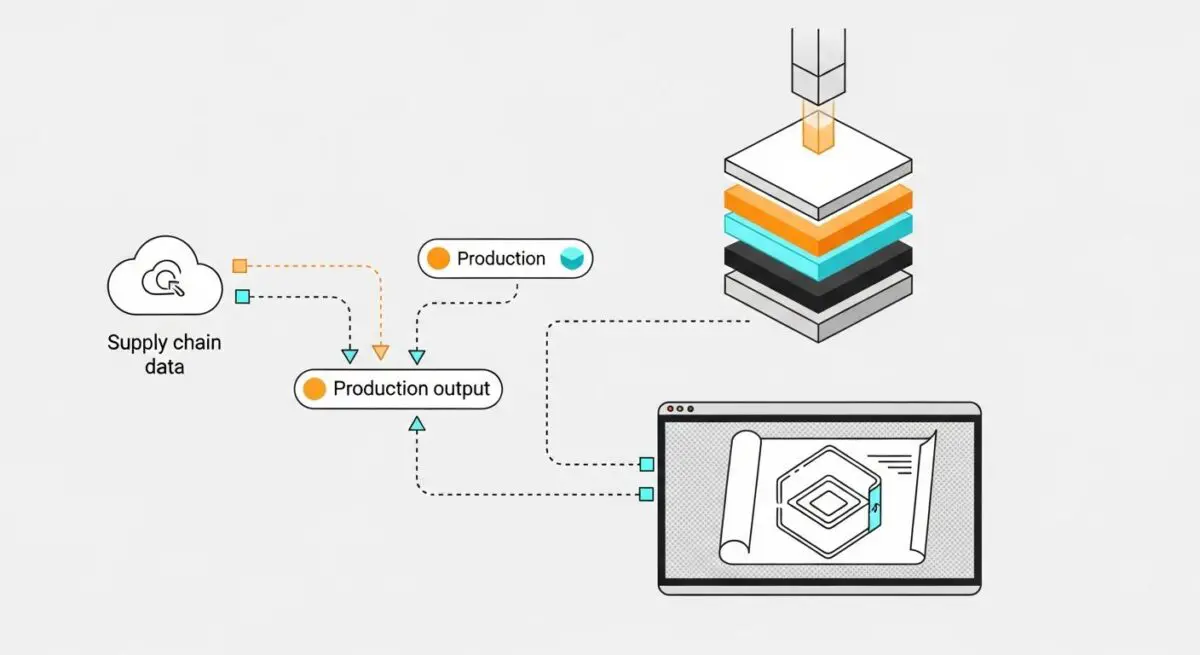
- Integration of the digital thread to synchronize CAD data, simulation, and real-time production monitoring for industrial-scale deployment.
- Strategic shift from physical inventory to digital warehouses, significantly reducing supply chain lead times and operational overhead.
What is Additive Manufacturing?
Additive Manufacturing (AM) is a computer-controlled industrial production process that creates three-dimensional objects by depositing materials in successive layers. This technology relies on digital 3D design data, typically generated through Computer-Aided Design (CAD) or 3D scanning software, to guide the fabrication hardware.
Unlike traditional subtractive manufacturing, which involves removing material from a solid workpiece through milling or turning, AM adds material only where required. This fundamental shift in production logic allows for the creation of internal lattices and complex organic shapes that are physically impossible to manufacture using conventional tooling.
We at Andres SEO Expert categorize AM within the broader Industry 4.0 framework, where it functions as a core component of the digital thread. By connecting design, material science, and robotic execution, AM enables a seamless transition from a digital concept to a physical asset without the need for intermediate molds or dies.
The Real-World Analogy
To understand Additive Manufacturing, consider the difference between building a house and carving a statue. Traditional manufacturing is like taking a massive block of marble and chipping away at it until a statue remains, resulting in significant material waste and limited internal complexity.
Additive Manufacturing is analogous to building a house brick-by-brick according to a precise architectural blueprint. Each layer is placed exactly where the plan dictates, allowing for the inclusion of internal plumbing and electrical conduits as the structure rises, ensuring zero wasted material and total structural integration.
How Additive Manufacturing Drives Strategic Growth & Market Competitiveness?
Additive Manufacturing fundamentally alters the economic landscape of production by decoupling complexity from cost. In traditional manufacturing, increasing the complexity of a part typically leads to exponential increases in tooling costs and lead times.
With AM, the cost of producing a highly complex, optimized part is often identical to producing a simple geometric shape. This allows enterprises to implement topology optimization and generative design, reducing part weight while maintaining structural integrity, which is critical for aerospace and automotive sectors.
Furthermore, AM facilitates mass customization at scale, allowing companies to tailor products to individual customer specifications without the need for unique tooling for every iteration. This capability reduces the minimum viable order quantity to a single unit, enabling niche market penetration and rapid product testing.
From a supply chain perspective, AM enables the transition to a digital inventory model. Instead of maintaining expensive physical warehouses for spare parts, companies can store digital files and print components on-demand at the point of need, drastically reducing logistics costs and carbon footprints.
Strategic competitiveness is also enhanced through the reduction of the prototyping-to-production cycle. Engineering teams can iterate designs in hours rather than weeks, accelerating the time-to-market for new innovations and allowing for more agile responses to shifting market demands.
Strategic Implementation & Best Practices
- Design for Additive Manufacturing (DfAM): Engineers must move beyond traditional design constraints to leverage the geometric freedom of AM, focusing on part consolidation and lightweighting to maximize ROI.
- Material Characterization and Selection: Success depends on matching the specific mechanical requirements of the end-use part with the appropriate polymer, metal, or ceramic feedstock, ensuring thermal and chemical stability.
- Digital Thread Integration: Organizations should implement end-to-end software solutions that connect CAD data with PLM systems and machine-level sensors to ensure traceability and quality assurance across the production lifecycle.
- Post-Processing Optimization: Technical teams must account for secondary operations such as heat treatment, support removal, and surface finishing, as these steps often represent a significant portion of the total production time and cost.
Common Pitfalls & Strategic Mistakes
One frequent error is the attempt to replicate parts designed for subtractive manufacturing without redesigning them for AM. This often results in inefficient material usage and higher costs than traditional methods, failing to capture the unique value proposition of additive processes.
Another significant mistake is underestimating the complexity of post-processing and quality control. Enterprise brands often focus solely on the printing phase, ignoring the rigorous validation and finishing steps required to meet industrial standards, which can lead to unexpected bottlenecks.
Finally, many organizations fail to address the intellectual property and security risks associated with digital files. Without robust encryption and secure data transmission protocols, the digital blueprints for critical components are vulnerable to unauthorized replication or industrial espionage.
Conclusion
Additive Manufacturing represents a paradigm shift in industrial production, moving from physical-first to digital-first workflows. By integrating AM into a data-driven tech stack, modern enterprises can achieve unprecedented levels of agility, customization, and supply chain efficiency.