




Key Points
- Entity-Graph Alignment: Shift focus from keyword density to establishing semantic relationships within an LLM’s latent space using nested JSON-LD schema.
- RAG-Friendly Structuring: Rebuild long-form articles into atomic, modular blocks that AI crawlers can easily extract as context window fragments.
- Generative Analytics: Implement share-of-model tracking via LLM APIs to measure brand citation frequency in zero-click search environments.
The AI Search Context
As of mid-2026, 70% of enterprise organic traffic is projected to originate from AI-synthesized responses rather than traditional blue links (Source: Gartner AI Search Maturity Report 2026).
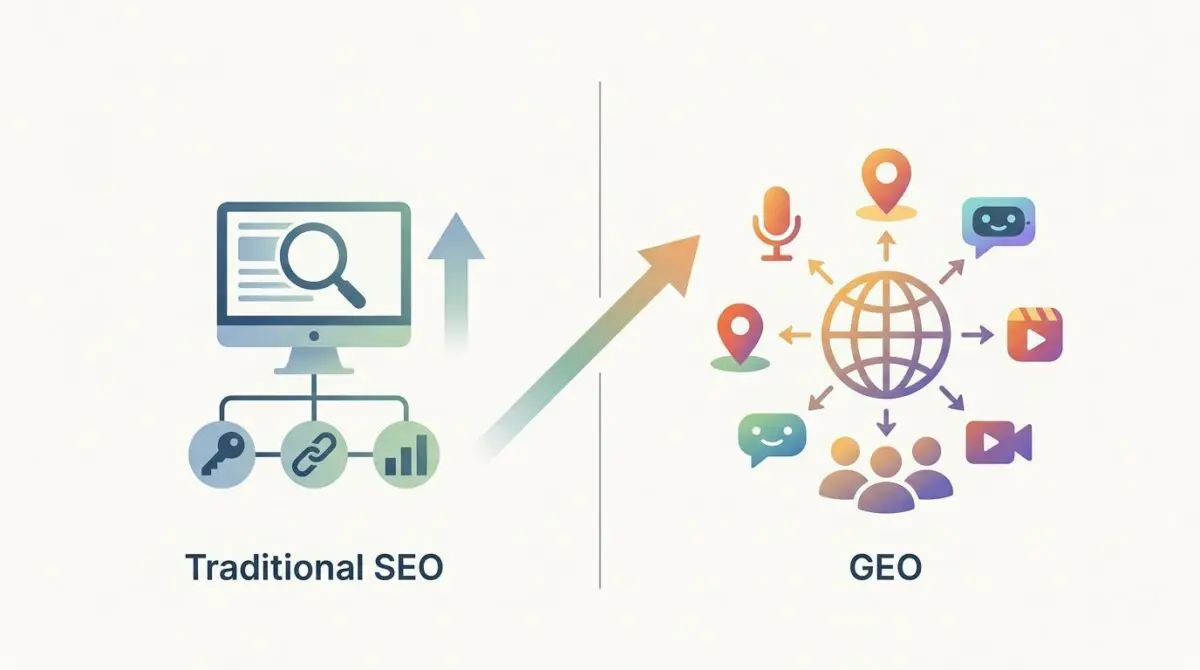
Transitioning from traditional SEO to a GEO mindset involves shifting the marketing focus from search engine algorithms and keyword density to Large Language Model synthesis and Retrieval-Augmented Generation.
In a GEO-driven environment, the goal is not just to rank in a list of blue links but to be the primary source cited within an AI-generated response.
This applies directly to interfaces like Google AI Overviews, SearchGPT, and Perplexity.
This requires a deep understanding of how generative engines weigh entity authority and factual consistency over legacy ranking signals like backlink quantity.
The impact of this transition is binary for modern brands. Those that adapt their content architecture for high synthesizability will dominate the new zero-click search landscape.
Conversely, those clinging to traditional keyword strategies will see a rapid decline in organic visibility.
As AI engines prioritize structured data and semantic relevance, the marketing team must evolve into Information Architects.
These architects feed the LLM’s knowledge graph rather than acting as Content Creators who target isolated search terms.
Understanding the mechanics of vector databases and embedding models is now a prerequisite for digital visibility.
Core Architecture & Pillars
Core Architecture & Pillars
Entity-Graph Authority
LLMs resolve queries by navigating knowledge graphs. Content must be anchored to specific entities (People, Places, Things) with clear semantic relationships to establish ‘authority’ in the model’s latent space.
RAG-Friendly Content Structuring
Retrieval-Augmented Generation relies on chunking data. Content that is modular, with clear headings and concise definitions, increases the likelihood of being retrieved as a top ‘k’ context window fragment.
Citation and Verifiability Optimization
AI models are increasingly trained to prioritize ‘verifiable’ content. This means content that cites external authoritative sources and is, in turn, cited by others, gains a higher trust score in generative outputs.
Semantic Narrative Alignment
Unlike keyword matching, LLMs look for narrative coherence. Optimization now involves aligning content with the ‘probabilistic expectations’ of the model for a given query’s intent.
LLMs resolve queries by calculating cosine similarity between the user’s prompt vector and the stored document embeddings.
Organizations that switched to ‘Entity-First’ content structures saw a 45% increase in citation frequency within LLM reasoning chains compared to those using keyword-centric models (Source: MIT Generative Search Lab 2026).
This fundamental shift in information retrieval mechanics means that content must be anchored to specific entities.
Establishing authority in the model’s latent space requires clear semantic relationships mapped out via structured data.
This shift is critical as Gartner predicts a 25% drop in traditional search volume by 2026, forcing brands to rethink their entire visibility strategy.
Retrieval-Augmented Generation relies heavily on efficient data chunking.
Content that is modular, featuring clear headings and concise definitions, increases the likelihood of being retrieved.
These fragments are evaluated as top ‘k’ context window candidates during the generation phase.
Recent research on Generative Engine Optimization (GEO) underscores that AI models are increasingly trained to prioritize highly verifiable content.
This means content that cites external authoritative sources and is cited by others gains a significantly higher trust score.
Generative outputs are inherently probabilistic, meaning they favor inputs that match their expected narrative structures.
Optimization now involves aligning your brand’s messaging with the factual patterns found in the LLM’s original training data.
Neutralizing marketing fluff in favor of objective, data-rich language is essential for this semantic narrative alignment.
The Execution Roadmap
Implementation Roadmap
Perform an Entity-Gap Audit
Analyze existing high-performing content using an LLM to identify ‘missing entities’ that top-tier AI responses include. Map these gaps to your new content calendar.
Implement Nested Schema Markup
Upgrade site-wide schema to include ‘sameAs’ attributes and ‘About/Mentions’ properties. Use JSON-LD to link your brand’s entities to established Wikidata or Knowledge Graph IDs.
Restructure for Atomic Content Blocks
Convert long-form articles into ‘Atomic Blocks’ where each H2/H3 section can stand alone as a complete answer to a specific prompt. Ensure every paragraph starts with a fact-dense sentence.
Deploy Generative Analytics Tracking
Set up monitoring for ‘Share of Model’ using APIs from Perplexity or OpenAI to track how often your brand is cited in generative responses versus competitors.
Executing a Generative Engine Optimization (GEO) Framework Transition requires a disciplined, highly technical approach to content restructuring.
The first step is performing a comprehensive Entity-Gap Audit across your entire domain.
By analyzing existing high-performing content using an LLM, teams can identify missing entities that top-tier AI responses naturally include.
Mapping these entity gaps to your new content calendar ensures your brand remains semantically relevant to the target knowledge graph.
Upgrading site-wide schema to include nested attributes is non-negotiable for modern AI crawlers.
Properties like ‘sameAs’ and ‘About’ must be explicitly defined using JSON-LD to link your brand to established Wikidata identifiers.
Converting long-form articles into atomic blocks ensures each section can stand alone as a complete, context-rich answer.
To support this modular architecture, engineering and marketing teams must collaborate to implement intelligent chunking strategies for Retrieval-Augmented Generation (RAG).
Every paragraph within these blocks must start with a fact-dense sentence to maximize vector embedding efficiency.
This inverted pyramid approach ensures the most critical semantic payload is parsed first by the embedding model.
Finally, setting up monitoring for ‘Share of Model’ using modern APIs allows teams to track citation frequency.
This generative analytics tracking is the only way to accurately measure performance against competitors in a zero-click ecosystem.
Technical Implementation
Feeding the LLM requires structured, nested JSON-LD that explicitly defines your brand’s relationship to known global entities.
Without this explicit mapping, AI crawlers are forced to rely on heuristic parsing, which introduces probabilistic errors into the knowledge graph.
The following schema configuration establishes the necessary semantic linkages for generative engines to confidently cite your content.
{"@context": "https://schema.org", "@type": "WebPage", "mainEntity": {"@type": "Organization", "name": "YourBrand", "sameAs": ["https://www.wikidata.org/wiki/QEXAMPLE", "https://www.linkedin.com/company/yourbrand"]}, "about": [{"@type": "Thing", "name": "Generative Engine Optimization", "sameAs": "https://en.wikipedia.org/wiki/Generative_engine_optimization"}]}Deploy this payload sitewide, dynamically injecting page-specific entities into the ‘about’ and ‘mentions’ arrays.
This ensures AI scrapers can definitively categorize the content purpose without ambiguity.
Furthermore, this structured data acts as a direct bridge between your proprietary content and the LLM’s foundational training weights.
By standardizing this markup across all digital assets, you create a highly synthesizable architecture that RAG pipelines naturally favor.
Validation & Future-Proofing
Validation & Monitoring
- Query major LLMs (GPT-4o, Claude 3.5, Gemini 1.5) with industry-specific prompts to check for brand citation frequency.
- Monitor Google Search Console’s ‘Search Appearance’ filter for AI Overviews.
- Utilize server logs to identify ‘User-Agent: GPTBot’ or ‘CCBot’ frequency to ensure crawl priority is being maintained.
Validation within a Generative Engine Optimization (GEO) Framework Transition must be continuous and API-driven.
Querying major LLMs with industry-specific prompts allows marketing teams to manually check for brand citation frequency.
However, scaling this requires automated scripts that measure your domain’s presence in the reasoning chains of GPT-4o and Claude 3.5.
Monitoring Google Search Console for AI Overviews provides leading indicators of generative visibility on traditional search surfaces.
Server logs must be rigorously analyzed to identify AI bot frequency, such as GPTBot or CCBot.
Ensuring crawl priority is maintained as models update is critical for keeping your vector embeddings fresh in the RAG pipeline.
As generative engines evolve, the reliance on exact-match keywords will approach zero.
The brands that survive will be those that successfully transitioned their marketing teams into entity-graph architects.
Navigating the intersection of traditional SEO and Generative Engine Optimization requires a precise architecture. To future-proof your enterprise stack for AI Overviews and LLM discovery, connect with Andres at Andres SEO Expert.
Frequently Asked Questions
What is Generative Engine Optimization (GEO)?
Generative Engine Optimization (GEO) is a content architecture framework designed to optimize visibility within AI-synthesized responses. Unlike traditional SEO, which focuses on keyword rankings and blue links, GEO prioritizes establishing entity authority and factual consistency to ensure a brand is cited within Large Language Model (LLM) outputs and AI Overviews.
How does Retrieval-Augmented Generation (RAG) affect content strategy?
RAG requires content to be modular and highly ‘chunkable’ so it can be easily retrieved for an AI’s context window. Optimization involves using clear H2/H3 headings, concise definitions, and fact-dense sentences that allow vector databases to match content fragments with high cosine similarity to user prompts.
Why is structured JSON-LD schema critical for GEO?
Structured data, specifically nested JSON-LD with ‘sameAs’ and ‘About’ attributes, provides explicit semantic linkages to global knowledge graphs like Wikidata. This helps AI crawlers definitively categorize brand entities, reducing probabilistic errors and increasing the likelihood of the content being used as a verifiable source.
What is an Entity-Gap Audit?
An Entity-Gap Audit is the process of using an LLM to identify ‘missing entities’—specific people, places, or technical concepts—that are present in top-tier AI responses but absent from your current content. Mapping these gaps allows marketing teams to feed the LLM’s knowledge graph more effectively.
How do you measure success in a zero-click AI search landscape?
Success is measured by ‘Share of Model,’ which tracks how frequently a brand is cited in the reasoning chains of models like GPT-4o, Claude, and Perplexity. Additionally, teams should monitor AI bot crawl frequency (e.g., GPTBot) in server logs and track ‘Search Appearance’ filters for AI Overviews in Google Search Console.
What are the core pillars of a GEO-driven architecture?
The four core pillars are Entity-Graph Authority (semantic relationship mapping), RAG-Friendly Structuring (modular blocks), Citation and Verifiability (citing external authoritative sources), and Semantic Narrative Alignment (matching the model’s probabilistic expectations).