


Executive Summary
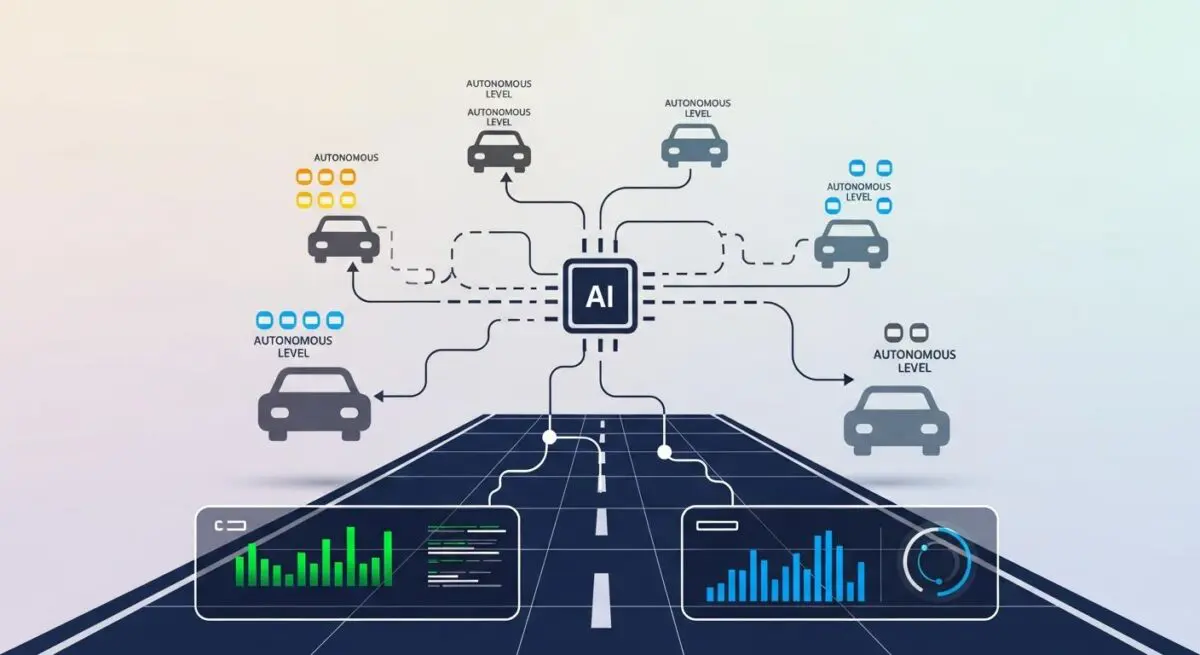
- SAE J3016 Standards: A classification system ranging from Level 0 (no automation) to Level 5 (full automation) that defines the degree of human intervention required.
- Sensor Fusion Architecture: The integration of LiDAR, Radar, and Computer Vision systems to create a high-fidelity, 360-degree environmental model for real-time decision-making.
- Edge Computing Requirements: The necessity for high-performance onboard processing to handle massive data throughput with ultra-low latency for safety-critical maneuvers.
What is Autonomous Driving?
Autonomous driving refers to the capability of a vehicle to sense its environment and navigate without human intervention. This technology relies on a complex stack of hardware and software, including computer vision, machine learning, and sensor fusion, to interpret external data in real-time.
The industry follows the SAE International J3016 standard, which categorizes automation into six distinct levels. While Level 1 and 2 involve driver assistance features, Level 4 and 5 represent high and full automation where the system manages all safety-critical functions under specific or all conditions.
From a technical perspective, autonomous driving systems operate through a continuous loop of perception, localization, path planning, and motion control. These systems utilize deep neural networks to identify objects, predict their trajectories, and execute precise mechanical commands via drive-by-wire systems.
The Real-World Analogy
Imagine a world-class symphony orchestra where every musician is an advanced sensor and the conductor is a high-performance central processing unit. The conductor does not just follow a static score; they interpret the acoustics of the hall, the timing of the performers, and the reactions of the audience in real-time.
In this scenario, the autonomous vehicle is the entire orchestra performing a complex piece without a human director. The system harmonizes disparate data points into a single, fluid movement, ensuring the performance reaches its destination without a single discordant note or error in timing.
How Autonomous Driving Drives Strategic Growth & Market Competitiveness?
Autonomous driving is a primary catalyst for the transition from traditional vehicle ownership to Mobility as a Service (MaaS). This shift allows enterprises to optimize fleet utilization rates, significantly reducing the overhead costs associated with idle assets and human labor in logistics.
In the supply chain sector, autonomous trucking addresses the global driver shortage and increases operational efficiency by removing hours-of-service limitations. This leads to a drastic reduction in Total Cost of Ownership (TCO) and improves the predictability of delivery timelines for global commerce.
Furthermore, the data generated by autonomous fleets provides unprecedented insights into urban mobility patterns and consumer behavior. Companies that control these data streams can leverage them for hyper-localized advertising, infrastructure planning, and the development of new insurance models based on precise risk assessments.
Strategic Implementation & Best Practices
- Data Pipeline Optimization: Establish robust data ingestion and labeling pipelines to train machine learning models on diverse edge cases and environmental variables.
- Redundancy Systems: Implement fail-operational hardware architectures that ensure the vehicle can reach a minimal risk condition even if a primary sensor or compute module fails.
- Cybersecurity Protocols: Secure Vehicle-to-Everything (V2X) communication channels using advanced encryption to prevent unauthorized access or malicious interference with vehicle control systems.
Common Pitfalls & Strategic Mistakes
Many organizations underestimate the complexity of the “long tail” of edge cases, focusing too heavily on highway driving while neglecting chaotic urban environments. This leads to systems that perform well in simulations but fail in unpredictable real-world scenarios.
Another frequent error is the lack of standardization in data formats across different sensor vendors, which creates integration bottlenecks. Failing to account for the evolving regulatory landscape can also result in significant sunk costs if the technology does not meet regional safety certifications.
Conclusion
Autonomous driving represents a fundamental shift in transportation logic, moving from human-centric control to data-driven algorithmic execution. Mastering this technology is essential for any organization looking to lead in the future of automated logistics and smart city infrastructure.