Key Points
- Googlebot ignores URL fragment identifiers, causing massive indexation loss for SPAs relying on legacy hash-based routing.
- Migrating to the HTML5 History API and configuring NGINX/Apache fallback routing ensures crawlers can access deep-linked content.
- Implementing Server-Side Rendering (SSR) or pre-rendering prevents crawler timeouts and builds semantic maps for AI-driven search.
Table of Contents
The Core Conflict: Hash Fragments and Crawl Waste
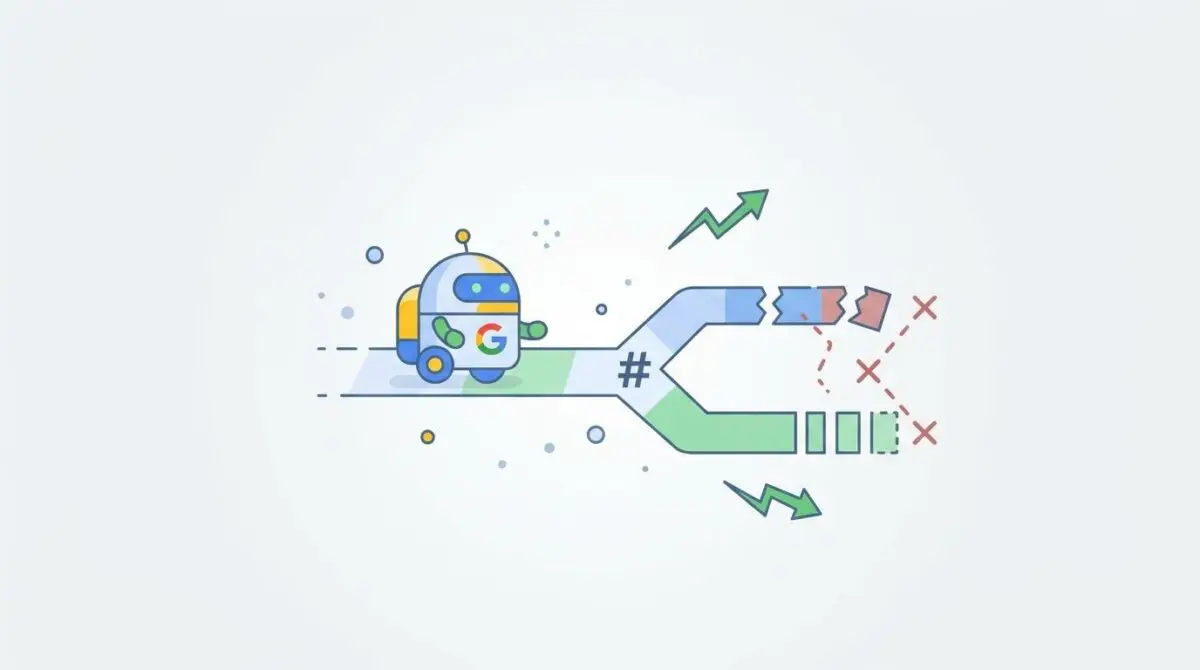
According to the HTTP Archive’s 2025 State of the Web report, SPAs that utilize hash-based routing see an average of 65% fewer indexed pages compared to those using the History API. This directly correlates to a significant drop in organic reach within AI-driven search environments. When developers build Single-Page Applications (SPAs) using legacy client-side hash routing, they inadvertently create a massive roadblock for search engine crawlers. This architecture relies on the URL fragment identifier to manage application state.
Because the hash and everything following it are processed locally by the browser, they are never sent to the server. Googlebot treats URLs like example.com/#/page as identical to the root example.com/. This causes severe crawl waste. The crawler repeatedly hits the root URL without ever discovering the deep-linked content hidden behind the hash.
In the context of modern Generative Engine Optimization, this is catastrophic. Generative AI and traditional SERPs require a highly structured semantic map of your site to attribute specific data points to correct sub-pages. Without unique, clean URLs, Googlebot fails to build this map, leaving your application’s internal pages completely invisible in Search Console.
Diagnostic Checkpoints
When diagnosing indexation failures in SPAs, the symptoms are usually clear. Your Google Search Console Pages report will show only the root URL indexed. Meanwhile, server logs will reveal repeated GET requests for the root path with zero requests for sub-paths, despite heavy internal linking.
Diagnostic Checkpoints
Legacy Hash-Mode Routing
Googlebot ignores fragment identifiers; only the base URL is indexed.
Deprecated AJAX Crawling Scheme Persistence
The _escaped_fragment_ protocol is deprecated; hashbangs no longer trigger crawls.
Lack of Server-Side Fallback Mapping
Direct requests to sub-directories return 404 errors without fallback config.
Client-Side Only Rendering (CSR) without Hydration
Crawlers timeout before JavaScript executes and populates unique page content.
This failure stems from fundamental web architecture rules. Under RFC 3986, fragment identifiers are processed exclusively by the user agent and are never passed in the HTTP request. If your application relies on this mechanism, the server is completely blind to the user’s intended destination.
Furthermore, older WordPress setups or legacy plugins often attempt to bypass this using the hashbang syntax. However, Google fully deprecated the legacy AJAX crawling scheme years ago. Relying on this deprecated protocol ensures your dynamic content remains unindexed.
The Engineering Resolution Roadmap
Resolving this issue requires a synchronized update across your client-side router and your server configuration. Transitioning away from Fragment Identifier Indexing is not optional for modern SEO. It is a mandatory architectural shift.
Engineering Resolution Roadmap
Migrate to HTML5 History API
Update the SPA router configuration (e.g., Vue Router or React Router) from ‘hash’ mode to ‘web history’ mode. This removes the # and uses standard URL paths (e.g., /about instead of /#/about).
Configure NGINX/Apache Fallback
Modify server configuration to ensure that all requests to sub-folders are served by the root index.php/index.html, allowing the JavaScript router to take over the request on the client side without throwing a 404.
Implement Server-Side Rendering (SSR) or Pre-rendering
Use a framework like Next.js or Nuxt.js, or a pre-rendering service like Prerender.io, to ensure that the initial HTML sent to Googlebot contains the full content of the page, not just an empty div.
Update Internal Linking and Sitemaps
Replace all hash-based links in the navigation and XML sitemap with the new clean URL structure. Use 301 redirects if moving from a previously established hash-based system to clean URLs.
The first step is shifting the SPA framework to use the HTML5 History API. This allows the browser to update the URL natively without triggering a full page reload. However, this client-side change will break direct traffic if the server is not configured to handle deep links.
When a user or crawler requests a clean URL directly, the server will look for a physical directory that does not exist. This results in a hard 404 error before the JavaScript application can even initialize. To prevent this, server-side fallback routing is essential.
Executing the Server Fallback
To support the History API, your web server must be instructed to route all missing file requests back to your primary index file. This hands control back to the client-side router, allowing it to parse the URL and render the appropriate component.
Fixing via NGINX Configuration
For high-performance stacks utilizing NGINX, implementing this fallback is straightforward. You must modify the location block of your server configuration to utilize the try_files directive. This ensures that valid files are served directly, while unknown paths fall back to the application shell.
location / {
    try_files $uri $uri/ /index.php?$args;
    # This NGINX directive ensures that if a user or Googlebot requests
    # /deep-link/, and that file doesn't exist, it falls back to the index,
    # allowing the JS router to handle the path correctly.
}
If you are running a Headless WordPress setup, this directive is often already present for the backend API. However, you must ensure the frontend environment serving the React or Vue application shares an equivalent fallback mechanism.
Validation Protocol & Edge Cases
Once the routing is updated and the server fallback is deployed, rigorous validation is required. You must ensure that Googlebot experiences a seamless 200 OK status when requesting deep links directly.
Validation Protocol
- Verify deep links return a 200 OK status via curl -I.
- Inspect rendered content using GSC URL Inspection Live Test.
- Confirm absence of hash-based location headers in Network tab.
- Validate JSON-LD parsing with the Google Rich Results Test.
During validation, you may encounter complex edge cases involving Content Delivery Networks. For instance, a Cloudflare Edge Worker might be configured to beautify URLs by stripping trailing slashes. This can conflict with the SPA router’s fallback logic.
This conflict often causes the router to enter an infinite loop of route not found errors. It returns a blank page to Googlebot while appearing perfectly fine for users who have the application shell already cached. Always bypass the CDN during initial cURL testing to isolate server responses.
Autonomous Monitoring & Prevention
Fixing the routing issue is only the first phase. Preventing regressions requires implementing automated SEO testing within your CI/CD pipeline. Utilizing tools like Lighthouse or custom Puppeteer scripts can automatically flag any new URLs containing a hash fragment before they hit production.
Furthermore, enterprise environments should regularly audit server logs for 404 errors on sub-directories. This ensures that the fallback routing remains functional after server updates or migrations. Using Googlebot-ready rendering monitoring is essential for maintaining visibility in 2026 standards.
At Andres SEO Expert, we engineer custom API alerts and Make.com pipelines to monitor entity integrity autonomously. By treating URL structures as critical infrastructure, you prevent minor development updates from causing catastrophic indexation drops.
Conclusion
Client-side hash routing is a relic of early SPA architecture that severely bottlenecks modern search engine discovery. By migrating to the HTML5 History API and configuring robust server fallbacks, you restore Googlebot’s ability to crawl, render, and index your deep-linked content.
Navigating the intersection of technical SEO, server architecture, and generative search requires a precise roadmap. If you need to future-proof your enterprise stack, resolve deep-level crawl anomalies, or implement AI-driven SEO automation, connect with Andres at Andres SEO Expert.
Frequently Asked Questions
Why is hash-based routing detrimental to SPA SEO?
Hash-based routing uses fragment identifiers (#) which are processed exclusively by the browser and never sent to the server. According to RFC 3986, Googlebot ignores everything after the hash, treating all deep links as the root URL, which leads to massive crawl waste and prevents internal pages from being indexed.
What is the advantage of migrating to the HTML5 History API?
The HTML5 History API allows Single-Page Applications to use standard URL paths (e.g., /about) instead of hash fragments. This transition enables search engines to crawl and index unique pages individually, which is essential for building the semantic maps required by modern AI-driven search environments.
Does Google still support the AJAX crawling scheme for hashbang URLs?
No. Google fully deprecated the legacy AJAX crawling scheme and the _escaped_fragment_ protocol years ago. Continuing to rely on hashbang syntax ensures that your dynamic content will remain unindexed in contemporary search engine results.
How do I prevent 404 errors when switching from hash to clean URLs?
To prevent 404 errors on clean URLs, you must configure a server-side fallback. For NGINX, this involves using the try_files directive to route all requests back to the index.php or index.html file, allowing the client-side JavaScript router to take control of the request.
How can I validate that my SPA deep links are crawlable?
Validation should include using a cURL command (curl -I) to verify that deep links return a 200 OK status. Additionally, use the Google Search Console URL Inspection Live Test to inspect the rendered content and confirm that Googlebot can see the unique page data.
What role does Server-Side Rendering (SSR) play in SPA indexation?
SSR frameworks like Next.js or Nuxt.js ensure that the initial HTML response sent to a crawler contains the full page content. This prevents indexation failure caused by crawlers timing out before client-side JavaScript can execute and populate the page’s unique components.