



Key Points
- Draft-First Architectures: Mitigate black-box liability by holding AI-generated solutions in a pending state until verified by domain specialists.
- Traceable Autonomy: Implement agentic governance frameworks to ensure compliance with stringent regulations like the EU AI Act.
- Shadow Supervision: Transition toward passive human-in-the-loop systems where AI autonomously refines weights by observing expert workflows.
Table of Contents
The Governance Gap
According to a 2026 strategic forecast by Gartner, AI-related legal claims are expected to exceed 2,000 cases by the end of the year. This surge is driven by insufficient human-in-the-loop risk guardrails in high-stakes sectors. This chilling statistic exposes a massive fault line in enterprise technology.
We are rapidly deploying autonomous systems without the safety nets required to catch catastrophic edge cases. The enterprise landscape is currently caught in a tug-of-war between rapid innovation and crippling liability.
AI agents are making sequential, autonomous decisions at a pace that traditional compliance frameworks simply cannot monitor. This creates a severe governance gap that threatens to derail digital transformation initiatives.
The solution lies in a fundamental restructuring of how machines and humans interact. Human-in-the-Loop (HITL) AI Quality Control and Agentic Governance have evolved far beyond simple data labeling. They now form the critical infrastructure bridging the gap between machine speed and human accountability.
Businesses are no longer just checking AI outputs after the fact. They are deploying dynamic systems where domain specialists interact with autonomous agents in real-time. This proactive dynamic prevents the black box liability that caused a massive spike in AI-related legal claims.
By integrating human oversight directly into the decision-making matrix, companies can achieve traceable autonomy. This allows highly regulated sectors like finance and healthcare to innovate aggressively while remaining fully compliant with stringent new laws.
Market Intelligence
The financial markets have already recognized that unbridled autonomy is a massive corporate liability. Institutional capital is aggressively flowing into the infrastructure of oversight, seeking to monetize the safety layers of artificial intelligence. Investors understand that the true bottleneck to enterprise AI adoption is not capability, but trust.
Market Intelligence & Data
HITL Market Valuation
The global human-in-the-loop AI market is projected to reach $6.73 billion by the end of 2026, growing at a 24.7% CAGR, according to ResearchAndMarkets.
VC Capital Concentration
Data from PitchBook reveals that AI companies captured a staggering 81% of all global venture funding in Q1 2026, totaling over $240 billion.
Productivity Surge
The 2026 PwC Global AI Jobs Barometer reports that productivity growth in AI-exposed sectors has nearly quadrupled to 27% through human-AI collaboration.
Governance Readiness
Only one in five companies possesses a mature model for governing autonomous AI agents as of mid-2026, according to research from Deloitte.
The numbers reveal a profound shift in venture capital concentration toward risk mitigation. Startups focused on AI observability triggered a massive funding surge in early 2026, signaling a new gold rush. The smart money is no longer just funding generative models; it is funding the digital leashes that control them.
The Rise of Agentic Oversight
Venture capital is now heavily concentrated on agentic governance platforms that automate the auditing of other AI agents. Recent massive valuations in the sector prove that safety and scaling are no longer mutually exclusive concepts.
This massive influx of capital underscores a fundamental market reality. Enterprises are willing to pay a premium for systems that guarantee their autonomous agents will not hallucinate their way into a catastrophic lawsuit. The financial upside of deploying safe AI far outweighs the initial infrastructure costs.
As productivity growth in AI-exposed sectors has nearly quadrupled to 27%, the economic imperative to scale these systems safely has never been higher. Yet, the friction of implementation remains palpable across legacy industries that lack the technical agility to adapt.
Strategic Deep Dive
The primary friction point today is the inability of legacy enterprise architecture to handle sequential agentic workflows. Traditional compliance was built for static software, not dynamic, self-prompting intelligence. This architectural mismatch creates a vulnerability that regulators are eager to exploit.
Recent industry surveys show that while most organizations use AI, their trust maturity scores remain dangerously low. This signals that human oversight structures are failing to keep pace with rapid agentic deployment. Executives are realizing that deploying AI without governance is akin to driving a sports car without brakes.
This profound trust deficit is precisely why only one in five companies possesses a mature model for governing autonomous AI agents. To survive this regulatory tightening, enterprises must implement robust, traceable autonomy across their entire tech stack.
Draft-First Architectures
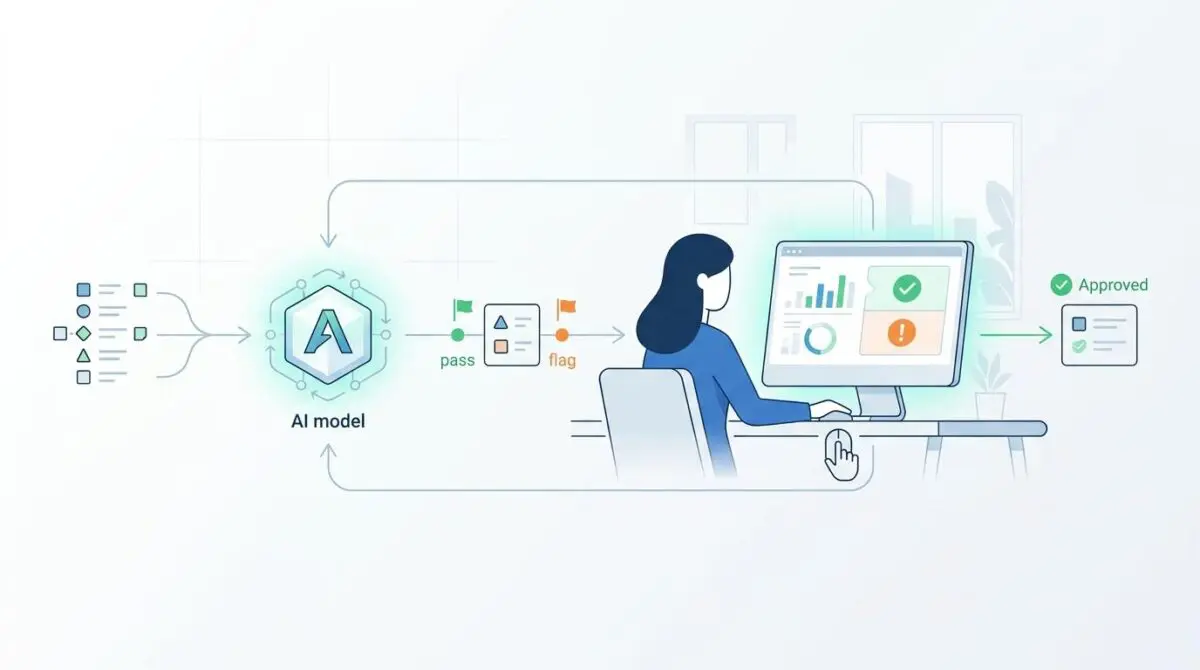
The killer strategy today is the implementation of draft-first architectures. In this model, AI generates high-stakes solutions that remain in a pending state until a human provides a cryptographic verification token. This creates a mandatory pause between machine ideation and real-world execution.
This workflow effectively creates a cognitive feedback loop. Domain specialists, such as doctors, lawyers, and structural engineers, become expert-in-the-loop validators rather than primary creators. Their expertise is leveraged to approve, reject, or refine the AI’s logic before it impacts the business.
By enforcing these strict checkpoints, enterprises can deploy agents that comply with strictly enforced global regulations. It ensures that every autonomous decision leaves an immutable, legally defensible audit trail that can be reviewed during regulatory audits.
Model Safety Guardrails
Pioneers in the space have successfully pivoted away from basic data annotation. They have transformed into sophisticated model safety guardrail platforms, dominating the enterprise oversight market. Their new platforms provide the exact tooling necessary to monitor agentic behavior at scale.
The focus has shifted from teaching AI to perform tasks, to teaching AI to recognize its own uncertainty. When an agent encounters an anomaly or low-confidence scenario, it must know exactly when to escalate the decision to a human supervisor. This self-awareness protocol is critical for high-stakes deployments.
This escalation dynamic is the cornerstone of modern agentic governance. It ensures that human intelligence is applied only where it is most valuable, optimizing both safety and operational efficiency without bottlenecking the system. It is the perfect symbiosis of human intuition and machine scale.
The Psychology of Traceable Autonomy
Beyond the technical implementation, there is a deep psychological shift required to master traceable autonomy. Employees must transition from viewing AI as a tool to viewing it as a junior colleague that requires mentorship and supervision. This mindset shift is often the hardest part of the digital transformation journey.
When users understand that the AI is operating within strict model safety guardrails, their adoption rate skyrockets. The fear of being replaced is mitigated by the reality that their role is being elevated to a supervisory capacity. They are no longer doing the heavy lifting; they are directing the intelligence.
This psychological safety translates directly into operational velocity. Teams that trust their agentic governance frameworks are far more likely to experiment, innovate, and push the boundaries of what their multi-agent networks can achieve.
The Executive Action Plan
The next evolution of oversight is passive HITL, commonly referred to as shadow supervision. Instead of active manual review, future systems will seamlessly observe human experts in their natural workflows to refine internal weights autonomously. This removes the friction of manual verification while maintaining the integrity of human expertise.
Strategic Trajectory
- Pivot from active manual review to ‘Passive HITL’ and ‘Shadow Supervision’ architectures.
- Integrate AI systems that refine internal weights by autonomously observing human experts in natural workflows.
- Redefine the human role from ‘Editor’ to ‘Supreme Court Justice’ for high-level oversight.
- Establish ‘Arbitration Alerts’ to focus human intervention strictly on the top 1% of edge-case probabilities.
- Architect multi-agent networks capable of autonomous scaling with human-level governance as the final arbiter.
By the end of the decade, the role of the human will fundamentally shift across the corporate landscape. We are moving away from the role of the editor, who meticulously reviews every output, to the role of a Supreme Court Justice. The human element will be reserved exclusively for the most complex, high-stakes moral and strategic dilemmas.
Humans will only intervene in the top 1% of edge-case probabilities that trigger arbitration alerts across multi-agent networks. This allows the AI to handle the volume while humans handle the nuance, creating an incredibly efficient operational paradigm.
Executives must architect these multi-agent networks today to ensure their organizations can scale autonomously over the next decade. The final arbiter of truth must remain human, but the execution layer must be entirely machine-driven. Delaying this architectural pivot is a recipe for obsolescence.
Conclusion
The era of unchecked AI experimentation is officially over. The future belongs to organizations that can seamlessly integrate human wisdom with machine velocity through rigorous agentic governance. Trust is the new currency in the artificial intelligence economy.
Implementing robust human-in-the-loop workflows is no longer just a regulatory requirement to avoid massive fines. It is a profound competitive advantage that will dictate market leadership over the next decade. Companies that master this balance will scale infinitely, while those that ignore it will collapse under the weight of their own liability.
Navigating the intersection of technology, capital, and market psychology requires a sharp strategy. To future-proof your business architecture and scale with precision, connect with Andres at Andres SEO Expert.
Frequently Asked Questions
What is the governance gap in enterprise AI deployment?
The governance gap refers to the lack of sufficient human-in-the-loop risk guardrails for autonomous systems. Without these safety nets, enterprises face massive liability risks, with legal claims predicted to exceed 2,000 cases by the end of 2026 due to unmonitored agentic decisions.
How does Human-in-the-Loop (HITL) reduce AI liability?
HITL integrates domain specialists directly into the AI decision-making matrix. This ensures traceable autonomy, allowing experts to validate AI outputs in real-time. This proactive oversight prevents black box liability and ensures compliance in highly regulated sectors like finance and healthcare.
What is a draft-first architecture in agentic governance?
A draft-first architecture is a strategy where AI-generated solutions remain in a pending state until a human provides a cryptographic verification token. This creates a mandatory cognitive feedback loop, ensuring that machines propose while human experts approve, reject, or refine high-stakes logic.
Why is venture capital focusing on agentic oversight platforms?
Institutional investors recognize that trust is the primary bottleneck for enterprise AI adoption. In early 2026, AI companies captured 81% of global venture funding, with the majority of capital flowing into infrastructure for observability, safety guardrails, and the digital leashes that control autonomous models.
What is the difference between active and passive HITL?
Active HITL involves manual verification and editing of AI outputs. Passive HITL, or shadow supervision, involves AI systems observing human experts in their natural workflows to refine internal weights autonomously, removing operational friction while maintaining human-level integrity.
How does AI governance impact productivity?
According to the 2026 PwC Global AI Jobs Barometer, productivity growth in AI-exposed sectors has nearly quadrupled to 27% through human-AI collaboration. Governance frameworks enable this by elevating employees from primary creators to supervisory roles, allowing for safer, faster scaling.