Executive Summary
- Semantic caching utilizes vector embeddings to identify and serve cached responses for semantically similar queries, bypassing redundant LLM inference.
- It significantly reduces operational costs and latency in Retrieval-Augmented Generation (RAG) pipelines by establishing similarity thresholds.
- For GEO, semantic caching dictates how AI engines maintain consistency across diverse but related user prompts, impacting brand visibility.
What is Semantic Caching?
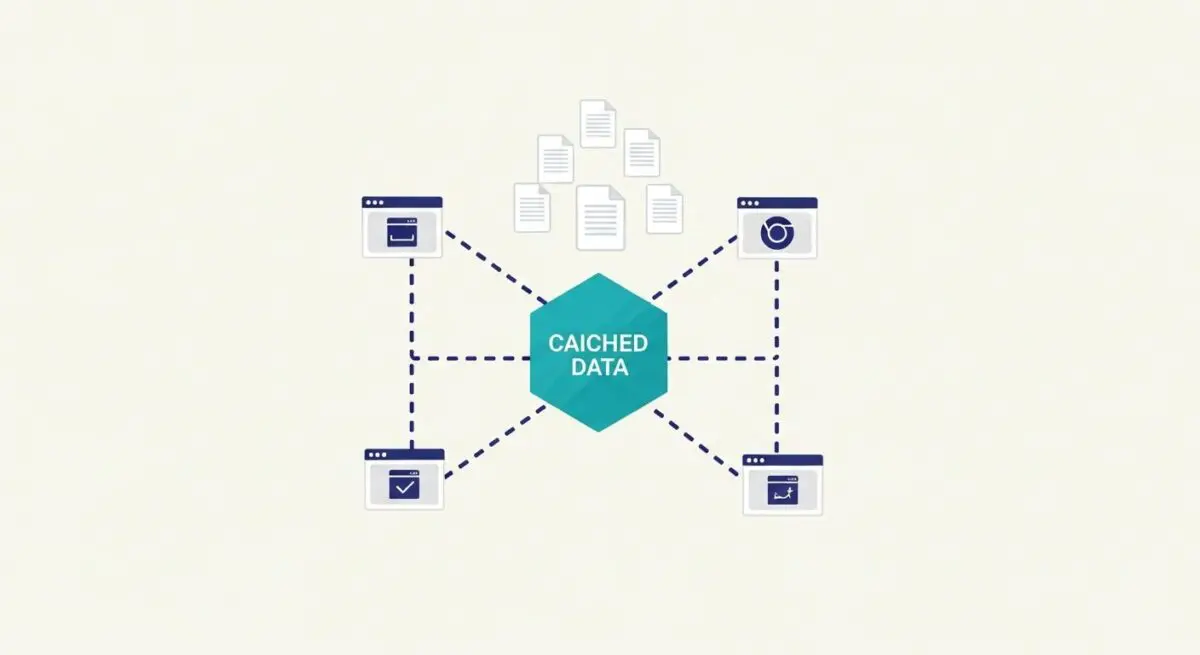
Semantic caching is an advanced computational technique used in Large Language Model (LLM) architectures to store and retrieve previously generated responses based on the semantic similarity of queries rather than exact string matching. Unlike traditional caching mechanisms (e.g., Redis or Memcached) that require a 1:1 character match to return a result, semantic caching transforms incoming natural language queries into high-dimensional vector embeddings. These embeddings are then compared against a database of previously cached queries using distance metrics such as cosine similarity or Euclidean distance.
When a new query is processed, the system calculates its proximity to existing vectors in the cache. If the similarity score exceeds a predefined threshold, the system serves the cached response immediately. This process bypasses the need for expensive and time-consuming inference from the LLM, effectively decoupling the response time from the complexity of the model. This is a critical component in Retrieval-Augmented Generation (RAG) systems where reducing latency and API token consumption is a primary architectural goal.
The Real-World Analogy
Imagine a highly experienced concierge at a luxury hotel. If a guest asks, “Where is the nearest place to get a coffee?”, the concierge provides a specific recommendation. Ten minutes later, another guest asks, “Is there a cafe nearby?” A traditional worker might treat this as a brand-new request and look through a directory again. However, a semantic concierge recognizes that both guests are asking for the same thing despite using different words. Instead of re-searching, the concierge immediately provides the same high-quality answer they just gave, saving time for both the staff and the guest.
Why is Semantic Caching Important for GEO and LLMs?
In the context of Generative Engine Optimization (GEO), semantic caching plays a pivotal role in how brand information is disseminated. Because AI engines like Perplexity, ChatGPT, and Gemini often cache responses to frequent queries to save on compute costs, the first high-quality answer generated for a specific topic often becomes the “sticky” response for a wide range of semantically related prompts. If your brand is cited in that initial cached response, you gain a significant advantage in AI Visibility across thousands of variations of that query.
Furthermore, semantic caching impacts Entity Authority. If an LLM consistently serves a cached response that identifies a specific brand as the leader in a category, that association is reinforced within the vector space of the cache. For AI Search professionals, understanding the similarity thresholds used by these engines is essential for ensuring that content is optimized to trigger these cached, authoritative responses, thereby maintaining a consistent presence in AI-generated summaries.
Best Practices & Implementation
- Define Precise Similarity Thresholds: Implement a similarity score (typically between 0.85 and 0.95) that balances the speed of caching with the accuracy of the response to prevent “semantic drift” or irrelevant answers.
- Utilize Robust Embedding Models: Use high-performance embedding models (e.g., OpenAI’s text-embedding-3-small or HuggingFace equivalents) to ensure that the vector representations of queries accurately capture intent.
- Implement Cache Invalidation Strategies: Establish a TTL (Time-to-Live) or an event-driven invalidation logic to ensure that cached responses do not become stale, especially for dynamic industries where data changes frequently.
- Monitor for Semantic Overlap: Regularly audit cache hits to identify which query clusters are most frequent, allowing for targeted optimization of the content that feeds those specific responses.
Common Mistakes to Avoid
One frequent error is setting the similarity threshold too low, which leads to the system serving answers that are contextually incorrect or outdated for the user’s specific intent. Another mistake is ignoring metadata; semantic caching should often be partitioned by user context, location, or permission levels to avoid serving sensitive or localized information to the wrong user. Finally, many developers fail to align embedding models between the cache and the RAG system, leading to vector mismatches and failed cache hits.
Conclusion
Semantic caching is a fundamental optimization layer that bridges the gap between LLM performance and cost-efficiency. For AI Search and GEO, it represents a critical frontier in ensuring brand consistency and visibility within the automated retrieval cycles of generative engines.