Executive Summary
- SABs must configure Google Business Profiles to hide physical addresses while defining specific service boundaries to maintain TOS compliance.
- Proximity ranking for SABs relies on the hidden verified address and the areaServed attribute within structured data.
- Effective SEO for SABs requires a hybrid approach of localized landing pages and geo-specific Schema.org markup.
What is Service Area Business (SAB)?
A Service Area Business (SAB) is a commercial entity that provides services directly to customers at their residential or business locations rather than serving them at a fixed physical storefront. In the context of Local SEO and the Google Business Profile (GBP) ecosystem, an SAB is defined by its operational model where the business address is often a private residence or a non-public office. To comply with search engine guidelines, these businesses must suppress their physical address from public view while defining specific geographic boundaries where they operate.
Technically, an SAB is distinguished from “Hybrid” businesses, which both serve customers at a physical location and deliver services. For a pure SAB, the primary ranking signals are derived from the verified (but hidden) physical location and the explicitly defined service areas, which can be specified by city names, postal codes, or administrative regions. This distinction is critical for maintaining visibility in the Local Pack without violating anti-spam policies regarding residential addresses.
The Real-World Analogy
Consider a traditional restaurant versus a high-end catering service. The restaurant is a brick-and-mortar establishment where the customer must travel to the product. The catering service is a Service Area Business; the “kitchen” (the business infrastructure) exists in one place, but the “dining experience” (the service delivery) happens exclusively at the client’s venue. Just as the caterer needs to tell potential clients which neighborhoods they are willing to drive to, an SAB must communicate its service boundaries to search engines to ensure they are matched with local demand.
Why is Service Area Business (SAB) Important for SEO?
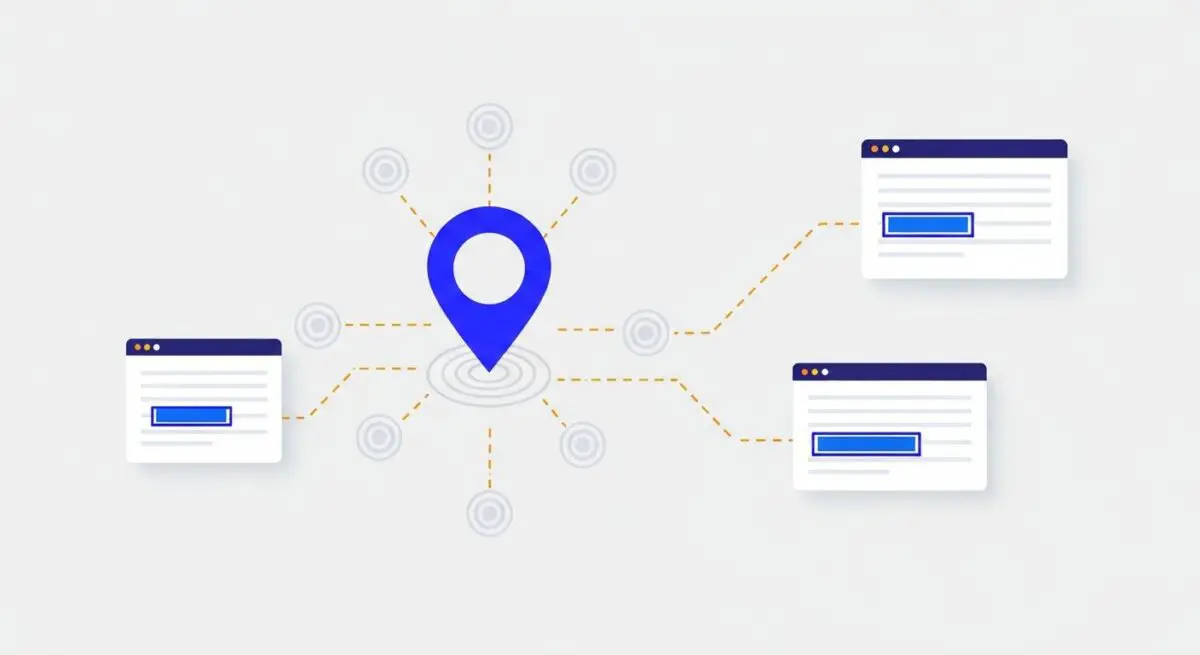
SABs face unique challenges in Local SEO because they lack the “permanence” signal of a public storefront, which search engines traditionally use to verify local relevance. Proximity remains a dominant ranking factor in the Local Map Pack. For an SAB, Google calculates the distance between the searcher and the business’s hidden verified address. If the service area is not correctly configured, the business may fail to appear for “near me” queries or localized searches within its actual operational zone.
Furthermore, the absence of a public address complicates the acquisition of local citations and backlink profiles. Search engines rely on NAP (Name, Address, Phone) consistency to build trust. For an SAB, technical SEO must bridge this gap by using structured data to explicitly define the areaServed property, ensuring that the business’s geographic relevance is programmatically clear to crawlers even in the absence of a public map pin.
Best Practices & Implementation
- GBP Address Suppression: Ensure the “Show business address to customers” toggle is disabled in the Google Business Profile settings to prevent suspension for residential-based operations.
- Granular Service Area Definition: Define service areas using specific zip codes or city names rather than a broad radius, as this provides more precise signals to the local search algorithm.
- LocalBusiness Schema: Implement LocalBusiness or specific Service schema on the website, utilizing the areaServed property to list all covered jurisdictions.
- Localized Service Pages: Develop individual landing pages for primary service cities, featuring unique content, local testimonials, and geo-specific metadata to capture long-tail local search traffic.
Common Mistakes to Avoid
One frequent error is the use of Virtual Offices or P.O. Boxes to establish a physical presence in a city where the business does not have a verified physical footprint; this is a direct violation of Google’s terms and often leads to permanent profile suspension. Another mistake is setting an excessively large service radius (e.g., over 2 hours of driving time), which dilutes local relevance and can trigger algorithmic filters for being unrealistic. Finally, many SABs fail to maintain NAP consistency across third-party directories, often omitting the address entirely on citations, which weakens the business’s foundational trust signals.
Conclusion
Optimizing a Service Area Business requires a precise balance of privacy compliance and aggressive geographic signaling to achieve high visibility in local search results.