Key Takeaways
- Naive attention out-of-place masked_fill adds a hidden Memcpy kernel; in-place removal yields instant speedup.
- PyTorch’s SDPA math backend is 3.7x slower with 20 kernels due to FP32 upcast and mask rebuild per call.
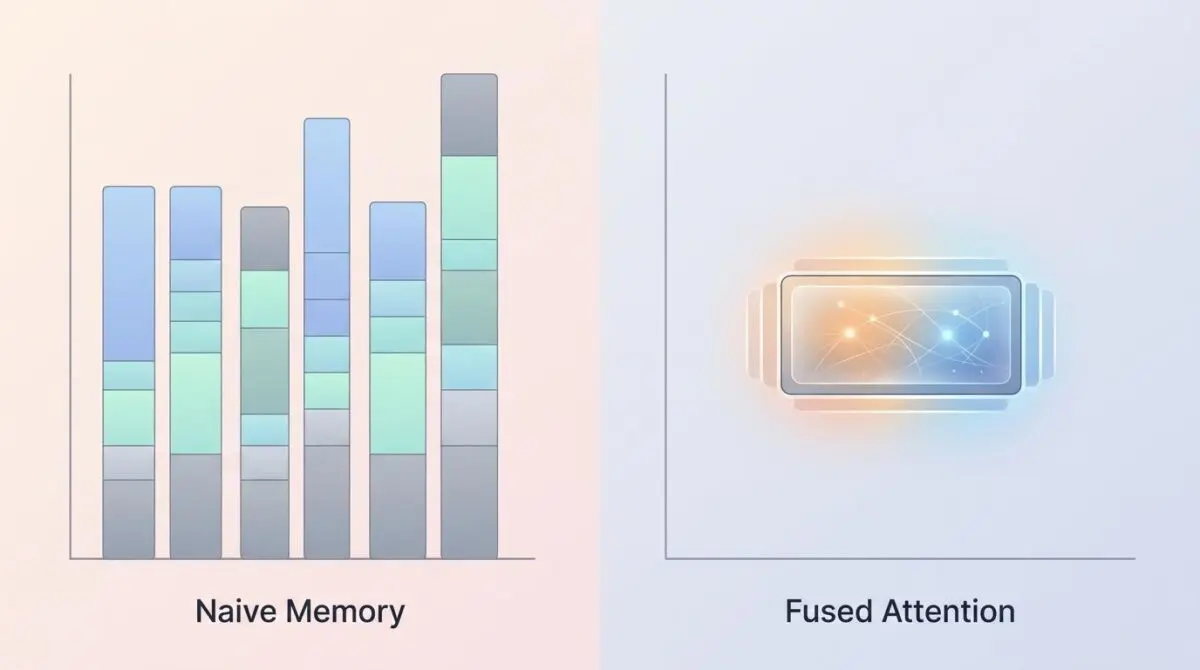
- FlashAttention fuses all attention ops into one kernel, stays in bf16, and its low occupancy (13%) is deliberate for on-chip reuse.
- cuDNN generates per-problem kernels with zero transposes but incurs higher CPU overhead from runtime tuning.
- The critical profiling habit: guess first, then look for mismatches — every mismatch is an insight.
Table of Contents
The Profiling Revelation: Attention Under the Microscope
A new deep-dive profiling series from Hugging Face reveals that PyTorch’s attention implementations hide dramatic performance differences. The naive attention you wrote by hand might be faster than PyTorch’s own math backend? Yes, and the reasons will change how you approach GPU optimization.
Published on July 10, 2026, on the Huging Face blog, an article by Aritra Roy Gosthipaty and team profiles five attention variants: naive, naive in-place, SDPA math, efficient (xformers), flash, and cuDNN. Each variant reveals a distinct fingerprint under the profiler — and the most optimized one looks the most ‘wrong’ on paper. For AI practitioners, this is a masterclass in reading beyond surface metrics.
Dissecting Each Backend: From Naive to Fused
Naive Attention: The Hidden Memcpy
The naive implementation uses five primitives: matmul, mul, masked_fill, softmax, matmul. Profiling the out-of-place masked_fill reveals an unexpected Memcpy kernel — PyTorch copies the tensor before applying the mask. Replacing it with masked_fill_ (in-place) eliminates the Memcpy, yielding a one-line speedup that compounds across layers.
SDPA Math Backend: 20 Kernels and 3.7x Slower
Simply calling F.scaled_dot_product_attention with the math backend launches 20 GPU kernels per forward, compared to 5 for the naive version. Why? It upcasts bf16 inputs to FP32, runs on CUDA cores instead of Tensor Cores, rebuilds the causal mask from scratch each call, and uses a safe softmax to avoid NaNs. The math backend is a reference implementation: correct but painfully slow.
Efficient and Flash: Fused Kernels, Deliberate Trade-offs
The efficient backend (xformers) collapses attention into a single fmha_cutlassF kernel. FlashAttention-2 goes further with its pytorch_flash kernel. Both fuse all operations, stay in bf16 on Tensor Cores, and never materialize the full attention matrix. Yet the profiler reports only 13% occupancy for flash — a figure that alarms newcomers but is intentional. Flash uses heavy per-block registers and shared memory to keep tiles on-chip, avoiding HBM traffic. Low occupancy does not mean poor performance; it means each block maximizes data reuse.
cuDNN: Generated Kernels, Zero Transposes, But CPU Cost
cuDNN’s backend generates a kernel tailored to the exact problem shape, avoiding the transposes that flash and efficient require. The kernel name cudnn_generated_fort_native_sdpa_sm80_flash_fprop_wmma_f16 signals a dynamic, per-problem binary. However, the runtime tuning adds CPU overhead (214 µs per call vs. flash’s 138 µs). On the GPU, cuDNN performs competitively but currently trails flash on the profiled shape. The key insight: a cleaner trace does not always mean less work — work can move to opaque library calls.
Strategic Implications: What This Means for AI Engineering
The profiling data carries critical lessons for production AI systems. As noted in a recent hyper.ai analysis, ‘Flash drastically reduces data movement, which typically dominates attention latency.’ This explains why flash’s low GPU occupancy yields high throughput — the bottleneck is memory bandwidth, not compute.
An empirical study on arxiv confirms that for attention-heavy models, FlashAttention backend latency is dominated by cuBLAS calls, not the fused kernel itself. Meanwhile, NVIDIA’s GTC25 session (June 2026) highlighted that cuDNN ‘remains a core library for PyTorch, flash attention variants — cuDNN is powering them all, with a 1.5 to 2x speedup compared to PyTorch’s default.’ This underscores the importance of choosing the right backend per workload: flash for long sequences, cuDNN for diverse shapes, math only for debugging.
The broader takeaway for AI engineers: profiling must drive optimization decisions. The habit of ‘guess first, then look’ — as the original authors emphasize — turns every mismatch into an opportunity. Whether you are training LLMs, diffusion models, or transformers, these micro-optimizations accumulate into significant cost savings.
Final Verdict: Adopt the Profiling Habit
The Hugging Face series demonstrates that attention is not a monolithic operation. Each backend makes different trade-offs between numerical stability, memory traffic, and GPU utilization. The fastest backend looks ‘wrong’ under the profiler, and that mismatch is precisely what makes it correct. As the authors conclude: ‘Profiling is just the discipline of looking closely and asking why until the answer clicks.’
Staying ahead in the rapidly shifting landscape of AI requires precision. To future-proof your digital strategy and scale effortlessly, you need a foundation built on precision. Optimize your site with advanced speed engineering, secure your infrastructure in high-performance hosting environments, and streamline your entire workflow through autonomous AI pipelines. Connect with Andres at Andres SEO Expert to build your ultimate architecture.
Frequently Asked Questions
Why is naive attention sometimes faster than PyTorch’s math backend?
The naive attention implementation uses only 5 GPU kernels per forward pass, while the SDPA math backend launches 20 kernels. The math backend upcasts bf16 to FP32, runs on CUDA cores instead of Tensor Cores, rebuilds the causal mask each call, and uses a safe softmax, making it 3.7x slower despite being a reference implementation.
What is the hidden memcpy in naive attention and how to avoid it?
In the naive attention implementation, the masked_fill operation (out-of-place) causes an unexpected Memcpy kernel because PyTorch copies the tensor before applying the mask. Replacing it with masked_fill_ (in-place) eliminates the Memcpy, yielding a one-line speedup that compounds across layers.
Why does SDPA math backend launch 20 kernels per forward pass?
The SDPA math backend launches multiple kernels because it performs separate operations: upcasting bf16 inputs to FP32, using CUDA cores instead of Tensor Cores, rebuilding the causal mask from scratch each call, and applying a safe softmax to avoid NaNs. This contrasts with fused variants that combine all steps into one kernel.
Why does FlashAttention have low GPU occupancy but still high performance?
FlashAttention uses heavy per-block registers and shared memory to keep data tiles on-chip, avoiding HBM traffic. Low occupancy is intentional: each block maximizes data reuse, and the bottleneck is memory bandwidth, not compute. The profiler’s occupancy metric can be misleading; flash achieves high throughput despite low occupancy.
What are the trade-offs between FlashAttention and cuDNN backends?
FlashAttention fuses all operations into a single kernel and avoids materializing the full attention matrix, excelling for long sequences. cuDNN generates a kernel tailored to the exact problem shape, avoiding transposes, but incurs CPU overhead for runtime tuning (214 µs vs. flash’s 138 µs). On the GPU, cuDNN is competitive but currently trails flash on profiled shapes. The choice depends on workload: flash for long sequences, cuDNN for diverse shapes.
How should AI engineers choose the right attention backend?
Choose the backend based on workload: FlashAttention for long sequences, cuDNN for diverse shapes, and the math backend only for debugging. Profiling must drive optimization decisions; the fastest backend may look ‘wrong’ under the profiler. Adopt the habit of profiling and asking why until the answer clicks, as micro-optimizations accumulate into significant cost savings.