Key Points
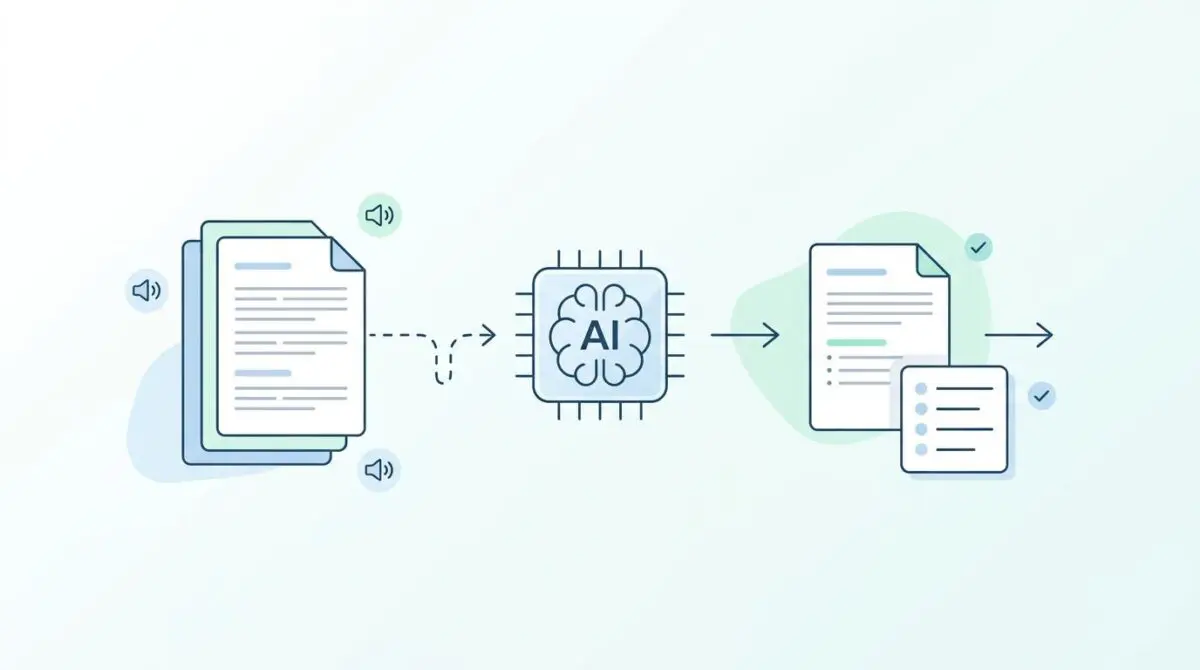
- Eradicating the Administrative Tax: AI-driven task extraction reclaims up to 4 hours weekly by eliminating information decay and automating follow-up workflows.
- Rise of Agentic Execution: The shift to reasoning-first architectures enables AI to directly update CRMs and ERPs, pushing task completion rates to an unprecedented 95%.
- Scaling Executive Presence: Deploying ‘Shadow Attendee’ digital twins via RAG allows founders to maintain decision-making authority across global time zones without physical attendance.
Table of Contents
The Core Friction: Eradicating the Administrative Tax
According to a May 2026 report by Laxis, 75% of professionals now use an AI note-taker in their work meetings. This marks the transition of automated synthesis from a competitive advantage to a baseline enterprise requirement. The modern enterprise is drowning in a sea of unstructured verbal data.
Leadership teams are spending more time discussing work than actually executing it. The average knowledge worker spends 15.5 hours weekly in meetings, paying a massive administrative tax that drains cognitive bandwidth. This friction slows down operational velocity and creates a disconnect between strategic planning and ground-level execution.
The true cost of this inefficiency is hidden in lost momentum. Autonomous Meeting Intelligence and Agentic Task Extraction are no longer futuristic concepts. They are the definitive antidotes to this friction.
We are witnessing a seismic shift from passive transcription to proactive, agentic execution. By addressing the information decay problem, this technology ensures absolute retention of organizational memory. Without documentation, 60% of critical meeting decisions evaporate within 24 hours.
Corporate memory is suddenly being treated as a highly liquid asset class. When verbal commitments are instantly digitized, the entire organization moves faster. This technology reduces follow-up administrative lag by an average of 50%.
It frees up human capital to focus on high-leverage, creative problem-solving rather than mundane data entry. The era of the human scribe is officially over.
Market Intelligence & Smart Capital Flow
Market Intelligence & Data
Market Valuation
Precedence Research identifies the global AI meeting assistant market hitting this milestone in 2026 as organizations prioritize generative automation over simple transcription.
Weekly Time Recovery
According to 2026 Laxis survey data, 62% of professionals reclaim this amount of time each week through automated synthesis and autonomous follow-up generation.
Meeting Duration Drop
Organizations implementing AI transcription report this average reduction in meeting length due to less information redundancy, according to Sonix’s 2026 adoption study.
Agentic Integration
Data from index.dev reveals that 40% of all enterprise software applications will include task-specific AI agents by the end of 2026, up from less than 5% in 2025.
Smart capital is rapidly repositioning to capitalize on the automation of corporate memory. The hyperscalers are battling for dominance, but the real disruptive innovation is happening at the infrastructure level. Investors are looking past simple transcription and betting heavily on autonomous workflows.
This data reveals a critical inflection point in enterprise software architecture. The global AI meeting assistant market is experiencing hyper-growth because organizations are prioritizing generative automation over simple transcription. The smart money is chasing solutions that actually execute tasks.
Dominance is currently shared by Microsoft Copilot 3.0 and Zoom AI Companion 2.0. However, institutional capital is surging into specialized startups like Laxis and Fireflies.ai. These agile disruptors are outmaneuvering the legacy giants by offering highly customized, secure environments.
The Rise of Private AI Factories
These specialized solutions cater to the 15% of enterprises that, according to Forrester, are moving toward on-premises meeting intelligence. The goal is to prevent corporate data from being used in hyperscaler model training. Data sovereignty has become a board-level mandate.
These private AI factories offer a closed-loop system where proprietary conversations remain strictly internal. Venture activity in Q1 2026 prioritized action-oriented LLMs capable of executing tasks across disparate software stacks. The market is demanding agents that can act, not just listen.
Founders are recognizing that relying on public clouds for sensitive strategic discussions is a massive liability. By deploying localized intelligence, companies protect their intellectual property while still reaping the benefits of automated synthesis. It is the perfect balance of security and scale.
The Strategic Deep Dive: Infrastructure & Psychology
By mid-2026, meeting intelligence has shifted dramatically toward reasoning-first architectures. This is not just a technological upgrade; it is a fundamental rewiring of how teams collaborate. The AI is now expected to understand context, nuance, and operational intent.
Leading enterprises now deploy agenda-guarding AI that proactively nudges participants when discussions deviate from pre-set objectives. This represents a profound psychological shift in the modern workplace. The AI acts as an impartial referee, keeping human conversations ruthlessly focused on ROI.
This dynamic eliminates the social friction of interrupting a rambling colleague. The digital assistant handles the enforcement of meeting discipline, allowing human participants to maintain positive interpersonal relationships. It is a brilliant intersection of machine logic and human psychology.
Reasoning-First Architectures
The current killer strategy involves real-time integration with CRM and ERP systems. The AI doesn’t just recap the meeting; it fundamentally alters the company’s operational database in real-time. This is where the true disruptive power of agentic task extraction lies.
During a sales call, the AI automatically updates lead statuses in Salesforce based on verbal commitments. Simultaneously, it triggers procurement workflows in SAP if a vendor agreement is reached verbally. The gap between a spoken decision and a digital action has been reduced to zero milliseconds.
To understand the velocity of this shift, one only needs to look at the May 2026 report by Laxis, which highlights how localized AI models are outperforming generalized cloud solutions in specific task extraction. The precision of these models is transforming enterprise resource planning.
Closing the Execution Gap
A 2026 performance analysis from Laxis reveals that action-item completion rates have reached an unprecedented 95% for teams using AI-driven task extraction. This nearly doubles the 50% baseline observed in manual tracking environments just three years ago. This metric alone justifies the capital expenditure.
When an AI agent assigns a task, sets a deadline, and automatically follows up via Slack, human accountability skyrockets. The cognitive load of remembering what was promised is entirely offloaded to the machine. Employees can finally focus on doing the work instead of managing the work.
This level of automation creates a culture of hyper-execution. Excuses regarding lost notes or forgotten emails are eliminated by the immutable ledger of the AI transcript. The organization becomes a finely tuned, highly accountable execution engine.
The Executive Action Plan: Scaling the Shadow Attendee
The next logical evolution for Founders and CEOs is the shadow attendee. These are autonomous digital twins that represent executives in routine meetings. It is the ultimate hack for scaling leadership presence.
Strategic Trajectory
- Deploy ‘Shadow Attendee’ autonomous digital twins to represent founders and CEOs in routine sessions.
- Integrate Retrieval-Augmented Generation (RAG) to enable agents to respond with authentic executive voice and authority.
- Scale decision-making presence across multiple global time zones without requiring physical executive attendance.
- Leverage autonomous synthesis to transform leadership from meeting participants to oversight directors.
These agents utilize Retrieval-Augmented Generation (RAG) to answer queries in the executive’s exact voice and authority level. By ingesting years of past emails, transcripts, and strategic documents, the AI perfectly mimics the founder’s decision-making framework. It is leadership cloned as code.
This architecture allows leadership to scale decision-making presence across multiple global time zones without physical attendance. A CEO in New York can simultaneously attend a supply chain meeting in Tokyo and a marketing sync in London. The constraints of human biology and linear time are effectively bypassed.
Executives must aggressively pivot their operational models to integrate these shadow attendees. The goal is to transform the C-suite from exhausted meeting participants into high-level oversight directors. You are no longer managing people; you are managing the agents that manage the workflows.
Conclusion: The Future of Executive Oversight
The era of manual meeting synthesis is officially dead. Autonomous meeting intelligence is the new operational baseline for any enterprise serious about scaling its output without linearly scaling its headcount. The market will mercilessly punish those who cling to analog management styles.
Those who adopt agentic task extraction will operate at a velocity that renders their competitors obsolete. The transition from passive transcription to proactive workflow execution is the most asymmetric bet a founder can make today. It is time to weaponize your corporate memory.
Navigating the intersection of technology, capital, and market psychology requires a sharp strategy. To future-proof your business architecture and scale with precision, connect with Andres at Andres SEO Expert.
Frequently Asked Questions
What is the projected market valuation for AI meeting assistants by 2026?
According to Precedence Research, the global AI meeting assistant market is expected to reach $1.42 billion by 2026, driven by an enterprise-wide shift toward generative automation and agentic execution over simple transcription.
How much time can professionals recover using AI meeting intelligence?
Data from 2026 surveys indicates that 62% of professionals reclaim an average of 4 hours per week through automated synthesis and autonomous follow-up generation, effectively reducing the administrative tax on cognitive bandwidth.
What are the primary benefits of agentic task extraction for enterprise teams?
Agentic task extraction increases action-item completion rates to 95% and reduces follow-up administrative lag by 50%. It achieves this by automatically updating CRM and ERP systems like Salesforce and SAP based on verbal commitments made during meetings.
What is an AI ‘shadow attendee’ and how does it function?
A shadow attendee is an autonomous digital twin that represents an executive in routine meetings. Using Retrieval-Augmented Generation (RAG) and past communication data, it can answer queries in the executive’s voice and apply their specific decision-making framework.
Why are some enterprises shifting toward private AI factories for meeting data?
Enterprises are adopting private AI factories to maintain data sovereignty. By using on-premises meeting intelligence, organizations prevent proprietary strategic discussions from being used to train public hyperscaler models.
How does reasoning-first AI architecture improve meeting productivity?
Reasoning-first AI acts as an impartial referee by providing agenda-guarding nudges. This technology monitors discussions in real-time and intervenes when a meeting deviates from pre-set objectives, reducing social friction and ensuring a focus on ROI.