Key Takeaways
- Async APIs decouple producers and consumers, eliminating the request-response bottleneck for modern automation.
- Channel-oriented protocols like AMQP, Kafka, MQTT, and WebSockets enable scalable, event-driven integrations.
- Event-driven architectures can process over 150,000 events per second with sub-100ms latency.
Table of Contents
The Request-Response Bottleneck Is Now an Automation Problem
Most API integrations still assume a caller waits for a reply.
That assumption collapses when a payment job, fulfillment chain, or IoT stream outlives a single HTTP connection.
n8n’s engineering team published a technical breakdown today that explains why asynchronous APIs are the structural fix for event-driven automation.
An async API, as n8n’s technical breakdown explains, lets the sender dispatch a message and move on.
Neither side needs to be online at the same time.
The result is fewer frozen front ends and far less coupling between services that scale independently.
The operational shift is bigger than avoiding timeouts.
It changes how automation platforms receive, route, and act on events.
Channel-Oriented APIs Are Rewiring the Integration Stack
REST is endpoint-oriented and synchronous by default.
A client calls a specific URL resource, and the connection stays open until the server returns a final response.
Async API is channel-oriented instead.
Producers publish messages to a channel, and consumers subscribe on their own schedule.
That decoupling is why async architectures fit microservices that need to share data without creating hard dependencies.
The AsyncAPI specification gives teams a machine-readable way to document these systems.
A single YAML or JSON file defines the spec version, server connections, channels, and operations.
From that document, teams can generate documentation, validate payloads, and generate code.
The protocol layer varies by use case.
- AMQP: Message brokers
- Kafka: High-throughput event streams
- MQTT: Lightweight pub/sub and IoT
- WebSockets: Bidirectional real-time communication
The protocol determines how data is routed, buffered, and delivered safely between microservices.
Not every operation should be asynchronous.
Password checks and access decisions need an instant response.
Async wins when a transaction depends on warehouse lookups, label generation, or multiple external systems that can outlast a typical request window.
It also wins when one event must fan out to multiple consumers.
The Consumer Workflow Without Custom Services
After an event is published, a consumer still has to review it.
The payload must be transformed, routed, and pushed into downstream actions.
Most teams build a separate consumer service for every async source.
n8n replaces that with a visual workflow.
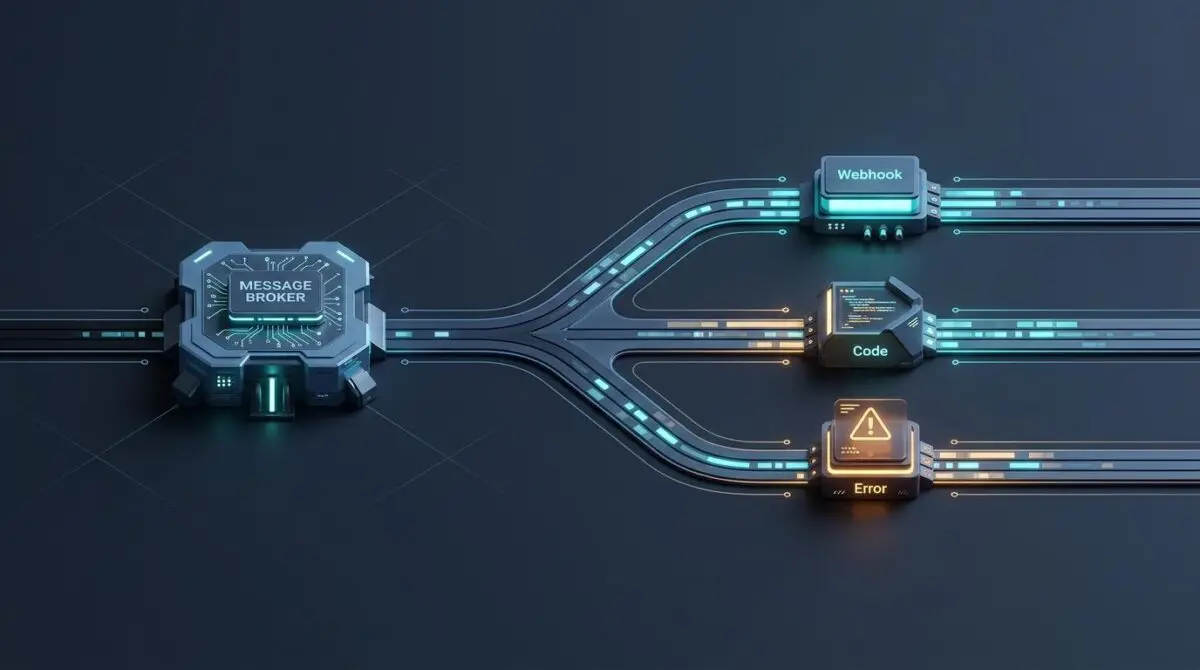
The Webhook node captures incoming events from webhook-enabled SaaS tools or custom services.
Native nodes then reshape the payload before it reaches other systems.
For complex cases, a Code node supports JavaScript or Python.
The HTTP Request node handles outbound REST calls to external services.
Queue mode adds asynchronous retry and processing through Redis-backed workers.
Failed executions can be routed into dedicated error workflows, and workflow-level triggers expose what broke and why.
Message broker sources such as RabbitMQ, AMQP, MQTT, or Kafka can be read directly.
That removes the need to rebuild the same reliability layer for each new event source.
Throughput Benchmarks and the Operational Cost of Coupling
The performance case for decoupling goes beyond developer convenience.
A February 2025 review in the International Journal of Research in Computer Applications and Information Technology, authored by Amazon Principal Engineer Raghukishore Balivada, synthesizes existing benchmarks on event-driven programming.
That review is not original experimental research, but it compiles findings from multiple studies.
The figures it cites are stark.
Event-driven architectures can process more than 150,000 events per second with latency below 100 milliseconds.
Some cloud-native implementations exceed 200,000 operations per second with sub-millisecond latency for 99 percent of requests.
Memory efficiency is another pressure point.
Event-driven systems can require about 2.5 kilobytes per connection, compared with roughly 1 megabyte per connection for traditional thread-per-connection models.
Those differences translate into real capacity limits.
Single-threaded event loops can manage more than 50,000 concurrent connections.
Thread-per-connection models often degrade significantly beyond roughly 8,000 connections.
The review also cites latency reductions of up to 48 percent and resource utilization improvements around 35 percent for event-driven designs.
Asynchronous event processing can push latency reduction as high as 65 percent and resource utilization gains to 45 percent.
Reliability figures follow the same pattern.
Structured error handling can prevent up to 85 percent of common runtime failures.
Error recovery rates can exceed 98 percent with average resolution below 100 milliseconds.
But the architecture is not free.
Enterprise teams moving systems like Salesforce to event-driven integrations face trade-offs around eventual consistency, error visibility, and middleware infrastructure.
Decision rules from broader implementation patterns are telling.
Raw data synchronization above 50,000 updates per day often favors change data capture.
Platform events become the better fit when preprocessing logic or payloads exceed one megabyte.
If replay requirements stretch beyond a standard 72-hour window, teams frequently route immediately to an external Kafka broker.
These are not abstract choices.
They determine whether an automation stack scales or stalls.
The Consumer Layer Is the Next Automation Battleground
The real bottleneck is no longer the API contract; it is the consumer layer that must receive, transform, and act on every payload without rebuilding reliability infrastructure each time. For teams building event-driven automation pipelines that need to scale without custom consumer services, programmatic SEO AI automation is how Andres SEO Expert approaches infrastructure-aware content and automation systems — get in touch.
Frequently Asked Questions
What is an asynchronous API and how does it differ from synchronous REST?
An asynchronous API lets the sender dispatch a message and move on without waiting for a reply, so neither side needs to be online at the same time. REST is endpoint-oriented and synchronous by default, keeping the connection open until a final response is returned. Async APIs use channels where producers publish and consumers subscribe on their own schedule.
When should you use asynchronous APIs instead of REST?
Async wins when a transaction depends on warehouse lookups, label generation, or multiple external systems that can outlast a typical request window, and when one event must fan out to multiple consumers. Operations like password checks and access decisions still need an instant response and should stay synchronous. Async is also preferred for high-throughput event streams and IoT use cases.
What throughput benefits do event-driven architectures offer?
Event-driven architectures can process more than 150,000 events per second with latency below 100 milliseconds, and some cloud-native implementations exceed 200,000 operations per second with sub-millisecond latency for 99 percent of requests. They also use about 2.5 KB per connection versus 1 MB per thread, and can handle over 50,000 concurrent connections compared to roughly 8,000 for thread-per-connection models.
Which protocols are commonly used in async API systems?
The protocol layer varies by use case: AMQP for message brokers, Kafka for high-throughput event streams, MQTT for lightweight pub/sub and IoT, and WebSockets for bidirectional real-time communication. The protocol determines how data is routed, buffered, and delivered safely between microservices.
How does n8n simplify building consumers for async APIs?
n8n replaces custom consumer services with a visual workflow, using the Webhook node to capture incoming events and native nodes to reshape payloads. For complex cases, a Code node supports JavaScript or Python, while Queue mode adds asynchronous retry through Redis-backed workers. It can also read directly from message brokers like RabbitMQ, AMQP, MQTT, or Kafka.
What are the trade-offs of event-driven integration for enterprise systems?
Enterprise teams moving systems like Salesforce to event-driven integrations face trade-offs around eventual consistency, error visibility, and middleware infrastructure. Decision rules matter: change data capture suits raw sync above 50,000 updates per day, platform events fit when preprocessing logic or payloads exceed one megabyte, and external Kafka brokers are used when replay requirements stretch beyond 72 hours.
Why is the consumer layer the next automation battleground?
The real bottleneck is no longer the API contract but the consumer layer that must receive, transform, and act on every payload without rebuilding reliability infrastructure each time. Teams need to handle event routing, transformation, and error handling efficiently to scale event-driven pipelines. This is where visual workflow tools and native broker integrations provide an advantage over custom consumer services.