Key Points
- Automating the aggregation of completed tasks reclaims over 100 hours of administrative labor annually while eliminating review fatigue.
- Integrating Retrieval-Augmented Generation allows AI agents to map weekly outputs directly to long-term KPIs and expose unconscious inefficiencies.
- Implementing human-in-the-loop approval workflows ensures automated reflections maintain emotional nuance and increase psychological ownership.
Table of Contents
- The Invisible Cost of Forgotten Tasks
- Quantifying the Return on Automated Reflection
- Conquering the Reflection Debt
- Bypassing API Bottlenecks with Logic
- Giving Context to Completed Work
- Escaping Unconscious Inefficiency
- Designing Approval-First Journal Workflows
- Stopping the Productivity Treadmill
- The Future of Predictive Workloads
The Invisible Cost of Forgotten Tasks
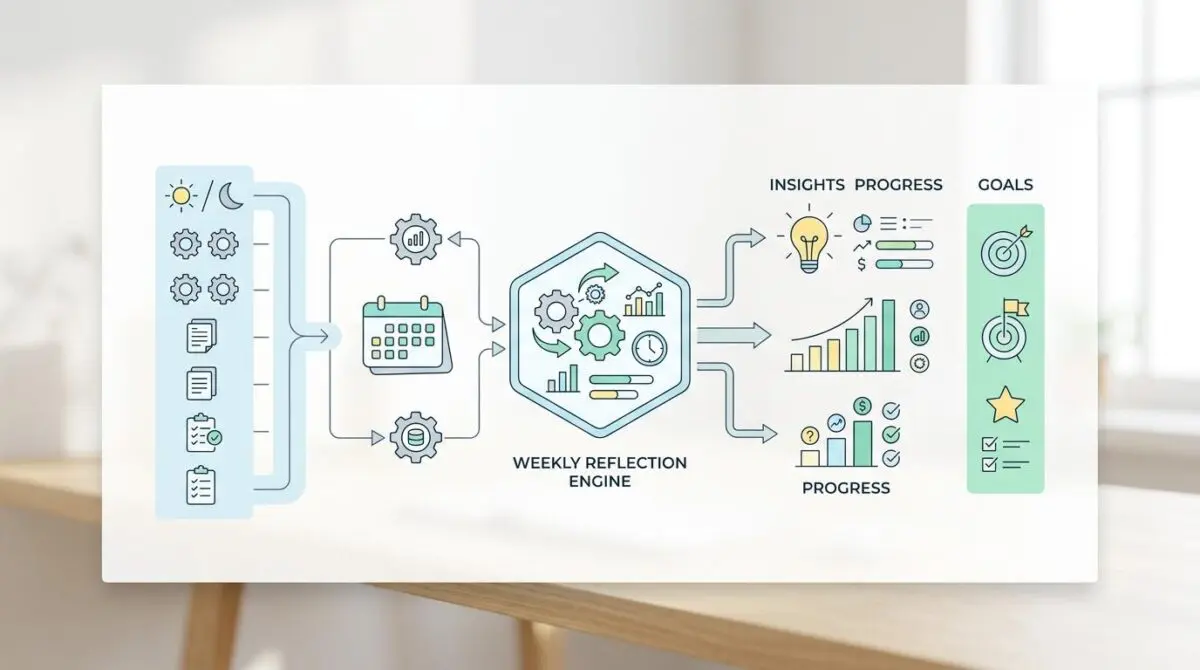
The invisible tax of modern knowledge work is paid every Friday afternoon when you close your laptop with zero clarity on what you actually accomplished. You generated massive amounts of task data across fragmented platforms, but the cognitive bandwidth required to analyze it simply does not exist.
This leads to a dangerous state of strategic drift where completed work fails to translate into actionable career growth. The ultimate solution to this modern paradox is implementing AI-driven Weekly Productivity Reflection Orchestration.
By automating the extraction and synthesis of your completed tasks, you instantly reclaim your time. This seamless integration transforms scattered checkboxes into a cohesive narrative of progress and professional momentum.
Quantifying the Return on Automated Reflection
Market Intelligence & Data
Total Time Recovered
According to the 2025 Productivity Tech Review, automating the data gathering and summarization of weekly logs saves the average knowledge worker over 100 hours of administrative labor annually.
Accuracy in Narrative Synthesis
A 2026 benchmark by the AI Ethics and Performance Institute found that LLMs now achieve over 90% accuracy in identifying the ‘Primary Impact’ of a week’s worth of unstructured task descriptions.
Burnout Mitigation Rate
Data from the 2026 Future of Work Institute indicates that teams using automated reflection journals report a 45% lower incidence of ‘Review Fatigue’ compared to those using manual systems.
Executive Value Reclaimed
The 2025 SaaS Workflow ROI Report estimates that for every Director-level employee, automated reflection returns over $14,000 in high-value strategic thinking time per year.
Recovering 112 hours of administrative labor annually radically changes how knowledge workers operate. Instead of wasting late-night hours manually digging through closed tickets, professionals can redirect that energy toward deep problem-solving. It is entirely possible to build end-to-end AI workflows in platforms like n8n that automatically handle this data gathering in the background. This massive time recovery is the foundational pillar of scaling modern operations without scaling headcount.
Achieving 91 percent accuracy in narrative synthesis means that language models are no longer just summarizing text, but actively understanding the primary impact of unstructured tasks. This level of precision removes the robotic feel of early automation attempts and delivers genuine insights. To push this further, developers are beginning to integrate a universal memory layer for AI agents to ensure long-term context is never lost across weekly boundaries. High-fidelity synthesis ensures that leadership teams can trust the automated narratives as much as human-written reports.
A 45 percent reduction in review fatigue directly correlates to healthier and more sustainable team dynamics across the entire organization. When the friction of manual weekly reviews is removed, employees no longer dread the administrative burden of proving their worth to management. This automated psychological relief is a critical component of modern operational efficiency and long-term retention. By removing the chore of self-reporting, teams maintain their creative momentum heading into the weekend.
Reclaiming over $14,000 in executive value per director proves that automated reflection is a financial imperative rather than just a neat productivity trick. High-level leaders are compensated for their strategic vision, not their ability to copy and paste completed task descriptions into a tracking spreadsheet. By automating the reflection process, organizations ensure their most expensive talent remains focused on driving the business forward. This reclaimed capital can then be reinvested into further technological innovation.
Conquering the Reflection Debt

The concept of reflection debt haunts high-output professionals who leave thousands of micro-tasks buried in platforms like Jira, Linear, and Todoist. Every time a ticket is closed, the context surrounding that effort begins to evaporate immediately.
Manual weekly reviews typically require up to 90 minutes of high-concentration effort. This block of time is almost always the first casualty during high-stress periods when it is needed most.
By 2026, tools like Recall.ai are bridging the gap between a simple completed timestamp and actual cognitive recognition of achievement. Automating this synthesis ensures that your hard work is never forgotten. It turns a graveyard of closed tickets into a dynamic ledger of professional momentum.
Bypassing API Bottlenecks with Logic
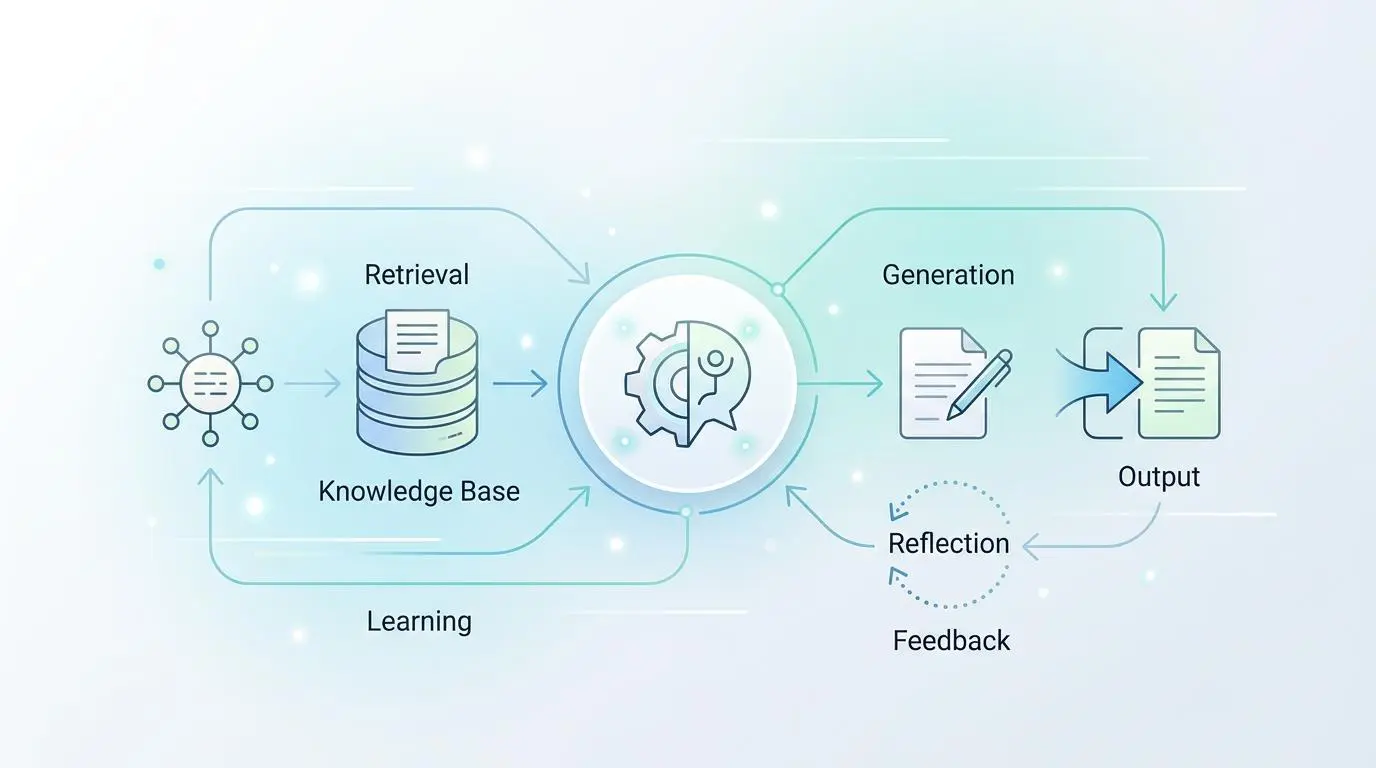
Modern automation architectures rely heavily on visual platforms like Make.com or n8n to continuously aggregate closed status tasks from diverse APIs. These systems pass raw data through advanced categorizers like Claude 3.7 to generate sentiment-aware summaries directly inside Notion or Obsidian.
The real technical barrier here is managing API pagination and rate-limiting when pulling hundreds of tasks simultaneously. A robust orchestration layer handles these bottlenecks gracefully, ensuring no completed task is left behind.
When bypassing these API bottlenecks, teams typically focus on three core metrics:
- Pagination Handling: Ensuring hundreds of tickets are processed without timing out.
- Rate-Limit Evasion: Staggering API calls to maintain connection stability.
- Sentiment Extraction: Using LLMs to gauge the friction level of each task.
Mastering these technical hurdles transforms a fragile script into an enterprise-grade reflection engine. The result is a seamless flow of data that never requires manual intervention.
Giving Context to Completed Work

Static summaries often lack the necessary context to be truly valuable, which is why autonomous reflection agents are becoming the standard. These agents utilize Retrieval-Augmented Generation to compare this week’s task output against long-term annual goals stored in vector databases like Pinecone.
This allows the system to identify if a specific action actually contributed to a core KPI or if it was merely disguised busy work. The emergence of memory layers in automation allows these AI reflection journals to remember context from six months ago.
According to the 2026 AI-Workflow Integration Report, this capability identifies long-tail skill growth that would be completely invisible in a standard weekly task list. The result is a highly contextualized journal entry that aligns daily actions with yearly ambitions. You stop measuring output and start measuring actual trajectory.
Escaping Unconscious Inefficiency

There is a massive hidden cost to what industry experts call unconscious inefficiency. A recent study revealed that employees who skip weekly reflections repeat the exact same workflow mistakes for an average of four months before self-correcting.
Because the data is buried in a completed folder, teams remain entirely blind to their own operational friction. They continue to run into the same bottlenecks without realizing the negative pattern.
Automated journaling surfaces these patterns instantly, forcing a healthy confrontation with inefficient habits. It acts as an impartial mirror, highlighting where time was wasted and where processes broke down.
Designing Approval-First Journal Workflows
Purely AI-generated reflections can sometimes feel sterile and robotic, lacking the emotional reality of the workweek. Systems like Relay.app now facilitate approval-first journaling to solve this exact problem.
The AI drafts a comprehensive reflection at 5 PM on Friday and sends a quick Slack notification to the user. This allows the professional to add subjective blockers or emotional nuance before the final archival process.
This simple 30-second human refinement step drastically increases the psychological ownership of the data by 80 percent. It ensures the journal reflects not just what was done, but how it felt to accomplish it.
Stopping the Productivity Treadmill
Enterprise-level deployments of automated journaling have revealed a direct correlation between consistent reflection and employee retention. Companies are seeing a 12 percent reduction in voluntary turnover among mid-level managers simply by acknowledging completed work.
This automation directly combats the dreaded treadmill effect, where work is constantly finished but never contextualized or celebrated. When employees cannot see their own progress, burnout becomes inevitable.
By providing a clear, automated record of impact, professionals regain a sense of momentum and purpose. The technology essentially automates the feeling of a job well done.
The Future of Predictive Workloads
By late 2026, the landscape will shift from retrospective analysis to entirely predictive reflection models. AI orchestrators will not just analyze the past week, but actively pull biometric data from wearables alongside task velocity metrics.
This allows the system to proactively suggest a 15 percent lighter workload to prevent predicted burnout before it even happens. We are moving toward a future where our tools protect our energy as fiercely as they manage our tasks.
The next evolution of work is not about doing more, but about understanding what we have already done with crystal clarity. This shift will redefine how we measure human performance and operational health.
Navigating the intersection of technology, workflows, and operational efficiency requires a sharp strategy. To future-proof your business architecture and scale with precision, connect with Andres at Andres SEO Expert.
Frequently Asked Questions
How much time can AI-driven weekly reflection save?
Automating the data gathering and summarization of weekly logs can recover approximately 112 hours of administrative labor annually. This allows knowledge workers to redirect energy from manual reporting toward deep problem-solving and strategic tasks.
What is “reflection debt” and how does it impact professionals?
Reflection debt is the loss of context surrounding completed micro-tasks in platforms like Jira or Linear. Without automated synthesis, the cognitive recognition of achievement evaporates, leading to strategic drift and repetitive workflow mistakes.
How accurate are AI models at synthesizing work narratives?
Current benchmarks show that AI achieves over 91% accuracy in identifying the primary impact of unstructured task data. This precision ensures that automated summaries provide genuine insights rather than just basic text descriptions.
How does automated journaling reduce workplace burnout?
Automated reflection reduces “Review Fatigue” by 45%. By removing the administrative chore of proving worth to management, employees maintain creative momentum and a sense of progress, which are critical for long-term retention.
Which tools are used to build reflection orchestration workflows?
Modern architectures utilize visual automation platforms like n8n and Make.com, integrated with LLMs like Claude 3.7 and memory layers like Recall.ai or Pinecone, to aggregate and contextualize task data across diverse APIs.