Key Points
- Cloud Access Security Brokers (CASB) have evolved into the central nervous system of the Autonomous Security Edge, neutralizing the friction between enterprise agility and data sovereignty.
- The convergence of SASE titans and the influx of smart capital into Identity-Centric CASB are driving the adoption of real-time semantic firewalling to combat decentralized AI risks.
- Forward-thinking executives are pivoting toward Predictive Cloud Governance, utilizing behavioral telemetry to build a proactive Cyber-Immune System that anticipates breaches.
Table of Contents
The Core Friction: Enterprise Agility vs. Data Sovereignty
According to a 2026 Gartner Security Leadership Report, 85% of global enterprises have now fully transitioned to ‘Invisible CASB’ architectures that leverage AI-driven zero-trust protocols to secure hyper-distributed cloud environments. This is not merely a technological upgrade for IT departments. It represents a fundamental shift in how digital empires protect their most valuable assets in a borderless world.
The modern enterprise operates as a sprawling, decentralized entity. Remote workforces, third-party contractors, and an explosion of SaaS-to-SaaS integrations have created a massive blind spot for Chief Information Security Officers (CISOs). Traditional perimeter defenses are entirely obsolete. The corporate network is no longer a walled garden; it is a bustling, chaotic metropolis.
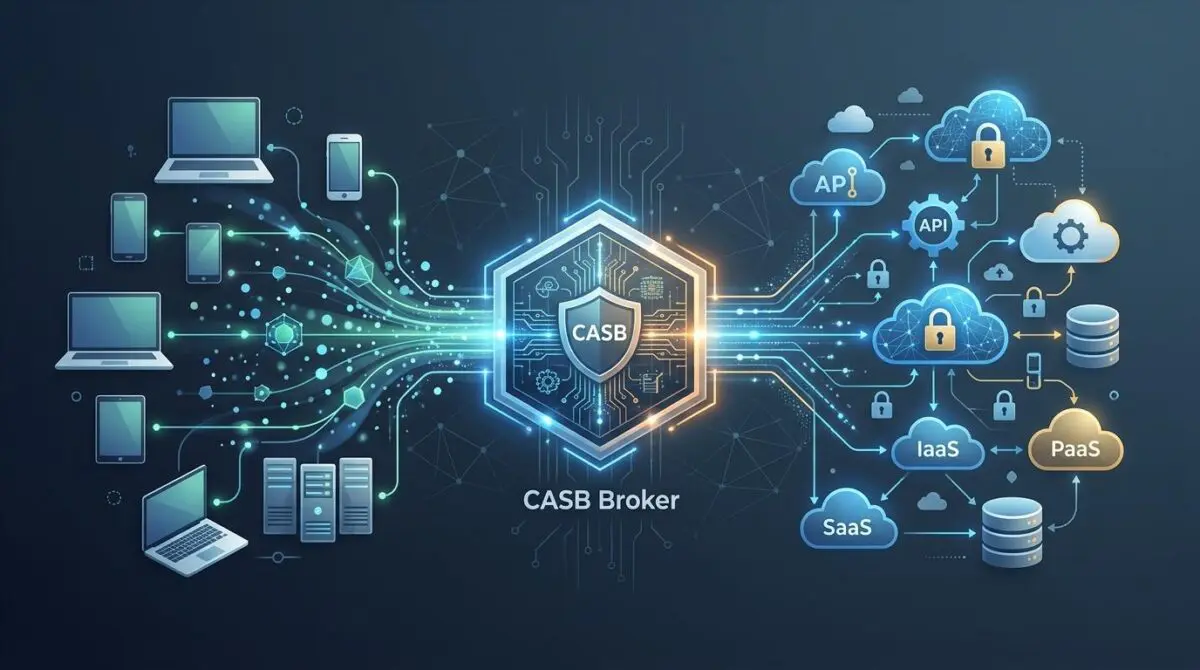
Enter Cloud Access Security Brokers (CASB). In 2026, CASB has evolved from a simple visibility tool into the central nervous system of the “Autonomous Security Edge.” It addresses the critical tension between the demand for rapid enterprise agility and the strict requirements of data sovereignty. Without a modern CASB, companies are effectively flying blind through a hurricane of encrypted cloud traffic.
The friction here is deeply rooted in market psychology. Employees want frictionless access to the best productivity tools, while executives are terrified of regulatory fines and intellectual property theft. Modern CASBs provide the only viable solution for real-time visibility into this complex web of interactions. They act as the ultimate digital diplomats, negotiating access while enforcing ironclad security policies in the background.
Market Intelligence & Smart Capital Flow
Market Intelligence & Data
Global Market Valuation
IDC reports that total enterprise spending on CASB and integrated cloud security services reached $12.4 billion in Q1 2026, driven by the surge in decentralized AI workflows.
Shadow AI Prevalence
A 2026 Microsoft Security Intelligence report found that 92% of corporate data leaks now originate from unsanctioned ‘Shadow AI’ applications that lack CASB oversight.
OpEx Efficiency
Forrester Consulting research indicates that consolidating standalone security tools into a unified CASB/SASE platform has reduced operational overhead for Fortune 500 security teams by 40%.
Zero-Latency Inspection
Netskope’s 2026 Global Performance Benchmark reveals that premier CASB providers have achieved sub-50ms latency for deep-packet inspection, eliminating the ‘productivity tax’ of cloud security.
The data grid above paints a vivid picture of where the “smart money” is currently flowing. Venture capital is no longer chasing legacy endpoint protection or static firewalls. Instead, institutional funds are aggressively backing startups that specialize in next-generation cloud visibility. We are witnessing a massive reallocation of enterprise budgets toward identity-centric defenses.
This aggressive capital movement perfectly mirrors the rapid growth in enterprise spending on cloud security services, which has reached unprecedented heights. Investors recognize that the real battleground is data context, not just data location. Smart capital is currently flooding into firms specializing in “Semantic DLP” and “Identity-Centric CASB,” such as Wiz and emerging AI-native security platforms.
Venture capital activity in 2026 highlights a definitive shift toward “Agentic Security.” In this paradigm, autonomous software agents residing within the CASB layer actively negotiate security permissions between SaaS applications without human intervention. This eliminates the operational bottlenecks that have historically plagued enterprise IT teams.
The Economics of Zero-Latency Inspection
One of the most critical breakthroughs in the CASB market is the achievement of sub-50ms latency for deep-packet inspection. Historically, routing cloud traffic through a security broker introduced a noticeable “productivity tax.” Employees experienced lag, leading to frustration and the dangerous practice of bypassing security protocols entirely.
By eliminating this latency, premier CASB providers have aligned security with user experience. This is a massive economic unlock for Fortune 500 companies. When security operates invisibly and instantaneously, employee productivity remains uninterrupted, and the business scales without friction.
The Strategic Deep Dive: Shadow AI & Zero-Trust
To truly understand the disruptive power of modern CASBs, we must examine the architectural shifts happening beneath the surface of the modern enterprise. The transition away from trust-based networks is accelerating. Organizations are realizing that implicit trust is a critical vulnerability in an era of sophisticated digital espionage.
This realization is driving the complex process of transitioning to modern zero-trust architectures. In a zero-trust framework, no user, device, or application is inherently trusted, regardless of their location on the network. CASBs serve as the critical enforcement point for this philosophy, dynamically verifying every single cloud transaction in real-time.
The Shadow AI Crisis
The most pressing threat vector today is the unchecked proliferation of generative AI tools within the corporate environment. Employees are routinely feeding proprietary code, sensitive financial data, and strategic roadmaps into public Large Language Models (LLMs) to boost their daily productivity. This phenomenon, known as “Shadow AI,” represents a catastrophic risk to corporate intellectual property.
Modern CASBs are deploying AI Security Posture Management (AISPM) to automatically discover and govern these unauthorized tools. For organizations focused on mitigating data leaks caused by Shadow AI, a next-generation CASB is no longer optional. It is the absolute baseline for survival.
These platforms allow companies to safely embrace generative AI productivity tools without paralyzing innovation. They ensure that data exfiltration risks and regulatory non-compliance issues—such as violations of GDPR 2.0 or the EU AI Act—are mitigated through automated, context-aware policy enforcement.
Real-Time Semantic Firewalling
The threat landscape is mutating faster than traditional rule-based defenses can adapt. Data from the 2026 World Economic Forum Cyber Risk Report highlights that ‘Prompt Injection’ attacks targeting enterprise-integrated LLMs have surged by 400% year-over-year, forcing top-tier CASB providers to implement real-time semantic firewalling as a standard feature.
This is where innovation is currently centered on “Zero-Trust Data Security.” Modern CASBs utilize sub-millisecond deep packet inspection combined with automated semantic analysis. They do not just look at file types or keywords; they analyze the actual intent and context of the data being transmitted.
This allows the system to prevent proprietary code and sensitive data from being leaked into public AI training sets in real-time. If an employee attempts to paste a confidential earnings report into an unsanctioned chatbot, the semantic firewall intercepts the action instantaneously, blocking the transmission and alerting the security operations center.
The Titan Convergence
The competitive landscape of cloud security is currently dominated by what industry insiders call the “Titan Convergence.” Secure Access Service Edge (SASE) providers like Netskope, Zscaler, and Palo Alto Networks have successfully subsumed standalone CASB functionalities. They are building monolithic, all-encompassing security clouds.
This convergence is driven by enterprise demand for operational simplicity. CISOs are exhausted by the complexity of managing dozens of disparate, siloed security tools. By consolidating into a unified CASB/SASE platform, organizations can drastically reduce their operational overhead and close the dangerous visibility gaps that exist between disconnected systems.
However, this consolidation creates a fascinating market dynamic. While the titans dominate the broad infrastructure play, agile AI-native startups are carving out highly lucrative niches. These upstarts are forcing the legacy giants to continuously acquire new technologies or risk obsolescence in the face of hyper-specialized AI threats.
The Executive Action Plan: Predictive Governance
Strategic Trajectory
- Transition corporate leadership focus toward ‘Predictive Cloud Governance’ as the next logical security evolution.
- Evolve CASB implementations from reactive blocking to advanced behavioral-based risk forecasting.
- Integrate biometric and behavioral telemetry to enable dynamic access adjustments on a per-transaction basis.
- Architect a ‘Cyber-Immune System’ capable of anticipating breaches before the initial byte of data is compromised.
The roadmap for CEOs and Founders is clear: the era of reactive cybersecurity is over. The next logical evolution is the transition toward “Predictive Cloud Governance.” By late 2026 and into 2027, CASBs will move entirely beyond simple reactive blocking and static policy enforcement.
Founders must prepare their organizations for a world where security systems utilize biometric and behavioral “telemetry.” This means the CASB will analyze how a user types, how they move their mouse, and their typical working hours. If a user’s behavior suddenly deviates from their historical baseline, the system will dynamically adjust access levels on a per-transaction basis.
This requires a fundamental shift in capital allocation and technical architecture. Executives must mandate the integration of identity providers, endpoint management, and CASB into a singular, unified data lake. The ultimate goal is the creation of a “Cyber-Immune System.”
Much like the human body’s immune response, this system will learn, adapt, and anticipate a breach before the first byte of data is compromised. It transforms security from a defensive posture into a proactive business enabler, allowing the enterprise to scale aggressively without fear of catastrophic compromise.
Conclusion
The evolution of Cloud Access Security Brokers represents a masterclass in market adaptation and technological resilience. As the traditional enterprise perimeter dissolves entirely into the cloud, the mechanisms we use to protect our data must become smarter, faster, and entirely invisible to the end-user.
Those who master the Autonomous Security Edge will not just protect their assets; they will outmaneuver their competitors. By embracing semantic firewalling, agentic security, and predictive governance, visionary leaders can turn cybersecurity into a distinct competitive advantage in the AI era.
Navigating the intersection of technology, capital, and market psychology requires a sharp strategy. To future-proof your business architecture and scale with precision, connect with Andres at Andres SEO Expert.
Frequently Asked Questions
What is Invisible CASB and why is it important in 2026?
Invisible CASB refers to an architecture that leverages AI-driven zero-trust protocols to secure hyper-distributed cloud environments without disrupting user workflows. It is critical because traditional perimeter defenses are obsolete in a borderless world where 85% of enterprises have transitioned to decentralized, cloud-first operations.
How does Shadow AI impact enterprise data security?
Shadow AI involves employees using unsanctioned generative AI tools for productivity, which currently accounts for 92% of corporate data leaks. Modern CASBs mitigate this risk by using AI Security Posture Management (AISPM) to discover and govern unauthorized LLM interactions, preventing sensitive data from entering public training sets.
What are the economic benefits of zero-latency inspection?
By achieving sub-50ms latency for deep-packet inspection, premier CASB providers have eliminated the ‘productivity tax’ of security. This alignment of security with user experience reduces operational overhead by 40% for Fortune 500 teams and prevents employees from bypassing protocols due to performance lag.
What is Real-Time Semantic Firewalling?
Semantic firewalling is a next-generation security feature that analyzes the intent and context of data transmissions rather than just file types. It uses sub-millisecond inspection to intercept sensitive proprietary data or code before it can be leaked into unauthorized AI platforms or external environments.
What is the ‘Titan Convergence’ in the security market?
The Titan Convergence is the market trend where major SASE providers like Netskope and Zscaler integrate standalone CASB functions into unified, all-encompassing security clouds. This consolidation helps CISOs eliminate visibility gaps and simplify the management of complex security stacks.
How does Predictive Cloud Governance evolve security strategies?
Predictive Cloud Governance shifts security from reactive blocking to proactive risk forecasting. By integrating biometric and behavioral telemetry—such as typing patterns and working hours—the system can dynamically adjust access levels and anticipate breaches before the first byte of data is compromised.