Key Points
- Predictive Philanthropy: AI algorithms accurately calculate personalized donation requests, drastically lowering donor acquisition costs and maximizing lifetime value.
- Dynamic Optimization: Enterprise CRMs utilize LLMs to instantly generate and test thousands of unique ad variants, eliminating manual campaign bottlenecks.
- Cryptographic Verification: Zero-Knowledge Proofs and C2PA watermarking secure voter data and authenticate political content to combat deepfakes and maintain public trust.
Table of Contents
Shattering the Megaphone
Imagine a campaign war room buried in spreadsheets, blindly blasting identical donation emails to a million different inboxes. This outdated approach is the political equivalent of throwing darts in the dark. It drains campaign resources and alienates an increasingly fragmented voter base.
Traditional campaigns bleed millions on this blind outreach. They target voters who have already made up their minds or are entirely ineligible to vote in that district. The inevitable result is skyrocketing opt-out rates, severe donor fatigue, and an exhausted field staff.
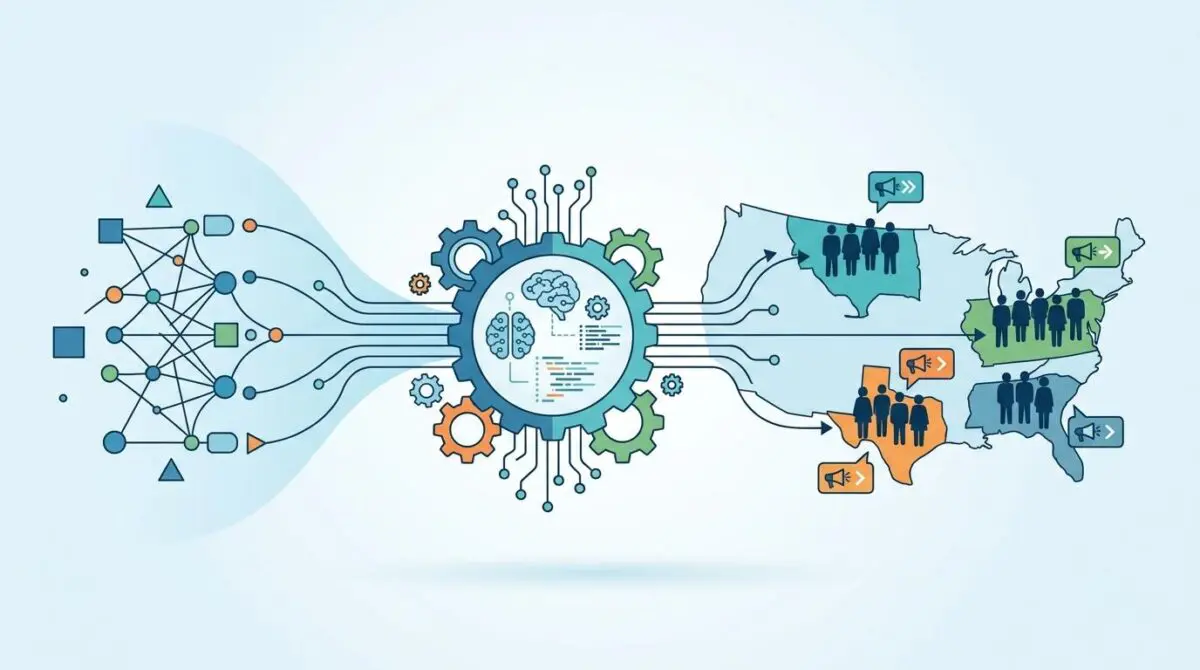
The ultimate solution to this chaos is AI-driven micro-targeting and predictive political philanthropy. By leveraging advanced machine learning, campaigns can transform chaotic data pools into precise, individualized voter journeys. This shift replaces the loud, generic megaphone with a highly personalized digital handshake.
The Numbers Behind the Shift
Market Intelligence & Data
AI-Automated Ad Buying
According to the AdImpact 2026 Mid-Year Analysis, over 80% of digital political ad placements in the current cycle are executed via AI-automated programmatic platforms.
Predictive Tool Market
The 2025 TechPolicy Strategic Report projects that the market for AI-driven donor identification and predictive analytics will exceed $1.4 billion by the end of 2026.
Turnout Efficiency Gain
Data from the 2025 BallotBox Innovation Survey indicates that hyper-personalized AI outreach increases turnout among low-propensity voters by 27% compared to traditional mailers.
AI Disclosure Mandates
As of June 2026, the National Conference of State Legislatures (NCSL) reports that 19 US states have enacted mandatory disclosure laws for AI-generated political content.
The staggering shift toward AI-automated ad buying reveals a fundamental change in how political capital is deployed. With over 80 percent of digital placements handled programmatically, campaigns no longer guess where constituents spend their time online. Algorithms dynamically bid on ad spaces in real-time, ensuring every dollar reaches a specific demographic at the exact moment they are most receptive.
This rapid automation drives massive investments, with the predictive tool market expected to surpass 1.4 billion dollars by the end of 2026. This capital builds enterprise-grade data engines capable of identifying untapped donor networks. By predicting philanthropic behavior before a single email is sent, campaigns drastically lower their donor acquisition costs.
The impact of this technology is evident in the 27 percent gain in turnout efficiency among low-propensity voters. Hyper-personalized AI outreach cuts through the noise of traditional mailers by delivering messages tailored to unique civic interests. When citizens receive communication that aligns with their daily struggles, they are significantly more likely to vote.
However, this rapid technological expansion forces regulatory bodies to act swiftly to maintain public trust. As the landscape evolves, 19 states have enacted mandatory disclosure laws for AI-generated political content to ensure transparency. Furthermore, major tech platforms are actively adopting C2PA watermarking standards to prove ad authenticity, creating a necessary safeguard against digital manipulation.
Curing Voter Fatigue

Voters today are completely overwhelmed by irrelevant political spam. When a citizen cares deeply about local infrastructure but only receives generic messaging about national partisan drama, they immediately disengage. This disconnect represents the core problem modern political operations must solve to survive.
To combat this, modern campaigns utilize AI tools to analyze voter sentiment at scale. These platforms monitor how individuals interact with previous outreach, ensuring they only receive content regarding the specific issues they care about. If a voter clicks on a climate policy article, the system automatically tags their profile for future environmental messaging.
This level of AI-driven micro-targeting acts as a digital filter, protecting the voter’s inbox from irrelevant noise. By respecting the constituent’s time and interests, campaigns dramatically reduce opt-out rates. Ultimately, this precision transforms a frustrated audience into an engaged and active donor base.
Smart Campaign Infrastructure

The human bottleneck of manually drafting and testing thousands of ad variations is a massive operational liability. In the past, field teams spent days creating a handful of email segments, hoping one would resonate. Today, that manual friction is entirely eliminated by smart campaign infrastructure.
Large language models are now deeply integrated into enterprise CRM platforms. These systems instantly generate thousands of unique email variants tailored to micro-segments of the voting population. This allows a single campaign manager to execute the workload of an entire traditional marketing department.
These tools utilize dynamic content optimization to swap images and headlines in real-time based on the recipient’s donor history. If a supporter previously donated after seeing a family-focused headline, the AI ensures their next email features similar thematic elements. This creates a seamless, highly personalized narrative that drives consistent engagement.
Securing the Digital Ballot

The rapid rise of AI has brought a significant erosion of public trust, primarily fueled by the threat of deepfakes and misinformation. Voters are increasingly skeptical of the content they consume online. Compounding this issue is the ever-present risk of massive voter database breaches, which can cripple a campaign overnight.
To address these critical vulnerabilities, the industry is implementing robust cybersecurity protocols. Platforms enforce strict C2PA watermarking standards to cryptographically prove the authenticity of political advertisements. This ensures voters can instantly verify whether a video or image is a genuine campaign asset or a synthetic manipulation.
Behind the scenes, data privacy is being revolutionized by zero-knowledge proof protocols. These advanced cryptographic methods allow campaigns to verify a voter’s eligibility or registration status without ever exposing their personally identifiable information. This creates a secure, trustless environment where data can be utilized for targeting without risking a catastrophic leak.
Translating the Data Ocean

For decades, campaign managers have suffered from being data rich but insight poor. They possessed massive spreadsheets of voter history but lacked the analytical power to make quick, strategic decisions. This paralysis often resulted in deploying field staff to the wrong neighborhoods at the worst possible times.
Modern dashboards are built to translate billions of raw data points into actionable persuasion scores. Instead of relying on simple, outdated metrics like party affiliation, these systems use predictive clusters. They can pinpoint swing-probable voters down to the specific precinct, maximizing the impact of every door knocked.
Furthermore, campaigns are now utilizing synthetic personas to refine their messaging. These are AI models trained on specific voter demographics used to stress-test political ads in virtual environments. This allows strategists to predict public backlash and optimize their narrative before an ad is ever released to the public.
The New Fundraising Calculus
The traditional model of political fundraising relied heavily on massive monthly email blasts and expensive telemarketing operations. However, these outdated methods now yield diminishing returns and unacceptably high acquisition costs for new donors. Campaigns can no longer afford to waste money on inefficient financial outreach.
AI-optimized fundraising cycles have completely shifted this paradigm toward trigger-based micro-donations. Instead of asking everyone for the same amount, intelligent tools analyze a supporter’s past behavior to predict their financial capacity. The AI calculates the exact ask amount a specific donor is statistically most likely to accept on any given day.
This predictive political philanthropy maximizes the lifetime value of every single supporter. By timing the donation request to coincide with high-engagement moments, such as immediately after a candidate’s debate performance, campaigns secure critical funding with surgical precision. It turns fundraising from a blunt instrument into a highly calibrated revenue engine.
The Conversational Frontier
One of the greatest logistical hurdles in any election is the sheer impossibility of hiring enough human volunteers. Campaigns simply cannot facilitate meaningful, one-on-one policy discussions with every single constituent. This lack of personal connection often leaves undecided voters feeling ignored by the candidates they are supposed to support.
The current election cycle is poised to shatter this limitation with the widespread deployment of conversational canvassing AI agents. These voice-interactive bots are capable of holding nuanced, policy-driven conversations over the phone. They do not just read scripts; they actively listen and respond to the specific concerns of the voter.
If a constituent asks a complex question about a candidate’s stance on healthcare, the AI agent can instantly retrieve and articulate the exact platform details. This technology scales the candidate’s voice infinitely. It ensures every voter receives a personalized, informative, and engaging interaction without exhausting the campaign’s human capital.
The Autonomous Campaign Era
The landscape of political strategy is rapidly evolving toward a reality of autonomous campaigning. In the near future, AI will no longer just suggest targeting parameters or draft email copy. It will execute real-time budget reallocations across social platforms, adjusting financial strategies based on hourly shifts in voter sentiment and live exit poll simulations.
This shift represents a fundamental rewiring of how democracy interfaces with technology. Campaigns that embrace AI-driven micro-targeting and predictive philanthropy will operate with an unprecedented level of agility and financial efficiency. Those who cling to the outdated megaphone approach will simply be drowned out by the precision of their competitors.
Navigating the intersection of modern technology, software architecture, and business growth requires a sharp strategy. To future-proof your tech stack and scale with precision, connect with Andres at Andres SEO Expert.
Frequently Asked Questions
What is AI-driven micro-targeting in political campaigns?
AI-driven micro-targeting uses advanced machine learning to analyze voter data and deliver highly personalized outreach. Unlike traditional mass messaging, it creates individualized voter journeys that align with a constituent’s specific interests, reducing donor fatigue and improving engagement.
How does predictive political philanthropy lower fundraising costs?
By leveraging AI tools like Revv, campaigns can predict a donor’s financial capacity and the exact moment they are most likely to give. This trigger-based approach replaces expensive, inefficient telemarketing and mass emails with precision asks, drastically lowering donor acquisition costs.
What are the current legal disclosure requirements for AI political content?
As of June 2026, 19 US states have enacted mandatory disclosure laws for AI-generated political content. To maintain transparency and public trust, campaigns are also increasingly adopting C2PA watermarking standards to cryptographically prove the authenticity of their advertisements.
How does AI increase voter turnout efficiency?
According to the 2025 BallotBox Innovation Survey, hyper-personalized AI outreach can increase turnout among low-propensity voters by 27%. By delivering tailored messages that address a voter’s unique civic concerns, AI cuts through the noise of generic political spam that often leads to disengagement.
What is Conversational Canvassing AI?
Conversational Canvassing involves voice-interactive AI agents that can hold nuanced, one-on-one policy discussions with voters. These bots scale a candidate’s voice infinitely, providing accurate platform information and answering complex constituent questions without the logistical limitations of human volunteer staffing.
How are campaigns securing voter data against breaches?
Modern campaigns utilize Zero-Knowledge Proof (ZKP) protocols to protect data privacy. These cryptographic methods allow campaigns to verify voter eligibility or registration status for targeting purposes without ever exposing or risking the voter’s Personally Identifiable Information (PII).