Key Points
- Symmetric Learning Loops: Forward-thinking enterprises are deploying AI systems that learn from human nuance while simultaneously upskilling the human operator.
- Explainable AI Infrastructure: Smart capital is flowing into Human-in-the-loop (HITL) platforms that provide Reasoning Transparency Logs to mitigate black-box liabilities.
- Proactive Cognitive Offloading: The future of AI relies on Neural-Symbiotic Frameworks that anticipate strategic needs using biometric feedback and digital workflow patterns.
Table of Contents
The Core Friction and the Augmentation Imperative
According to a 2026 Deloitte Human Capital Trends report, 72% of enterprises that prioritized ‘Augmentation UX’ over ‘Pure Automation’ saw a 40% higher retention rate among high-skilled talent compared to those who focused solely on headcount reduction.
This data exposes a massive psychological friction point in the modern enterprise. The initial wave of artificial intelligence triggered profound skills displacement anxiety and a widening trust gap between human operators and black-box algorithms.
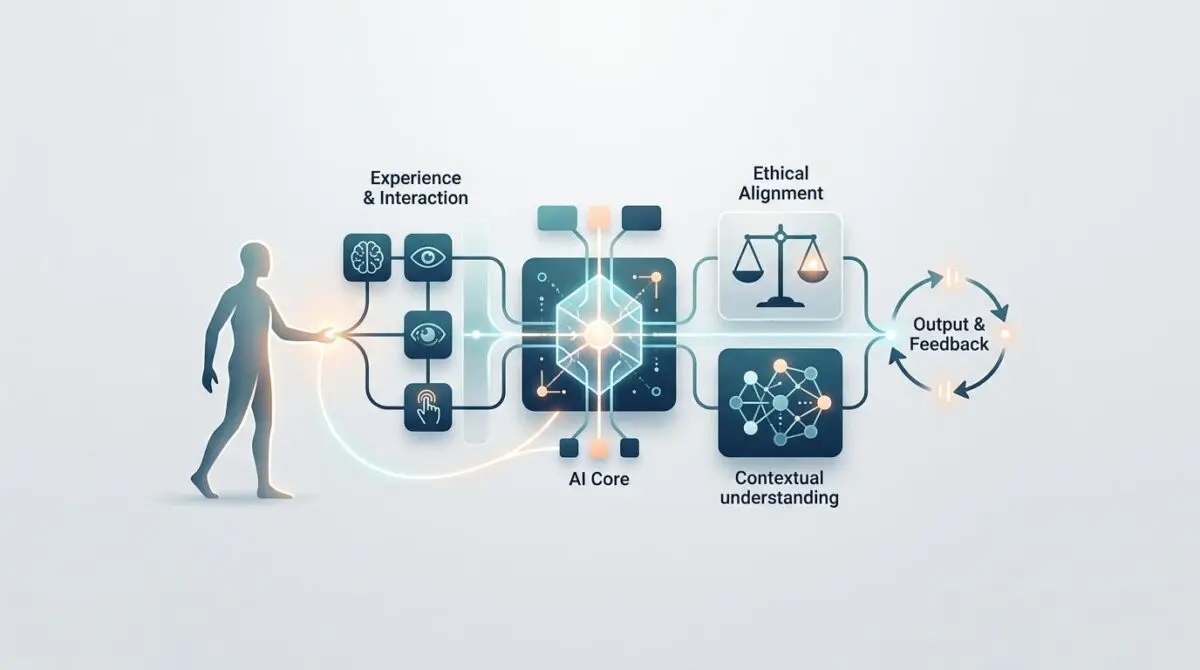
Enter Human-Centered AI Augmentation (HCAA). This is not just a technological framework; it is a fundamental redesign of the corporate nervous system.
HCAA transforms AI from a mere task-executioner into a co-pilot of thought. By designing systems that require human validation for high-stakes decisions, businesses neutralize the legal and ethical liabilities of AI hallucinations.
Market Intelligence and Smart Capital Flows
The era of deploying isolated, generic LLMs is over. Today, institutional capital is aggressively hunting for infrastructure that bridges the gap between raw compute power and human ingenuity.
Market Intelligence & Data
Collaborative AI Market
IDC projects the global market for AI systems designed specifically for human-machine collaboration will exceed $1.2 trillion by the end of 2026.
KPI Evolution
According to Gartner, 65% of Fortune 500 CIOs have officially replaced ‘Headcount Reduction’ with ‘Cognitive Capacity Gain’ as their primary AI success metric in 2026.
Productivity Multiplier
Research from the MIT Initiative on the Digital Economy shows that teams using augmented agentic workflows are 4.5x more productive than those using legacy, non-interactive automation tools.
Explainability Mandate
A 2026 PwC survey found that 88% of global executives now refuse to deploy AI systems that do not feature real-time ‘Reasoning Traces’ for human oversight and auditability.
The numbers reveal a seismic shift in enterprise priorities. Smart money from tier-one firms like Sequoia and Andreessen Horowitz is flowing heavily into human-in-the-loop infrastructure startups.
These venture capitalists recognize that the ultimate moat is not the model itself, but the connective tissue between the model and human oversight. Investors are specifically targeting explainable AI platforms.
In highly regulated sectors like fintech and healthcare, explainability mitigates the liability of opaque decision-making. If a human cannot audit the machine’s logic mid-process via reasoning transparency logs, the system is deemed un-deployable by modern risk committees.
The Strategic Deep Dive: Beyond Chatbots
By 2026, the paradigm has decisively shifted from the primitive chatbot UI to sophisticated agentic orchestration. The market is now dominated by agent infrastructure providers like OpenAI, with their Operator framework, alongside Anthropic.
Niche disruptors like Cognition and Adept are pushing the boundaries further by focusing on actionable intelligence. However, the true competitive advantage lies in solving the context collapse problem.
Solving Context Collapse with Agentic Orchestration
Context collapse occurs when an AI lacks the institutional memory or nuanced situational awareness of a veteran employee. Generic web-scraped data cannot replace ten years of internal corporate strategy.
To solve this, forward-thinking enterprises are integrating deep retrieval-augmented generation systems. These architectures prioritize a company’s unique internal expertise, ensuring the AI operates within the specific strategic boundaries of the firm.
The most disruptive implementation of this is the symmetric learning loop. In this environment, the AI learns from human nuance while simultaneously training the human on complex data patterns, creating a mutual upskilling flywheel.
The Interface-less Revolution
As these learning loops become more advanced, the physical constraints of the traditional screen become a bottleneck. The interface itself must evolve to match the speed of human cognition.
A 2025 strategic shift by Microsoft, reported by Bloomberg, revealed a $15 billion internal pivot toward ‘Interface-less AI,’ focusing on systems that integrate directly into physical environments and AR overlays to support frontline workers, moving AI away from the desk and into the physical field.
This marks the dawn of dynamic interface adaptation. The AI now modifies its UI in real-time based on the human user’s cognitive load, stripping away unnecessary data when stress is high and providing deeper analytics during focused deep-work sessions.
The Executive Action Plan
The next evolution of HCAA is proactive cognitive offloading. Founders must prepare for a landscape where AI anticipates strategic needs based on biometric feedback and workflow patterns, rather than waiting for a prompt.
Strategic Trajectory
- Pivot to Proactive Cognitive Offloading models that anticipate needs without waiting for manual prompts.
- Integrate biometric feedback loops, including eye-tracking and heart rate, to align AI response with physiological digital workflow patterns.
- Architect Neural-Symbiotic Frameworks to remove friction between human strategic intent and machine execution.
- Leverage decentralized Agent Swarms to enable CEOs to manage complex, distributed systems with the ease of a single direct report.
Implementing this trajectory requires a fundamental shift in technical architecture. We are moving rapidly toward neural-symbiotic frameworks where the boundary between human intent and machine execution becomes entirely frictionless.
For the C-suite, this means managing massive, decentralized agent swarms with the same intuitive ease as managing a single direct report. The executives who master this orchestration will outpace their competitors by orders of magnitude.
Conclusion: The Future is Symbiotic
Human-Centered AI Augmentation is the definitive business strategy of the decade. It is the bridge between raw computational scale and the irreplaceable nuance of human leadership.
The organizations that thrive will not be those that automate the most humans, but those that augment their humans most effectively. The future belongs to the neural enterprise.
Navigating the intersection of technology, capital, and market psychology requires a sharp strategy. To future-proof your business architecture and scale with precision, connect with Andres at Andres SEO Expert.