Key Points
- Autonomous Treasury Management: Advanced AI agents now execute real-time tax withholding, dynamic invoice factoring, and algorithmic yield farming, transforming solopreneurs into highly efficient micro-enterprises.
- Layer-2 Settlement Rails: The integration of decentralized blockchain protocols enables instant, near-zero-cost international payments, entirely bypassing the friction and fees of legacy SWIFT systems.
- Algorithmic Underwriting: AI-driven credit lines utilize ‘Proof of Talent’ and projected pipeline revenue to provide instant liquidity, replacing lagging traditional credit scoring models.
Table of Contents
The Financial Tech Friction: Decoding the Solo-Economy
According to the 2026 World Economic Forum Future of Work Report, the global solo-economy now accounts for $6.4 trillion in economic activity. Within this massive liquidity pool, 72% of high-earning freelancers are utilizing AI-automated treasury stacks to manage multi-currency revenue streams. This is no longer about simple bookkeeping; it is a fundamental rewiring of how independent talent interacts with global capital.
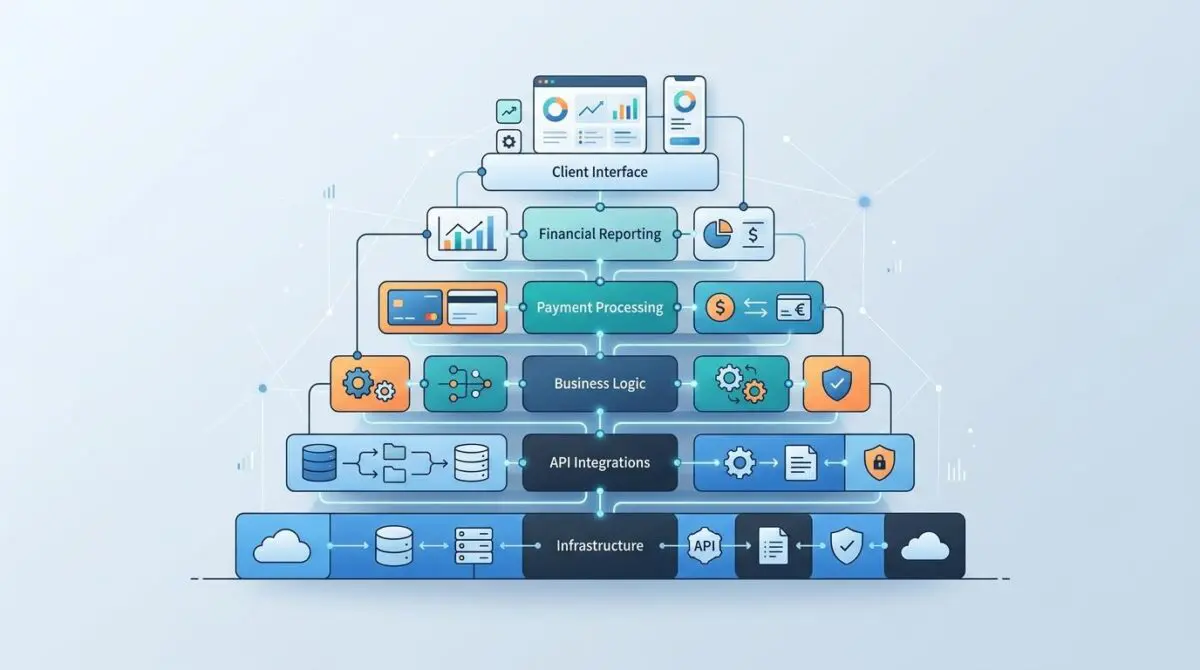
At the center of this disruption is the Autonomous Freelance Financial Infrastructure. This represents the ultimate FinTech stack for a freelancer, transforming fragmented banking applications into a cohesive, intelligent machine. It acts as an algorithmic CFO, seamlessly bridging the gap between raw creative output and institutional-grade wealth management.
For decades, solopreneurs operated at a distinct disadvantage compared to corporate entities. They suffered from delayed payments, disjointed tax liabilities, and a complete lack of yield-generating treasury tools. Today, disruptive technology has inverted this dynamic, turning the solo-operator into a highly efficient, capital-allocating powerhouse.
The shift is profound because it removes the human element from tedious financial maintenance. By automating capital flows, freelancers can dedicate 100% of their cognitive bandwidth to revenue-generating activities. The financial stack is no longer a passive storage mechanism; it is an active engine for wealth acceleration.
Market Intelligence & Capital Flow
The transition toward autonomous treasury management is heavily backed by institutional capital and aggressive venture deployments. Smart money is actively targeting vertical FinTech solutions that cater specifically to the nuances of the solo-economy. We are currently witnessing a historic decoupling from legacy retail financial institutions.
Market Intelligence & Data
AI-Tax Adoption
According to Deloitte’s 2026 Freelance Insights, nearly 9 in 10 freelancers now use automated tax-provisioning tools to eliminate year-end liability surprises.
VC Solo-FinTech Funding
Crunchbase 2026 data shows that venture capital investment into ‘Autonomous Solopreneur Finance’ startups hit a record $2.1 billion in the first quarter alone.
Efficiency Multiplier
A 2026 study by the London School of Economics found that freelancers using integrated FinTech stacks are 4.2 times more likely to scale their revenue compared to those using fragmented legacy tools.
Stablecoin Settlement
The 2026 Global Payments Report by JP Morgan indicates that 65% of cross-border freelance transactions are now settled via regulated stablecoins, reducing fee overhead by 80%.
This data paints a vivid picture of a financial ecosystem undergoing rapid, irreversible evolution. The venture capital flooding into this space is not chasing marginal software improvements or basic user interface updates. Instead, it is funding a complete paradigm shift in how individual economic agents store, move, and multiply their capital.
Broader macroeconomic analyses, such as those detailed in the World Economic Forum Future of Work Report, underscore the absolute necessity of these adaptive financial structures. As the gig economy matures into a high-leverage solo-economy, traditional retail banking simply cannot process the velocity of these micro-corporate transactions. Institutional investors recognize this friction, redirecting billions toward startups that build invisible, embedded banking layers.
The FinTech Deep Dive: Architecting the BOSaaS
The 2026 freelancer stack is fundamentally defined by Business-Operating-Systems-as-a-Service, or BOSaaS. These platforms have evolved far beyond basic invoicing to become predictive, AI-driven command centers. Generative AI models now execute real-time cash-flow forecasting, allowing independent contractors to manage liquidity with the precision of a Wall Street treasurer.
Capital is flooding into vertical FinTech firms like Lili and Found, which have successfully pivoted into AI-first entities. However, the true disruptors of 2026 are emerging platforms like NexaFlow and QuantSolo. These leaders dominate by offering invisible finance, where the banking and settlement layers are embedded directly into project management workflows.
Venture giants like Sequoia and Andreessen Horowitz have shifted their deployment strategies toward these autonomous solopreneur CFOs. These startups are designed to automate the entire accounting and investment lifecycle entirely without human oversight. The result is a frictionless environment where capital works continuously in the background.
Invisible Finance and Layer-2 Settlements
A critical component of this new architecture is the aggressive utilization of Layer-2 blockchain protocols. These decentralized networks enable instant, near-zero-cost international settlements for global contractors. By bypassing the legacy SWIFT system, freelancers recover massive percentages of their revenue previously lost to intermediary fees.
This shift is corroborated by deep industry research and shifting payment demographics. As highlighted in the Global Payments Report, the migration toward stablecoin settlements and decentralized rails is accelerating at an unprecedented pace. The modern freelancer demands cryptographic certainty and immediate liquidity upon project completion.
Data from the 2026 FinTech Pulse Survey reveals that 54% of solo-entrepreneurs in the tech sector have completely decoupled from traditional retail banks. They are opting instead for non-custodial decentralized finance platforms that offer instant liquidity against pending invoices. This mid-content insight proves that the future of freelance finance is inherently decentralized and non-custodial.
Eliminating the Complexity Tax
The primary friction solved by this ultimate FinTech stack is the heavy cognitive load of compliance. In the past, independent workers lost countless hours to manual bookkeeping and fragmented regulatory requirements. This inefficiency effectively functioned as a 25% complexity tax on their overall earning potential.
By automating the trifecta of tax, insurance, and retirement at the point of transaction, AI agents seamlessly reclaim this lost time. Smart contracts instantly route percentages of incoming revenue to designated tax-withholding wallets and high-yield decentralized pools. The solopreneur never even sees the gross capital, interacting only with the optimized net output.
While regulatory frameworks continue to adapt to these decentralized workflows, automated compliance engines ensure that freelancers remain fully insulated from audit risks. These platforms dynamically adjust withholding rates based on real-time jurisdictional tax codes. This guarantees perfect compliance without requiring the user to interpret dense legal statutes.
The Paradigm of Proof of Talent
Traditional financial institutions have historically struggled to underwrite freelance talent due to irregular income streams. Legacy risk models rely heavily on static credit scores and W-2 tax returns, which fail to capture the dynamic earning potential of a global contractor. This systemic flaw created a massive liquidity gap for top-tier independent professionals.
The new autonomous infrastructure solves this through a groundbreaking concept known as Proof of Talent. AI algorithms continuously analyze a freelancer’s GitHub commits, Upwork completion rates, and historical client retention metrics. By synthesizing these alternative data points, the system accurately projects future pipeline revenue with astonishing precision.
This real-time risk assessment allows embedded FinTech platforms to issue dynamic credit lines instantly. A developer can draw liquidity against a milestone that is only partially completed, utilizing capital to scale their operations immediately. It is a profound shift from backward-looking credit analysis to forward-looking revenue prediction.
The Strategic Action Plan: Deploying the Autonomous Stack
The next 18 months will dictate the hierarchy of the new solo-economy. The financial stack is moving aggressively beyond passive management into active, algorithmic wealth generation. For founders, developers, and institutional investors, the mandate is clear: build and adopt systems that operate autonomously.
Strategic Trajectory
- Cultivate ‘Personal Sovereign Wealth Funds’ to transition financial management into active, autonomous wealth generation.
- Deploy advanced AI agents to manage real-time currency hedging and trade execution for global contract work.
- Implement ‘Smart Escrow’ systems to ensure automated payment release based on AI-verified milestone completion.
- Mitigate financial volatility and eliminate non-payment risks through decentralized, programmatic payment infrastructures.
Executives must recognize that the future belongs to Personal Sovereign Wealth Funds tailored specifically for the individual. By deploying advanced AI agents, these micro-funds can autonomously trade and hedge currency risks for contractors operating across volatile global markets. This ensures that purchasing power is preserved regardless of macroeconomic fluctuations.
Additionally, the mass adoption of Smart Escrow protocols will fundamentally eliminate the risk of non-payment. Payment will be locked cryptographically upon project initiation and released automatically via AI-verified milestone completion. This programmatic trust layer is the final, essential piece of the autonomous freelance financial infrastructure.
For institutional investors, the strategic mandate involves funding the underlying infrastructure that supports these autonomous ecosystems. The smart money is moving away from consumer-facing challenger banks and toward robust API-first middleware. These invisible integration layers are exactly what allow project management tools to function as de facto banking institutions.
Conclusion: The Future of Smart Money
The evolution of the freelancer stack into an autonomous financial engine represents one of the most lucrative wealth transfers of this decade. Solopreneurs are no longer just independent workers; they are highly optimized, algorithmic micro-enterprises. The technology that powers them is reshaping the very boundaries of modern finance.
As Layer-2 protocols, generative AI, and invisible banking converge, the cognitive load of wealth management will effectively drop to zero. Those who architect, fund, and adopt these autonomous infrastructures will capture the lion’s share of the booming $6.4 trillion solo-economy.
Navigating the intersection of financial technology, institutional capital, and market psychology requires a sharp strategy. To future-proof your FinTech architecture and scale with precision, connect with Andres at Andres SEO Expert.
Frequently Asked Questions
What is Autonomous Freelance Financial Infrastructure?
Autonomous Freelance Financial Infrastructure is an intelligent FinTech stack that integrates banking, tax liabilities, and wealth management into an automated system. It acts as an algorithmic CFO, allowing freelancers to manage multi-currency revenue streams with institutional-grade efficiency.
How does AI-tax adoption benefit high-earning freelancers?
AI-tax adoption, currently utilized by nearly 9 in 10 freelancers, automates tax-provisioning and real-time withholding. This eliminates end-of-year liability surprises and ensures perfect compliance with jurisdictional tax codes without manual oversight.
What is BOSaaS in the context of the solo-economy?
BOSaaS stands for Business-Operating-Systems-as-a-Service. These are AI-driven platforms that provide predictive cash-flow forecasting and embed banking layers directly into project management workflows, moving beyond traditional invoicing to become active financial command centers.
How does the Proof of Talent model replace traditional credit scores?
Proof of Talent uses AI to analyze alternative data points such as GitHub commits, client retention rates, and work history. This allows FinTech platforms to project future revenue and issue dynamic credit lines based on earning potential rather than static, legacy risk models.
Why are stablecoins and Layer-2 protocols important for global contractors?
Layer-2 protocols and stablecoins enable instant, near-zero-cost cross-border settlements. By bypassing the legacy SWIFT system, global freelancers can reduce transaction fee overhead by up to 80% and achieve immediate liquidity upon project completion.
What are Smart Escrow systems for freelance work?
Smart Escrow systems use programmatic trust layers to lock payments cryptographically at the start of a project. Funds are released automatically through AI-verified milestone completion, fundamentally eliminating the risk of non-payment for independent professionals.