Key Points
- Semantic Entity Density: Maximize factual predicates and explicitly link concepts to Wikidata to improve LLM token-weighting and vector mapping.
- RAG-Friendly Architecture: Chunk content with concise, 150-word summary blocks to serve as primary extraction seeds for generative engines.
- JSON-LD Disambiguation: Deploy advanced Question/Answer schema to explicitly map document entities to established Knowledge Graph nodes.
Table of Contents
The AI Search Context
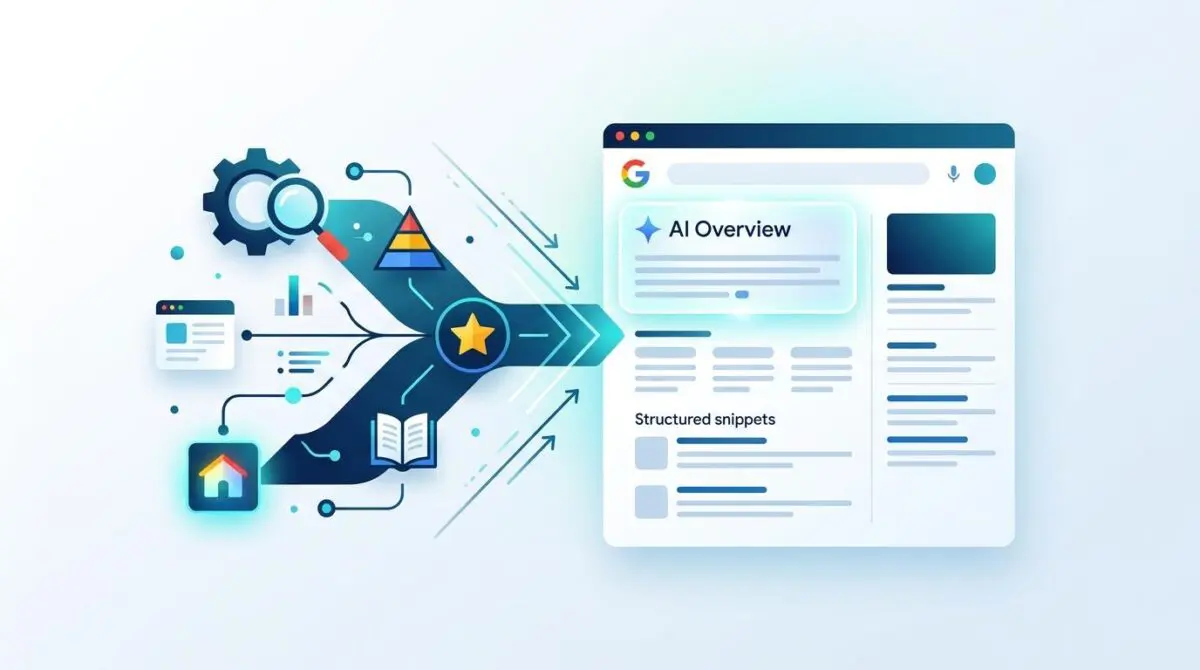
AI Overviews represent a fundamental shift in search technology. We are moving rapidly from a list-based retrieval system to a generative synthesis model. This process uses Retrieval-Augmented Generation (RAG) to combine information from multiple web sources into a concise, authoritative answer. For enterprise websites, this means that traditional keyword rankings are being actively superseded. The new mandate is to be selected as a cited source within the AI’s generated response.
According to a May 2026 study by Gartner, websites that fail to adapt their content for generative engines are predicted to experience a severe drop in organic search traffic by the end of the year. The impact is a dual-edged sword for enterprise domains. It can lead to a zero-click reality where users find answers without visiting a site. However, being cited as a primary source in an AI Overview provides unparalleled brand authority and high-intent referral traffic.
Optimization in 2026 focuses entirely on ensuring content is LLM-legible. Content must be structured in a way that AI models can easily parse, verify, and re-synthesize. This requires a transition from thematic, narrative content to entity-rich, fact-dense data structures. These structures must align with the logical inference patterns of large language models like Gemini and GPT-5.
To achieve this, technical SEOs must understand how vector databases store content. Modern search engines have transitioned from inverted indices to dense vector retrieval. They utilize cosine similarity to match conversational user intent directly to document embeddings. If your content is not mathematically optimized for these vector spaces, it will be invisible to the generative engine.
Core Architecture & Pillars
Core Architecture & Pillars
Semantic Entity Density
LLMs identify ‘entities’ (people, places, concepts) and their relationships via vector embeddings. To be selected for AIO, a page must have a high density of relevant entities connected by clear, factual predicates. This is analyzed at the server level during the indexing phase where nodes are weighted based on information-to-token ratios.
RAG-Friendly Document Architecture
Retrieval-Augmented Generation prioritizes content that is chunked effectively. AI engines look for specific ‘anchor’ sentences that summarize complex topics, which are then used as the ‘seed’ for the generated summary. If a document lacks clear summarization layers, the RAG system may skip it in favor of more modular competitors.
Verification & E-E-A-T Graph Signals
Modern AI Overviews use a ‘consensus-based’ validation model. If a site’s claims contradict the established consensus in the training set or other high-authority live results, it is filtered out to prevent hallucinations. The technical signal is sent via linked data and authoritative back-links from known ‘seed’ sites.
Conversational Intent Mapping
Search is shifting from noun-based queries to natural language logic. Optimizing for AIO requires content to be structured as an answer to a logical sequence of questions, mirroring the ‘chain-of-thought’ processing used by generative engines during inference.
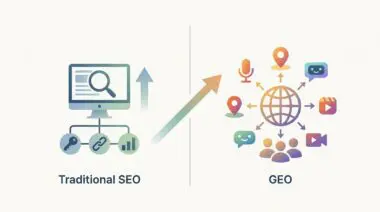
The shift toward Generative Engine Optimization (GEO) demands a fundamental rethinking of document architecture. Search engines no longer merely index keywords. They vectorize entire documents to map entities, relationships, and factual assertions. Organizations that fail to adopt these architectural changes are projected to see a 25% decrease in organic search traffic as traditional query volumes migrate to AI interfaces.
To be selected for AIO, a page must have a high density of relevant entities connected by clear, factual predicates. This semantic entity density is analyzed at the server level during the indexing phase. Nodes are weighted based on information-to-token ratios. In enterprise CMS environments, this involves moving beyond simple keyword tags. You must use advanced custom fields to ensure that every paragraph provides a distinct fact or relationship.
Retrieval-Augmented Generation prioritizes content that is chunked effectively. AI engines look for specific anchor sentences that summarize complex topics. These serve as the seed for the generated summary. If a document lacks clear summarization layers, the RAG system may skip it entirely. Chunks are typically processed in 512-token windows, making top-heavy summarization critical.
Modern AI Overviews use a consensus-based validation model to prevent hallucinations. If a site’s claims contradict the established consensus in the training set, it is filtered out. The technical signal is sent via linked data and authoritative back-links. A 2026 report by Perplexity AI revealed that pages utilizing schema tags to link content to established Knowledge Graph entities are 40% more likely to be featured as a primary source in AI-generated responses.
The Execution Roadmap
Implementation Roadmap
Implement Semantic Content Chunking
Rewrite core landing pages to include ‘Summary’ blocks at the top of each H2 section. Ensure each block is under 150 words and contains at least 3-5 distinct entities linked to the main topic.
Deploy Advanced JSON-LD Entity Schema
Modify the site header or use a schema plugin to inject ‘About’ and ‘Mentions’ schema, specifically identifying entities via their Wikidata or DBpedia URLs to remove any ambiguity for the AI crawler.
Optimize for Direct Answer Fragments
Use bulleted lists and tables for any comparative data. AI Overviews favor structured data for comparisons; formatting price lists or feature sets in HTML <table> tags significantly increases AIO inclusion rates.
Flush and Update Object Cache for Recency
Configure server-side caching (like Redis or Memcached) to ensure that when a page is updated with new facts, the ‘Last-Modified’ header is updated instantly, signaling AI crawlers to re-fetch and re-index for real-time RAG updates.
Implementing semantic content chunking requires rewriting core landing pages from the ground up. You must include summary blocks at the top of each structural section. Ensure each block is under 150 words. It must contain at least three to five distinct entities explicitly linked to the main topic. This modularity directly feeds the extraction algorithms of generative search engines.
Deploying advanced JSON-LD entity schema is no longer optional in the AIO landscape. You must modify the site header or use a schema plugin to inject specific metadata. Identify entities via their Wikidata or DBpedia URLs to remove any ambiguity for the AI crawler. This deterministic mapping resolves entity disambiguation issues during the vectorization phase.
Optimizing for direct answer fragments involves leveraging semantic HTML to its fullest extent. Use bulleted lists and tables for any comparative data. AI Overviews inherently favor structured data for comparisons. Formatting price lists or feature sets in standard HTML table tags significantly increases AIO inclusion rates.
Finally, recency is a critical ranking factor in RAG systems. You must configure server-side caching like Redis or Memcached properly. Ensure that when a page is updated with new facts, the Last-Modified header is updated instantly. This signals AI crawlers to re-fetch and re-index the document for real-time RAG updates, ensuring your data outpaces competitors in the generative snapshot.
Technical Implementation
To establish definitive entity relationships, raw schema injection is required. The following JSON-LD payload demonstrates how to explicitly link a document to the Knowledge Graph. It utilizes the SameAs property to map the topic directly to its Wikidata identifier.
Furthermore, wrapping the core content in a Question and Answer schema format aligns perfectly with conversational intent mapping. This syntax provides the exact node structure that LLMs parse during the retrieval phase. Deploy this script within the head of your target landing pages.
{
  "@context": "https://schema.org",
  "@type": "Article",
  "about": [
    {
      "@type": "Thing",
      "name": "AI Overviews",
      "sameAs": "https://www.wikidata.org/wiki/Q118289456"
    }
  ],
  "mainEntity": {
    "@type": "Question",
    "name": "How to optimize for AI Overviews?",
    "acceptedAnswer": {
      "@type": "Answer",
      "text": "Optimize for AI Overviews by using structured data, semantic entity density, and clear summary blocks that provide direct, factual answers to natural language queries."
    }
  }
}
Ensure that the JSON-LD is dynamically populated based on the specific entity focus of the URL. Static schema deployments often fail to trigger the granular entity recognition required by modern AI Overviews. The AcceptedAnswer text should exactly mirror the 150-word summary block placed at the top of your document chunk.
Validation & Future-Proofing
Validation & Monitoring
- Monitor the ‘Search Appearance’ section in Google Search Console, specifically filtering for ‘AI Overviews’ to track live performance metrics.
- Utilize LLM-based scraping tools to simulate target queries and audit the factual accuracy of AI-generated summaries.
- Use GEO platforms like BrightEdge to verify if your domain is being cited in the ‘sources’ carousel of the AI snapshot.
- Validate entity attribution by cross-referencing schema-linked Wikidata entries with the generative engine’s knowledge graph responses.
Validation in the era of Generative Engine Optimization requires a shift from tracking positions to tracking citations. You must monitor the Search Appearance section in Google Search Console. Filter specifically for AI Overviews to track live performance metrics and impression data. This reveals exactly which queries trigger a generative response for your domain.
Additionally, utilize LLM-based scraping tools or API integrations to simulate target queries. This allows you to audit the factual accuracy of AI-generated summaries referencing your domain. Use GEO platforms like BrightEdge to verify if your domain is being cited in the sources carousel of the AI snapshot.
Validate entity attribution by cross-referencing schema-linked Wikidata entries with the generative engine’s knowledge graph responses. As LLMs evolve, maintaining strict semantic discipline will be the primary moat against organic traffic decay. You must continuously audit your vector embeddings and token-to-information ratios.
Navigating the intersection of traditional SEO and Generative Engine Optimization requires a precise architecture. To future-proof your enterprise stack for AI Overviews and LLM discovery, connect with Andres at Andres SEO Expert.
Frequently Asked Questions
What is Generative Engine Optimization (GEO)?
Generative Engine Optimization (GEO) is a technical approach to content architecture that ensures data is legible for Large Language Models (LLMs). It prioritizes entity-rich, fact-dense structures over narrative content to align with how AI models parse, verify, and re-synthesize information for AI Overviews.
How does Retrieval-Augmented Generation (RAG) impact SEO strategy?
RAG shifts the focus from ranking in a list to being selected as a factual citation. AI engines use RAG to combine web sources into a single answer; therefore, content must be structured into effectively chunked, modular sections that can serve as ‘seed’ sentences for generated summaries.
What is semantic entity density in AIO optimization?
Semantic entity density refers to the concentration of people, places, and concepts (entities) and their relationships within a document. High entity density, defined by clear factual predicates, allows AI crawlers to weight content more heavily during the indexing phase and link it to established Knowledge Graphs.
How should enterprise content be chunked for AI engines?
Content should be organized into modular blocks with distinct ‘Summary’ headers. Ideally, these chunks should be under 150 words and fit within 512-token windows, providing direct, factual answers that AI extraction algorithms can easily identify and utilize.
Why is JSON-LD schema critical for AI Overviews?
Advanced JSON-LD schema, utilizing properties like ‘About’ and ‘Mentions’ linked to Wikidata URLs, removes entity ambiguity for AI crawlers. This deterministic mapping resolves identity issues during the vectorization phase, making a site 40% more likely to be featured as a primary source.
How does consensus-based validation prevent search hallucinations?
AI models use consensus-based validation to compare a site’s claims against established training data and other high-authority live results. If content contradicts the consensus, it is filtered out to maintain factual accuracy, making linked data and authoritative back-links essential technical signals.