Key Points
- Vector-Based Segmentation: Semantic chunking utilizes embedding models to partition text based on meaning rather than arbitrary character limits.
- RAG Precision: Dynamic chunking significantly reduces hallucinations and improves citation accuracy within enterprise retrieval-augmented generation pipelines.
- Agentic Pre-Scanning: Advanced architectures deploy lightweight LLMs to identify intent shifts and maintain contextual coherence for Generative Engine Optimization.
Table of Contents
The AI Search Context
Recent industry reports indicate that enterprises utilizing semantic chunking strategies have seen a massive increase in retrieval precision for their internal RAG systems. This metric underscores a fundamental shift in how search engines and large language models process unstructured data.
Traditional search relied heavily on keyword frequency and exact-match indexing. Today, platforms like SearchGPT and Google AI Overviews demand deep contextual cohesion to rank content effectively.
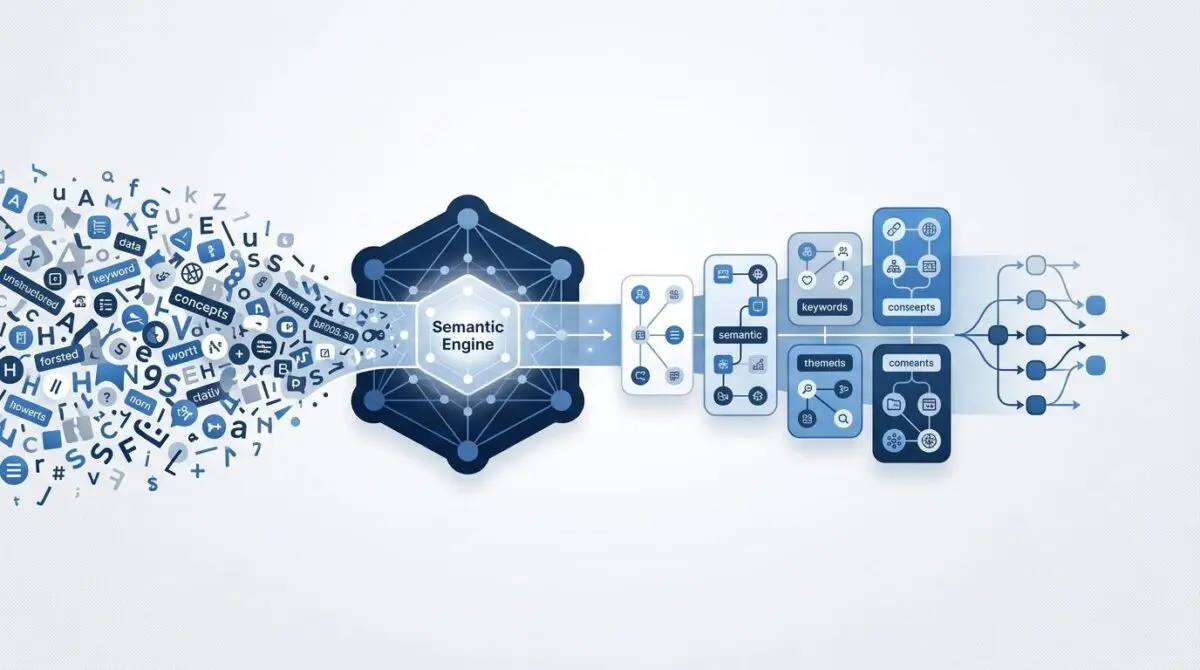
Semantic chunking is the advanced process of partitioning unstructured text into contextually coherent fragments. It relies entirely on meaning and thematic consistency while abandoning arbitrary character or word counts.
By utilizing vector embeddings to measure the similarity between sentences, semantic chunkers identify logical breakpoints where a topic shifts. This ensures that when an LLM or RAG system retrieves information, it receives a complete and logically sound idea.
Fragmented strings of text that lose their nuance are no longer acceptable in modern Generative Engine Optimization. Implementing semantic chunking allows enterprise content to be indexed with significantly higher retrieval relevance.
The impact of semantic chunking on GEO is truly transformative. For retrieval-augmented generation pipelines, semantic chunks provide higher signal-to-noise ratios.
This directly reduces LLM hallucinations and improves citation accuracy across AI search engines. Ensuring that your most critical insights are prioritized for AI-generated summaries requires a masterclass in vector-based text segmentation.
Core Architecture & Pillars
Core Architecture & Pillars
Cosine Similarity Thresholding
This strategy involves calculating the vector embeddings for every sentence in a document and comparing them to adjacent sentences. When the cosine distance exceeds a specific threshold, a semantic break is triggered.
Contextual Overlap Buffering
Unlike rigid splitting, semantic chunking incorporates ‘contextual bleeding,’ where a small portion of the previous semantic block is carried into the next to maintain narrative flow at the vector level.
Recursive Semantic Refinement
This uses a hierarchy of splitting rules: first by structural markers (H1, H2), then by semantic shifts within those sections, ensuring that the chunk size remains optimal for LLM context windows (e.g., 512 to 1024 tokens).
Agentic Chunking Logic
A high-level strategy where a secondary, lightweight LLM (like GPT-4o-mini) pre-scans the text to identify ‘Intent Shifts’ and marks chunk boundaries where a human would naturally transition topics.
Cosine Similarity Thresholding
At the heart of semantic segmentation lies mathematical text analysis. Every sentence in a document is converted into a high-dimensional vector using an embedding model. These vectors represent the underlying meaning of the text.
By comparing the vectors of adjacent sentences, systems can detect thematic continuity. When the cosine distance exceeds a specific threshold, the algorithm identifies a shift in topic.
This triggers a clean break, ensuring the resulting chunk contains only highly related concepts. Within headless CMS environments, this prevents plugins from cutting off mid-sentence or mid-argument.
Standard excerpt functions or basic RAG implementations often fail here. They destroy the contextual integrity required by modern LLMs to generate accurate responses.
Contextual Overlap Buffering
Rigid splitting often leaves isolated facts without their necessary preamble. Contextual overlap buffering solves this by introducing a controlled bleed between chunks.
A small percentage of tokens from the preceding block is intentionally duplicated into the start of the next block. This maintains narrative flow at the vector level.
In SEO-heavy content, this ensures that keywords and their supporting context are never separated. It allows Google’s AI Overviews to fully understand the relationship between a header and its supporting data points.
Recursive Semantic Refinement
Enterprise content often features complex hierarchies. Recursive semantic refinement addresses this by deploying a multi-tiered approach to chunking.
It first divides the document using structural markers like H1 and H2 tags. Once the structural skeleton is established, semantic shifts are analyzed within those specific sections.
This dual-layer approach ensures that the final chunk size remains optimal for LLM context windows. These windows typically range between 512 and 1024 tokens.
Leading AI search engines now prioritize sources that demonstrate semantic cohesion. This leads to a much higher citation rate for content processed through semantic segmentation.
For long-form technical guides, this recursive method prevents the LLM from losing the parent topic. It maintains focus even when analyzing a child sub-topic deep within a post.
Agentic Chunking Logic
The most advanced tier of semantic chunking involves autonomous reasoning. Agentic chunking logic utilizes a secondary, lightweight LLM to pre-scan the text.
Models like GPT-4o-mini are tasked specifically with identifying human-like intent shifts. Instead of relying purely on mathematical distance, the agent evaluates the narrative arc.
It marks chunk boundaries exactly where a human reader would naturally transition to a new topic. This is increasingly used to optimize high-value enterprise content for deep research modes in AI search engines.
The Execution Roadmap
Implementation Roadmap
Select Embedding Model
Choose a high-dimension embedding model such as OpenAI’s text-embedding-3-small or a local HuggingFace model (e.g., BGE-M3) to generate the vector representations needed for similarity comparison.
Define the Similarity Threshold
Set an initial percentile threshold (e.g., 95th percentile of distances) to determine where the ‘thematic breaks’ occur. Adjust this based on the typical density of your content.
Implement the Semantic Splitter
Deploy a SemanticChunker using libraries like LangChain Experimental or LlamaIndex. Integrate this into your content ingestion pipeline (e.g., via a Python script or a custom WP-CLI command).
Metadata Enrichment
For every chunk created, append metadata including the source URL, parent heading, and primary keyword to ensure the RAG system can provide accurate citations.
Vector Database Upsert
Push the semantically partitioned chunks to a vector database like Pinecone, Weaviate, or Milvus with an HNSW index for fast retrieval.
Step 1: Select Embedding Model
The foundation of any semantic chunking pipeline is the embedding model. This model dictates the dimensional space where your text will be analyzed.
High-dimension models like OpenAI’s text-embedding-3-small offer exceptional nuance for complex technical documents. Alternatively, local models from HuggingFace provide excellent multilingual support and data privacy.
The choice of model directly influences the accuracy of the similarity comparisons during the chunking phase. Selecting the right foundation is critical for long-term success.
Step 2: Define Similarity Threshold
Once vectors are generated, the system needs rules for separation. Setting a similarity threshold determines how drastically a topic must change before a new chunk is created.
A percentile-based approach is often the most reliable method. Setting an initial threshold at the 95th percentile of distances isolates the most significant thematic breaks.
You must adjust this threshold based on the typical information density of your content. The formatting style of your specific content corpus also plays a major role.
Step 3: Implement Semantic Splitter
Writing a custom semantic splitter from scratch is resource-intensive. Instead, developers should leverage established frameworks to save time and reduce errors.
You can deploy a SemanticChunker using libraries like LangChain Experimental to handle the complex vector math. This also automates sentence boundary detection seamlessly.
Once the library is configured and tested locally, the next step is automation. You must integrate this into your content ingestion pipeline to ensure all new publications are instantly optimized for RAG.
This integration is typically achieved via a Python microservice. Alternatively, a custom WP-CLI command can handle the processing efficiently.
Step 4: Metadata Enrichment
Raw text chunks are nearly useless without contextual anchors. Metadata enrichment is the process of tagging each semantic block with structured data.
This includes the canonical source URL, the exact parent heading, and the primary target keyword. When an AI search engine retrieves this chunk, the metadata acts as a citation blueprint.
It ensures the RAG system can provide accurate, clickable references back to your original domain. This is essential for driving referral traffic from AI platforms.
Step 5: Vector Database Upsert
The final step in the roadmap is storage and indexing. Semantically partitioned chunks must be pushed to a specialized vector database.
Platforms like Pinecone, Weaviate, or Milvus are engineered specifically for high-speed vector similarity search. Configuring an HNSW index within these databases guarantees millisecond retrieval times.
This speed is critical when serving dynamic context to user-facing LLM applications. It is equally important for custom AI search interfaces.
Technical Implementation
Executing a semantic chunking strategy requires precise integration with embedding APIs and text splitting libraries. The following Python implementation demonstrates how to initialize a dynamic chunker.
It uses LangChain Experimental and OpenAI’s embedding models to process the text. This provides a solid foundation for building your own automated pipeline.
from langchain_experimental.text_splitter import SemanticChunker
from langchain_openai.embeddings import OpenAIEmbeddings

# Initialize the embedding model
embeddings = OpenAIEmbeddings()

# Initialize the semantic chunker
text_splitter = SemanticChunker(embeddings, breakpoint_threshold_type="percentile")

# Split your content
with open('article.txt') as f:
    article_text = f.read()

documents = text_splitter.create_documents([article_text])

for i, doc in enumerate(documents):
    print(f"Chunk {i}: {doc.page_content[:100]}...")
Validation & Future-Proofing
Validation & Monitoring
- Verify semantic integrity by running ‘Retrieval Accuracy Tests’ using a tool like RAGAS.
- Compare the ‘Context Precision’ scores of semantic chunks versus fixed-size chunks in your LLM application logs.
- Monitor AI Search Console or Perplexity referral traffic to see if specific semantic blocks are being cited more frequently.
Deploying a semantic chunking pipeline is not a set-and-forget operation. Continuous validation is required as embedding models and LLM context windows evolve.
Engineering teams must verify semantic integrity by running automated retrieval accuracy tests. Tools like RAGAS provide quantitative metrics for context precision and recall.
By comparing the performance of semantic chunks against legacy fixed-size chunks, you can objectively measure the ROI of your GEO architecture. Analyzing your LLM application logs will reveal which chunking thresholds yield the lowest hallucination rates.
Furthermore, external monitoring is crucial for search visibility. Track your Perplexity referral traffic and analyze emergent AI Search Console data.
Identifying which specific semantic blocks are cited most frequently allows you to reverse-engineer the exact content structures that AI engines prefer.
Navigating the intersection of traditional SEO and Generative Engine Optimization requires a precise architecture. To future-proof your enterprise stack for AI Overviews and LLM discovery, connect with Andres at Andres SEO Expert.
Frequently Asked Questions
What is semantic chunking in the context of AI search?
Semantic chunking is an advanced data partitioning strategy that divides unstructured text into fragments based on thematic consistency and meaning rather than arbitrary word counts. By using vector embeddings to identify logical shifts in topic, it ensures that RAG systems and LLMs retrieve complete, coherent ideas, which increases retrieval precision by up to 40%.
How does semantic chunking improve Generative Engine Optimization (GEO)?
In GEO, semantic chunking improves content visibility by providing higher signal-to-noise ratios for AI search engines. By maintaining the contextual integrity of information, it reduces LLM hallucinations and improves the accuracy of citations in platforms like Perplexity and SearchGPT, making content more likely to be featured in AI-generated overviews.
What is the purpose of Cosine Similarity Thresholding in text segmentation?
Cosine Similarity Thresholding uses mathematical vector analysis to compare the underlying meaning of adjacent sentences. When the semantic distance between two sentences exceeds a specific threshold, the system identifies a shift in topic and triggers a chunk break, ensuring that each block of text remains focused on a single, specific concept.
Why is Contextual Overlap Buffering important for RAG pipelines?
Contextual Overlap Buffering involves intentionally duplicating a small portion of text from one semantic block into the next. This “contextual bleeding” prevents isolated facts from losing their necessary preamble, maintaining narrative flow at the vector level and helping AI engines understand the relationship between different data points.
What is Agentic Chunking Logic?
Agentic chunking logic is the most advanced tier of segmentation, where a secondary, lightweight LLM pre-scans text to identify human-like intent shifts. Rather than relying purely on mathematical thresholds, the agent determines chunk boundaries where a human reader would naturally transition topics, optimizing content for deep research modes.
How does metadata enrichment assist with AI citations?
Metadata enrichment tags each semantic chunk with structured data, such as its canonical URL, parent heading, and primary keyword. This creates a citation blueprint that allows RAG systems to provide accurate, clickable references back to the original domain when an AI search engine generates a summary based on that specific chunk.