Executive Summary
- Vector databases store data as high-dimensional embeddings, enabling semantic similarity searches rather than simple keyword matching.
- They serve as the foundational long-term memory for Large Language Models (LLMs) through Retrieval-Augmented Generation (RAG) architectures.
- For GEO, optimization requires increasing the semantic density of content to ensure high cosine similarity scores during the retrieval phase.
What is Vector Database?
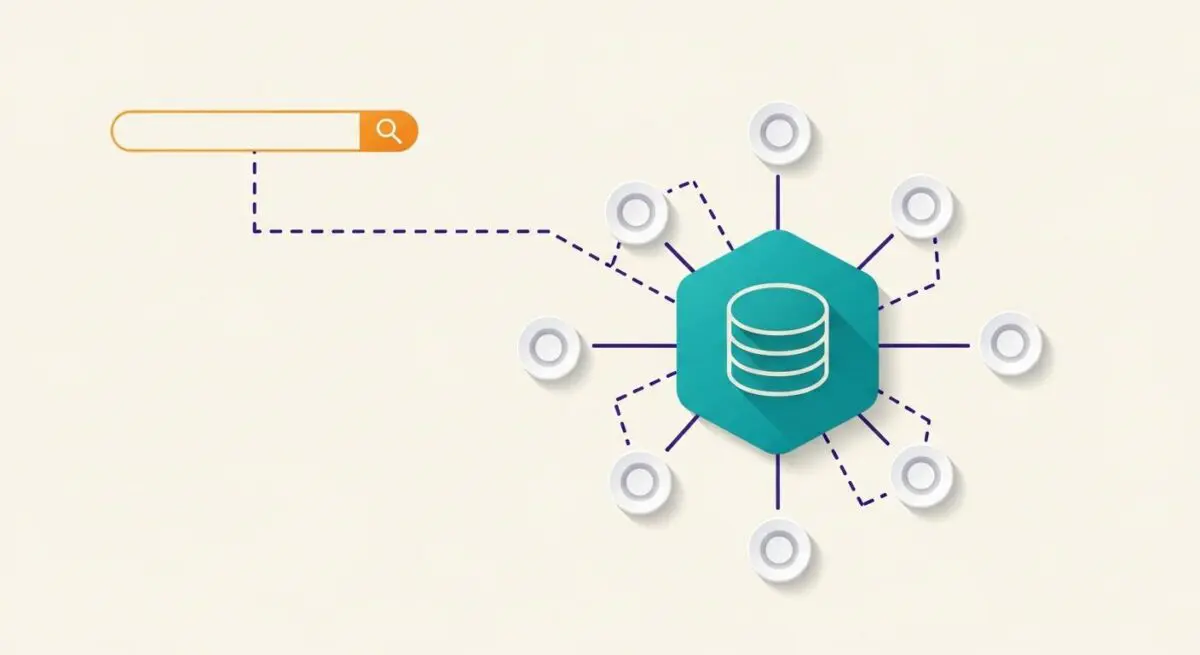
A vector database is a specialized storage engine designed to manage data represented as numerical vectors, often referred to as embeddings. Unlike traditional relational databases that store data in rows and columns or document stores that use JSON-like structures, vector databases index data based on mathematical coordinates in a high-dimensional space. These embeddings are generated by machine learning models (such as BERT, Ada, or proprietary LLM encoders) that transform unstructured text, images, or audio into a series of numbers that capture the semantic essence of the information.
The primary function of a vector database is to perform similarity searches, specifically finding the “nearest neighbors” to a given query vector. By utilizing algorithms like Hierarchical Navigable Small World (HNSW) or Inverted File Index (IVF), these databases can calculate the distance between vectors—using metrics such as Cosine Similarity or Euclidean Distance—at massive scales. This allows systems to retrieve contextually relevant information even when the query does not share any exact keywords with the source material, forming the backbone of modern semantic search and AI-driven retrieval systems.
The Real-World Analogy
Imagine a traditional library where every book is organized strictly by its ISBN number or the author’s last name. If you want to find books about “the feeling of nostalgia in autumn,” you would have to check every title or index manually. In contrast, a vector database is like a magical library where books are suspended in a 3D space. Books with similar themes, emotions, or topics physically float near each other. A book about “crisp October leaves” would be floating right next to a poem about “fading summer memories,” even if they were written centuries apart by different authors. To find what you need, you simply point to a spot in the air, and the library hands you everything hovering in that specific vicinity.
Why is Vector Database Important for GEO and LLMs?
Vector databases are the critical link between static LLMs and real-time, proprietary, or updated information. In the context of Generative Engine Optimization (GEO), vector databases facilitate Retrieval-Augmented Generation (RAG). When a user queries an AI search engine like Perplexity or ChatGPT, the system first converts that query into a vector, searches a vector database for the most relevant content “chunks,” and then feeds those chunks into the LLM to generate a response. If your brand’s content is not structured to be easily vectorized or if it lacks semantic depth, it will fail the similarity threshold and never be retrieved as a source.
Furthermore, vector databases impact entity authority and source attribution. AI engines use these databases to cluster related concepts. By maintaining high semantic consistency across your digital footprint, you increase the likelihood that your content is identified as a primary node for specific topics. This directly influences whether an AI engine cites your website as a definitive source or ignores it in favor of more mathematically relevant data points.
Best Practices & Implementation
- Optimize for Semantic Density: Ensure content is rich with contextually related terms and entities rather than repeating a single keyword. This creates a more robust embedding that is easier for vector engines to match.
- Implement Logical Content Chunking: Structure your technical documentation and articles with clear headings and concise paragraphs. Vector databases often retrieve data in “chunks”; if your content is disjointed, the retrieved segment may lose its meaning.
- Use Structured Data (Schema.org): While vector databases process unstructured text, providing clear metadata helps AI models better categorize and weight the importance of the information during the indexing phase.
- Maintain Entity Clarity: Clearly define the relationships between your brand, products, and industry concepts to ensure the embedding model maps your content to the correct high-dimensional neighborhood.
Common Mistakes to Avoid
A frequent error is the creation of “thin” content that lacks the semantic breadth necessary to generate a unique or strong vector. Another mistake is ignoring the “noise” within a page—excessive boilerplate text or irrelevant sidebars can dilute the primary vector of a content piece, leading to poor similarity matching. Finally, many brands fail to update their content regularly; since vector databases in RAG systems often prioritize the most recent or contextually accurate embeddings, stagnant content may eventually be pushed out of the retrieval window.
Conclusion
Vector databases represent the shift from keyword indexing to semantic understanding in the AI search era. For GEO professionals, mastering how content is vectorized and retrieved is essential for maintaining visibility in an ecosystem driven by mathematical similarity and RAG architectures.