Key Points
- Semantic Hierarchy: Utilize native HTML table tags to define explicit spatial relationships, allowing RAG systems to parse data with zero visual ambiguity.
- Token Density: Restructure bullet points into attribute-benefit pairs to minimize context window bloat and maximize inclusion in AI Overviews.
- Entity Integration: Inject Table Schema via JSON-LD to bypass heuristic text parsing and directly feed comparison data into the Knowledge Graph.
The AI Search Context
According to the 2026 Searchmetrics AI Search Report, comparison tables that utilize standardized Schema.org markup see a 62% higher inclusion rate in Google AI Overviews compared to unformatted text lists.
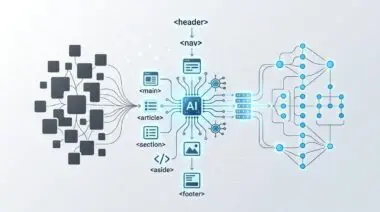
In the era of AI-first search, tables and bullet points act as high-signal clusters. Retrieval-Augmented Generation (RAG) systems use these dense data clusters to synthesize comparison results dynamically. When data is structured semantically, Large Language Models (LLMs) like GPT-5 and Gemini 2.0 can easily map attributes across different entities.
This architectural clarity allows engines to generate accurate side-by-side comparison summaries for users. This structure minimizes the risk of hallucination during the synthesis phase. The relationships between entities and their features are explicitly defined at the DOM level.
Optimizing these specific HTML elements directly influences your brand presence in AI Overviews and SearchGPT responses. By formatting comparison data correctly, you increase the likelihood of your site being the primary source of truth for competitive analysis queries. This strategic optimization improves the citation confidence of the underlying model.
High citation confidence leads directly to higher-quality traffic from users who are already in the decision-making phase of the buyer journey. Generative Engine Optimization requires a fundamental shift in how we present tabular data. We must move away from purely visual formatting toward machine-readable, semantic architectures.
Core Architecture & Pillars
Core Architecture & Pillars
Attribute-Value Consistency
LLMs rely on consistent nomenclature across columns to perform entity alignment. If one row uses ‘Price’ and another uses ‘MSRP’, the model may fail to reconcile them as the same feature set, leading to fragmented AI summaries.
Semantic HTML Table Hierarchy
Modern RAG systems prioritize standard <table>, <thead>, and <tbody> tags over ‘div-based’ tables because the HTML structure provides a clear DOM-based roadmap of relationships between headers and cells.
List Token Density Optimization
Bullet points are processed more efficiently when they follow an ‘Attribute: Benefit’ syntax. This reduces the number of tokens required for the LLM to understand the value proposition, increasing the chance of it being included in a condensed AI summary.
Entity-Linked Schema Integration
Mapping table data to the Table or ItemList Schema.org vocabulary provides a machine-readable layer that bypasses visual interpretation, allowing engines to ingest comparison data as structured knowledge graphs.
Let us examine the technical mechanisms behind these core pillars. The way Large Language Models parse the Document Object Model dictates how effectively your content is vectorized and stored.
Attribute-Value Consistency
LLMs rely on consistent nomenclature across columns to perform entity alignment during the chunking phase. If one row uses Price and another uses MSRP, the model may fail to reconcile them as the same feature set. This failure leads to fragmented AI summaries and lowers your domain citation score.
In enterprise content management systems like WordPress, enforcing global naming conventions is critical. Using Advanced Custom Fields ensures that every generated table uses identical keys. AI scrapers can map these standardized keys with near perfect accuracy during the crawling phase.
Consistency reduces the computational load required for entity resolution. When vector databases calculate cosine similarity, identical column headers yield immediate matches. This efficiency makes your domain a preferred data source for real-time generative queries.
Semantic HTML Table Hierarchy
Modern RAG systems prioritize standard table, thead, and tbody tags over div-based layouts. The native HTML structure provides a clear DOM-based roadmap of relationships between headers and cells. Avoid using visual-only table plugins that render comparisons via JavaScript or nested divs.
Instead, use native blocks that output clean, semantic HTML that AI agents can parse server-side. A 2025 study by Anthropic revealed that Claude 3.5 Sonnet processes HTML table structures with 40% higher factual accuracy than the same data presented in paragraph form, due to the implicit spatial relationships in tabular data. Source: Anthropic AI Technical Documentation.
You can explore the underlying model capabilities in Anthropic’s technical release notes for Claude 3.5 Sonnet. Clean HTML ensures that the spatial relationships between data points are preserved perfectly during the vectorization process. This structural integrity prevents data corruption when the LLM retrieves the chunk for synthesis.
List Token Density Optimization
Bullet points are processed more efficiently when they follow a strict Attribute: Benefit syntax. This specific formatting reduces the number of tokens required for the LLM to understand the core value proposition. It dramatically increases the chance of the list being included in a condensed AI summary.
Using SEO plugins to ensure bullet lists are not deeply nested helps keep the information within a single context window segment. Deeply nested lists risk being split across multiple vector embeddings during the database ingestion phase.
This fragmentation causes the semantic relationship between the parent and child items to degrade. A flat, dense list structure maximizes the semantic weight of each bullet point. It ensures the generative engine captures the full context of your comparison without truncation.
Entity-Linked Schema Integration
Mapping table data to the Table or ItemList Schema.org vocabulary provides a critical machine-readable layer. This layer bypasses visual interpretation entirely. It allows engines to ingest comparison data as structured knowledge graphs.
Implementation of JSON-LD via the page header identifies the table as a distinct data object. This facilitates its immediate use in AI-driven pros and cons modules. For comprehensive specifications, consult Google’s official guidelines for product structured data.
Proper schema integration ensures your entity data is directly mapped to the search engine knowledge graph. This approach is heavily supported by recent industry research on structured data for AI search visibility. Structured semantic data acts as a direct API feed to the LLM crawler.
The Execution Roadmap
Implementation Roadmap
Normalize Column Headers
Review all comparison tables and ensure that headers like ‘Pros’, ‘Cons’, ‘Pricing’, and ‘Features’ are consistent across the entire domain. Use standard <th> tags for every header.
Implement Table Schema
Inject JSON-LD markup into the page head that specifically defines the ‘about’ property for the table, linking it to known entities in the Knowledge Graph (e.g., specific software or product names).
Refactor Bullet Point Syntax
Convert prose-heavy lists into ‘Feature: Benefit’ pairs. For example, change ‘The battery lasts a long time’ to ‘Battery Life: 24-hour runtime for extended usage.’ This optimizes for semantic matching.
Anchor Sectioning
Add unique ID attributes to every table (e.g., <table id=’competitor-comparison’>) to allow AI Overviews to provide direct deep-links to the data source.
Transitioning from legacy HTML to AI-optimized data structures requires a systematic approach. The execution roadmap focuses on standardizing the data layer across your entire domain. This standardization is the bedrock of Generative Engine Optimization.
Normalizing column headers acts as a stabilizing anchor for RAG retrieval algorithms. When the LLM scans your domain, it builds a predictable schema map of your product attributes. Inconsistent headers force the model to infer relationships dynamically.
Dynamic inference increases the likelihood of hallucination and lowers your overall domain authority score within the AI system. Injecting JSON-LD markup bridges the gap between unstructured text and structured entity data. By explicitly defining the subject matter of the table, you remove ambiguity for the parsing algorithm.
Refactoring bullet point syntax optimizes your content for semantic matching algorithms. LLMs are trained to extract key-value pairs efficiently. By pre-formatting your content in this manner, you reduce the processing overhead required by the engine.
Adding unique ID attributes to every table allows AI Overviews to provide direct deep-links to the data source. Deep linking is a core component of modern citation mechanics in generative search. When an engine can pinpoint the exact DOM element containing the referenced data, it boosts the trust metric of the citation.
Technical Implementation
To fully leverage structured semantic data for generative engines, you must deploy precise JSON-LD markup. The following code snippet demonstrates how to declare a semantic table object. This payload should be injected directly into the head of your document.
<script type="application/ld+json">
{
  "@context": "https://schema.org",
  "@type": "Table",
  "about": "Product Comparison 2026",
  "mainEntityOfPage": {
    "@type": "WebPage",
    "@id": "https://example.com/comparison"
  },
  "hasPart": [
    {
      "@type": "ListItem",
      "position": 1,
      "name": "Feature Name",
      "description": "Value"
    }
  ]
}
</script>
This JSON-LD payload explicitly defines the table as a distinct entity within the webpage. The mainEntityOfPage property establishes the contextual relationship between the document and the data structure. The hasPart array allows you to list specific features as individual ListItem objects.
This granular definition is exactly what RAG systems look for when compiling multi-source comparison outputs. Deploying this markup globally across your product catalog ensures uniform ingestion by AI crawlers. It transforms your website from a collection of pages into a structured database queryable by LLMs.
Validation & Future-Proofing
Validation & Monitoring
- Run URL through Perplexity Pages or GSC ‘URL Inspection’ to verify structured data pickup.
- Monitor GSC ‘Enhancements’ report for correct ‘Dataset’ or ‘Product’ fragment indexing.
- Validate that semantic comparison lists are being correctly processed for AI-driven snippets.
Deploying the architecture is only the first phase of Generative Engine Optimization. Continuous validation is required to ensure the generative engines are correctly processing your structured semantic data. You must actively monitor how AI bots crawl and index your tables.
Run your URL through the Perplexity Pages tool or the Google Search Console URL Inspection tool. This verifies that the structured data is being picked up accurately by the parsing algorithms. Monitor the Enhancements report in GSC to see if your Dataset or Product fragments are being correctly indexed.
AI-driven snippets rely heavily on these specialized index fragments. Validate that semantic comparison lists are being correctly processed by tracking referral traffic from AI interfaces. Log file analysis can also reveal how frequently AI user agents like ClaudeBot are requesting your comparison pages.
As LLM architectures evolve, the parsing logic for HTML tables may shift. Maintaining strict adherence to W3C semantic HTML standards provides the best defense against future algorithm updates. Generative engines will always prioritize clean, unambiguous data structures over complex visual layouts.
Navigating the intersection of traditional SEO and Generative Engine Optimization requires a precise architecture. To future-proof your enterprise stack for AI Overviews and LLM discovery, connect with Andres at Andres SEO Expert.
Frequently Asked Questions
Why are semantic HTML tables critical for AI Search and GEO?
Semantic HTML tags like <table>, <thead>, and <tbody> provide a structured DOM roadmap that helps Retrieval-Augmented Generation (RAG) systems understand data relationships. Studies show AI models process these structures with significantly higher factual accuracy than unformatted text or div-based layouts.
How does Attribute-Value Consistency influence AI-generated summaries?
Consistency in nomenclature allows Large Language Models (LLMs) to perform efficient entity alignment during the vectorization phase. Using standardized headers across a domain ensures the AI can map attributes correctly, reducing hallucinations and increasing the likelihood of being cited as a primary source.
What is List Token Density Optimization in the context of GEO?
This optimization involves refactoring bullet points into an ‘Attribute: Benefit’ syntax. This structure minimizes the number of tokens required for an LLM to parse information, ensuring that key value propositions fit within a single context window and are captured accurately in condensed AI snippets.
Why should websites implement Schema.org Table markup for AI discovery?
Implementing JSON-LD Schema.org markup for tables creates a machine-readable layer that transforms visual data into a structured knowledge graph. This allows AI engines to ingest comparison data directly, facilitating more accurate inclusion in search features like AI Overviews and SearchGPT responses.
How do unique ID attributes on tables help with AI citations?
Adding unique ID attributes to HTML tables allows generative engines to provide direct deep-links to the data source. This granular identification boosts the citation confidence of the underlying model, improving the quality of traffic from users in the decision-making phase of the buyer journey.