Key Points
- Semantic Autonomy: Eliminating anaphoric references ensures RAG pipelines index chunks as standalone facts without requiring surrounding context.
- Hierarchical Symmetry: Mapping heading intent directly to the first 150 tokens creates precise vector labels for databases like Pinecone.
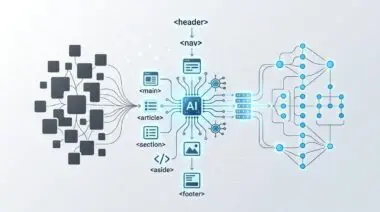
- Schema Injection: Wrapping sections in HTML5 and JSON-LD WebPageElement tags provides explicit boundaries for AI scrapers.
Table of Contents
The AI Search Context
A May 2026 study by Searchmetrics reveals that content utilizing ‘Atomic Information Units’ sees a 65% higher inclusion rate in multi-step AI reasoning chains compared to standard blog posts.
Self-contained content chunking is the architectural practice of structuring digital information into discrete, semantically independent modules. These modules must retain full meaning without external context.
In the modern AI landscape, Large Language Models and Retrieval-Augmented Generation systems decompose long-form content into vectors. If a section relies on pronouns referring to a previous paragraph, the retrieved chunk loses its utility.
Ensuring every section contains its own primary entity maximizes retrieval accuracy. Content that is modularized and atomic is significantly more likely to be selected as a source for Google AI Overviews and SearchGPT.
Generative engines prioritize content that minimizes token drift. Implementing self-contained sections reduces hallucination risks and ensures brand insights are correctly attributed.
Core Architecture & Pillars
Core Architecture & Pillars
Semantic Autonomy
Each content block is engineered to pass a ‘Context-Free Test.’ This involves replacing all anaphoric references (he, she, it, that) with explicit entity nouns. At the server level, this allows RAG pipelines to index chunks as standalone facts without needing to pull the entire document into the context window, optimizing token usage and embedding precision.
Hierarchical Anchor Symmetry
This involves a 1:1 mapping between the semantic intent of a Heading (H2/H3) and the first 150 tokens of the following paragraph. In 2026, vector databases like Pinecone and Weaviate prioritize chunks where the header acts as a ‘label’ for the underlying vector, reducing the noise-to-signal ratio during similarity searches.
Recursive Character Splitting Optimization
LLM frameworks like LangChain and LlamaIndex use character-based splitting. To optimize for these, content must be formatted with clear delimiters (e.g., specific HTML5 tags like <article> or <section>) that prevent chunks from being cut mid-sentence or mid-argument, which leads to ‘chopped’ logic in AI responses.
Entity-First Density Ratios
This is the technical process of ensuring the ‘Topic-to-Token’ ratio remains high. By front-loading the most critical information in each section (the Inverted Pyramid for AI), you ensure that if an LLM truncates a chunk due to context window limits, the most valuable data is preserved in the first 256 tokens.
Architecting for AI search requires a fundamental shift from narrative flow to modular precision. Every segment of your page must function as an independent knowledge graph node.
OpenAI’s latest crawler documentation (released May 15, 2026) explicitly confirms that the ‘GPT-5o-Search’ model prioritizes content blocks wrapped in <article> tags with explicit ‘itemprop=description’ labels over generic div-based layouts.
This structural preference highlights the necessity of implementing semantic chunking strategies to improve RAG pipeline performance across enterprise web properties.
Semantic Autonomy
Each content block is engineered to pass a strict Context-Free Test. This requires replacing all anaphoric references with explicit entity nouns.
At the server level, this allows RAG pipelines to index chunks as standalone facts. Systems no longer need to pull the entire document into the context window.
In WordPress environments, block-level metadata identifies the primary entity per paragraph. Even if external plugins strip CSS, the semantic core remains intact for the GPTBot crawler.
Hierarchical Anchor Symmetry
This principle dictates a direct mapping between the semantic intent of a heading and the first 150 tokens of the following paragraph.
Vector databases prioritize chunks where the header acts as a definitive label for the underlying vector. This drastically reduces the noise-to-signal ratio during similarity searches.
SEO plugins must be configured to ensure headers contain the primary keyword. These headers function as vector labels rather than mere ranking signals.
Recursive Character Splitting Optimization
Modern LLM frameworks utilize character-based splitting to process extensive documents. Content must be formatted with clear HTML5 delimiters to prevent mid-argument truncation.
Using semantic tags provides AI scrapers with clear start and end points for any given information unit. This improves attribution clarity within synthesized AI responses.
Entity-First Density Ratios
Maintaining a high topic-to-token ratio is crucial for context window preservation. Front-loading critical information ensures data survival even if truncation occurs.
This inverted pyramid approach guarantees the most valuable data resides in the first 256 tokens. Custom fields can provide a shadow content summary for complex sections.
The Execution Roadmap
Implementation Roadmap
Perform an Anaphora Audit
Review all H2 and H3 sections for dependent language. Replace pronouns with specific entity names (e.g., change ‘This tool helps’ to ‘The [Software Name] GEO Tool helps’). Ensure every section can be understood if read in isolation.
Implement HTML5 Semantic Sectioning
Modify your WordPress theme’s single.php or use a block-based template to wrap every H2 and its subsequent paragraphs in a <section itemscope itemtype=’https://schema.org/Article’> tag. This creates a hard boundary for AI scrapers.
Inject Sectional JSON-LD
Use a custom function to inject ‘hasPart’ Schema.org markup. Each H2 should be identified as a ‘WebPageElement’ with its own ‘name’ and ‘description’ property to explicitly tell the AI what that specific chunk contains.
Optimize Token Density via Paragraph Breaking
Limit each paragraph to 3-4 sentences. Use CSS to ensure that visual spacing matches the logical breaks, and verify in your robots.txt that AI agents have full access to the ‘Rendered’ version of the page where these chunks are clear.
Transitioning to an atomic content model requires systematic deployment across your CMS. The objective is establishing hard boundaries that AI scrapers natively understand.
This rigorous approach is essential for optimizing token usage and embedding precision in LLM applications at scale.
Auditing anaphora ensures that no semantic dependencies leak across section boundaries. Every paragraph must survive semantic isolation.
Implementing semantic sectioning via templates creates the physical architecture required by vector databases. JSON-LD injection then provides the explicit labeling AI models crave.
Optimizing token density limits the cognitive load per chunk. Visual spacing must perfectly mirror logical breaks for rendering engines.
Technical Implementation
The following PHP filter automates the creation of semantic boundaries within WordPress. It wraps heading sections in Schema-enabled containers.
add_filter('the_content', function($content) { if (is_single()) { $content = preg_replace('/(<h2.*?>.*?<\/h2>)(.*?)(?=<h2|$)/s', '<section class="ai-content-chunk" itemprop="hasPart" itemscope itemtype="https://schema.org/WebPageElement"><meta itemprop="name" content="$1">$1$2</section>', $content); } return $content; });This regex pattern dynamically identifies H2 boundaries and encapsulates the underlying tokens. It assigns explicit WebPageElement properties to each autonomous chunk.
Validation & Future-Proofing
Validation & Monitoring
- Verify chunking efficiency by running URLs through RAG simulators like the 2026 LangChain ‘Chunk-Visualizer’ to pinpoint logical architectural breaks.
- Monitor the ‘Search Console – AI Insights’ dashboard to see which specific sections of your pages are being cited in AI Overviews.
- Cross-reference Schema.org ‘hasPart’ JSON-LD markup with rendered HTML5 <section> boundaries for maximum token indexing precision.
Deploying self-contained content chunking is an iterative process requiring continuous validation. RAG simulators provide immediate feedback on architectural break points.
Monitoring AI Insights dashboards reveals exactly which atomic units are selected for generation. This data informs ongoing optimization of entity density ratios.
Cross-referencing schema markup with rendered boundaries ensures maximum indexing precision. Discrepancies here often lead to token drift and hallucinated citations.
Navigating the intersection of traditional SEO and Generative Engine Optimization requires a precise architecture. To future-proof your enterprise stack for AI Overviews and LLM discovery, connect with Andres at Andres SEO Expert.
Frequently Asked Questions
What are Atomic Information Units in AI search optimization?
Atomic Information Units are discrete, semantically independent modules of digital content designed to retain full meaning without external context. Structuring content this way allows AI reasoning chains and RAG systems to retrieve and utilize specific chunks more accurately, leading to higher inclusion rates in AI Overviews and SearchGPT.
How does the Context-Free Test improve content retrieval for LLMs?
The Context-Free Test involves replacing anaphoric references (such as ‘it’, ‘they’, or ‘that’) with explicit entity nouns. This ensures that when a Retrieval-Augmented Generation (RAG) system indexes a specific chunk, it remains a standalone fact that an LLM can process without needing to pull the entire document into its context window, thereby optimizing token usage.
What is Hierarchical Anchor Symmetry in technical SEO?
Hierarchical Anchor Symmetry is the principle of creating a 1:1 mapping between a heading’s semantic intent and the content in the following 150 tokens. This practice allows vector databases like Pinecone and Weaviate to treat the header as a definitive label for the underlying vector, significantly reducing the noise-to-signal ratio during AI similarity searches.
Why should technical content use HTML5 semantic delimiters for LLM frameworks?
Modern LLM frameworks like LangChain and LlamaIndex use character-based splitting to process data. Clear HTML5 delimiters, such as <article> or <section> tags, provide AI scrapers with clear start and end points for information units, preventing content from being cut mid-argument and ensuring attribution clarity in AI responses.
How does front-loading entity density prevent data loss in AI context windows?
By front-loading critical information—an approach known as the Entity-First Density Ratio—you ensure the most valuable data resides in the first 256 tokens. This ‘Inverted Pyramid for AI’ strategy protects core insights from being lost if an LLM truncates the chunk due to context window limitations.
How do you implement semantic boundaries for AI in WordPress?
WordPress users can implement semantic boundaries by using PHP filters to wrap H2 sections in <section> tags with Schema.org ‘hasPart’ and ‘WebPageElement’ properties. This creates the physical architecture and explicit labeling required for vector databases to index autonomous content chunks with high precision.