Executive Summary
- Utilizes advanced multivariate regression analysis to quantify the incremental impact of marketing channels on total revenue.
- Provides a privacy-centric attribution framework that functions independently of third-party cookies or individual user tracking.
- Accounts for exogenous variables such as seasonality, economic fluctuations, and competitor activity to ensure high model accuracy.
What is Media Mix Modeling?
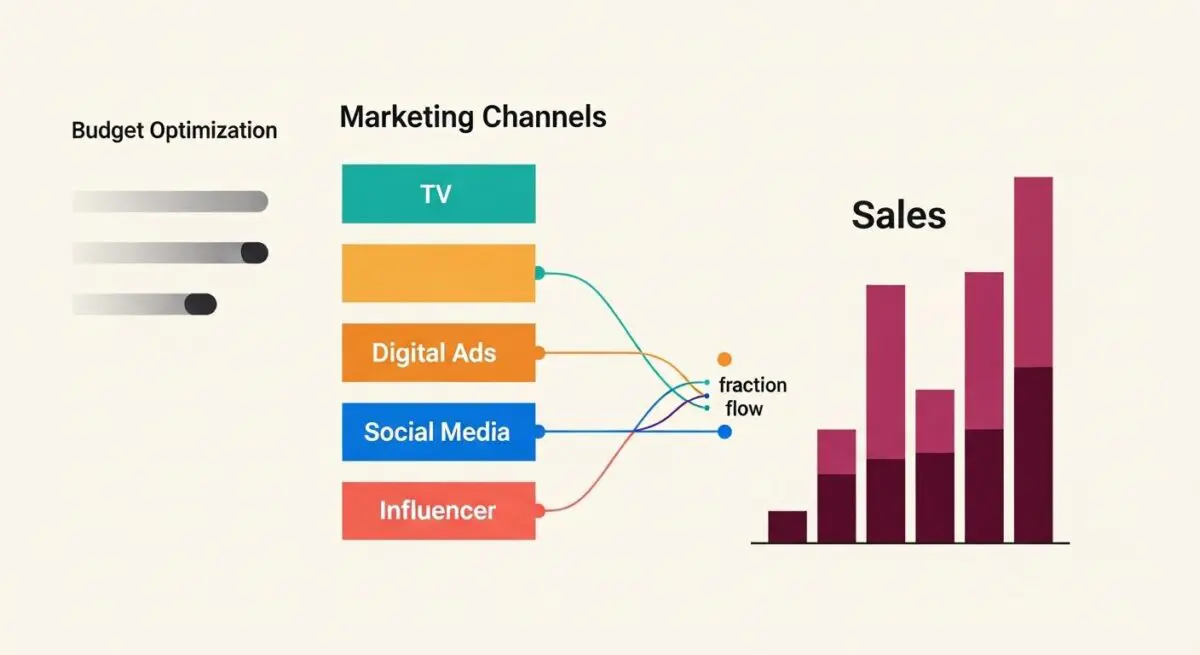
Media Mix Modeling (MMM) is a high-level statistical analysis technique used to estimate the impact of various marketing tactics on sales and then forecast future results. It employs multivariate linear or non-linear regression to determine how much each marketing input—such as organic search, paid social, programmatic display, and offline media—contributes to a specific Key Performance Indicator (KPI). Within a modern MarTech stack, MMM serves as a top-down measurement solution that aggregates historical data to identify correlations between spend and conversion, providing a holistic view of the marketing ecosystem.
Unlike granular tracking methods, MMM does not require user-level data, making it an essential tool in the era of General Data Protection Regulation (GDPR) and the deprecation of third-party cookies. By analyzing time-series data, MMM identifies the adstock effect (the prolonged impact of advertising) and diminishing returns, allowing data scientists and marketing directors to optimize budget allocation across diverse channels. In the context of Search Engine Optimization (SEO) and Generative Engine Optimization (GEO), MMM helps quantify the long-term value of organic visibility that often goes uncaptured by short-term attribution models.
The Real-World Analogy
Consider a professional sports team’s performance over a season. To understand why the team is winning, a manager cannot look solely at the player who scored the final goal (last-click attribution). Instead, they must analyze the entire ecosystem: the defensive strategy, the quality of the assists, the weather conditions during the game, and even the players’ fitness levels. Media Mix Modeling is the equivalent of a comprehensive seasonal data analysis that determines exactly how much credit the defense, the midfield, and the strikers deserve for the total wins, while also accounting for external factors like home-field advantage or injuries. It identifies which “player” or marketing channel is the most efficient contributor to the final score, regardless of who touched the ball last.
How Media Mix Modeling Impacts Marketing ROI & Data Attribution?
Media Mix Modeling significantly enhances marketing efficiency by solving the “walled garden” problem. While platforms like Google and Meta provide internal attribution, they often operate in silos, leading to double-counting of conversions. MMM provides a unified source of truth by analyzing all channels simultaneously. This leads to a more accurate calculation of Customer Acquisition Cost (CAC) and Return on Ad Spend (ROAS) by isolating the true incremental lift of each channel.
Furthermore, MMM bridges the gap between short-term performance and long-term brand equity. It allows organizations to see how upper-funnel activities, such as content marketing and SEO, influence lower-funnel conversions over time. By incorporating variables like price changes and macroeconomic trends, MMM ensures that marketing ROI is not falsely inflated by external demand surges, providing leadership with a realistic framework for strategic financial planning and scalable growth.
Strategic Implementation & Best Practices
- Ensure Data Hygiene: Consolidate at least two to three years of historical data across all marketing channels, including spend, impressions, and conversions, to account for seasonal cycles.
- Incorporate Exogenous Variables: Include non-marketing factors such as national holidays, economic indicators (CPI), and competitor pricing to prevent the model from misattributing external demand to marketing efforts.
- Account for Lag and Decay: Apply adstock transformations to reflect that the influence of a marketing touchpoint often persists days or weeks after the initial exposure.
- Validate with Incrementality Testing: Use randomized controlled trials (RCTs) or geo-lift tests to calibrate the MMM outputs and ensure the statistical correlations align with real-world causality.
Common Pitfalls & Strategic Mistakes
One frequent error is overfitting the model, where the statistical framework is too complex and captures noise rather than actual trends, leading to poor predictive capabilities. Another critical mistake is the omission of offline variables; failing to account for physical store promotions or traditional media can lead to an overestimation of digital channel performance. Finally, many enterprise brands treat MMM as a one-time project rather than an iterative process. Without regular updates and refreshes, the model quickly becomes obsolete as consumer behavior and market dynamics shift in the AI-driven landscape.
Conclusion
Media Mix Modeling is a foundational component of a sophisticated data architecture, offering a resilient, privacy-safe method for optimizing cross-channel investments. By integrating MMM with granular attribution, organizations can achieve a balanced, high-fidelity view of marketing performance that drives sustainable ROI.