Key Takeaways
- The pipeline compresses website creation from 3-5 days to under 15 minutes per page.
- It uses a seven-layer architecture with separate agents for planning, copy, code generation, and asset optimization.
- A human-in-the-loop gate ensures brand compliance and production reliability.
Table of Contents
From Days to Minutes: The Automation Pipeline Redefining Web Development
Marketing teams and technical founders have long accepted a frustrating reality: spinning up a targeted landing page takes three to five days of asynchronous effort across copywriters, designers, and developers. That paradigm now faces a structural challenge. A comprehensive technical blueprint published by N8N Lab demonstrates how an n8n-orchestrated AI agent pipeline can compress that entire cycle to under 15 minutes per page, with a single human approval gate standing between generation and production deployment.
The architecture, detailed in their newly released implementation guide, moves decisively beyond the limitations of off-the-shelf AI website builders. Those tools generate generic HTML that ignores brand guidelines, design systems, and deployment infrastructure. The N8N Lab framework instead constructs a multi-agent pipeline that plans site architecture, generates brand-aligned copy, produces React and Next.js components mapped to an existing component library, optimizes assets, and halts for human review before pushing live.
The business implications are substantial. Teams currently producing two pages per week can scale to over 50 without adding headcount, according to the performance benchmarks outlined in the guide. The architecture specifically eliminates hallucinated designs by constraining the AI to work exclusively within a pre-defined component library, a guardrail that N8N Lab identifies as the critical distinction between production-ready systems and experimental toys.
Inside the Seven-Layer Architecture That Enforces Brand Discipline
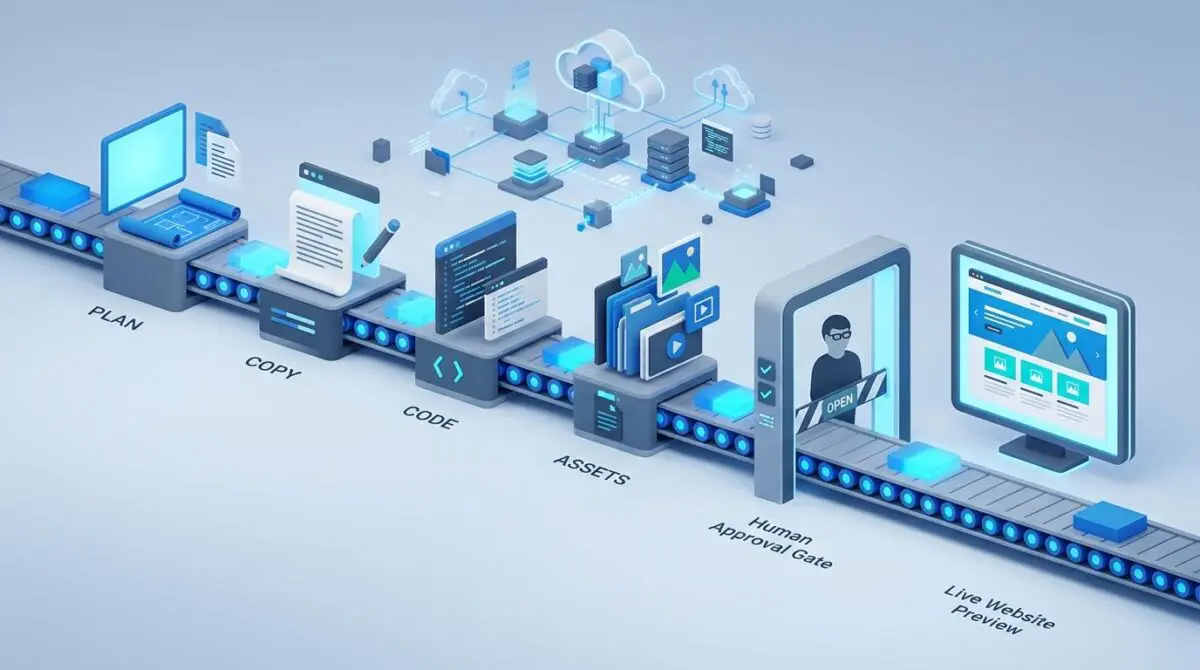
The pipeline is not a single monolithic prompt fired at a large language model. N8N Lab structures it as a seven-stage orchestrated workflow, with each layer handling a discrete responsibility and passing structured data to the next. This separation of concerns is what prevents the chaotic output that plagues simpler AI generation tools.
The perception layer begins with a webhook that ingests a structured JSON brief containing target audience, campaign goals, required sections, brand voice guidelines, and constraints. A validation gate immediately rejects incomplete briefs before they can waste expensive API calls downstream. The reasoning layer then activates a planner agent powered by Claude 3.5 Sonnet, which outputs a rigid JSON schema defining the sitemap and section-by-section outline. Critically, the component types are restricted to an enumerated list that matches exactly what exists in the organization’s React design system.
The content layer iterates over the approved plan, generating localized copy constrained by length requirements and CTA targets. N8N Lab recommends routing this task to a faster, cheaper model like Claude 3.5 Haiku, reserving Sonnet for complex reasoning and code generation. The code generation layer then maps the compiled plan and copy to actual Next.js component files, pushing them to a new GitHub branch created dynamically for each build.
Asset management flows through Cloudinary for automatic format optimization, WebP conversion, and dimensional cropping. The human review gate, which N8N Lab describes as the absolute most critical guardrail, suspends the entire workflow using an n8n Wait node and routes a Vercel preview URL to Slack or Microsoft Teams. Execution resumes only when a human clicks an approval link, after which the branch merges, the production build triggers, and a Lighthouse API check runs against the live URL.
What Autonomous Code Generation Means for the Automation Market
The broader automation industry is grappling with a labeling crisis. As the distinction between simple scripted automation and genuine agentic workflows blurs, procurement decisions become vulnerable to overpromising vendors. The N8N Lab guide enters this environment with a conspicuously precise definition of what constitutes a true AI agent pipeline: autonomous creation paired with zero autonomy in production deployment.
That human-in-the-loop architecture addresses a persistent anxiety among engineering leaders. The Wait node implementation, configurable with a 48-hour timeout and resilient against container restarts when backed by PostgreSQL, creates an audit trail that satisfies both compliance requirements and brand governance standards. The guide explicitly warns against running such workloads on SQLite-based n8n instances, where execution state vanishes on restart.
Cost transparency is another dimension where the guide diverges from industry norm. Rather than obscuring API expenses behind opaque pricing, N8N Lab publishes per-execution cost estimates of $0.05 to $0.15 when using Claude 3.5 Sonnet across all stages. Their recommended model routing strategy, offloading copy generation to Haiku, reduces costs by over 70 percent with what they describe as negligible quality impact. For teams contemplating programmatic SEO at scale, this level of financial visibility is essential to building a defensible business case.
The guide also surfaces practical failure modes that rarely appear in vendor marketing materials. Build failures caused by hallucinated component imports, Wait node timeouts exceeding default configurations, and off-brand copy resulting from overloaded context windows are all documented with specific remediation steps. This operational candor reflects a maturation in how automation practitioners discuss agentic systems, moving from aspirational demos toward hardened production patterns.
Beyond the Proof of Concept: When AI Agents Graduate to Enterprise Infrastructure
The architectural decisions documented in this pipeline carry implications that extend well beyond website generation. The pattern of constraint-based generation, where an AI agent operates freely within a tightly bounded design system, is applicable to documentation generation, internal tool creation, and API integration scaffolding. The core insight is that guardrails are not limitations on creativity but enablers of reliability.
Scaling this architecture to multi-page site orchestration, headless CMS integration, and automated A/B test variation generation are all on the immediate roadmap N8N Lab outlines. Each extension builds on the same foundational principle: structured data passing between isolated agents, with human judgment positioned at the only point where irreversible action occurs. For organizations managing sensitive brand data or proprietary code, the recommendation to self-host n8n within a virtual private cloud and fetch proprietary logic from internal databases rather than exposing it in webhook payloads is a non-negotiable security posture.
For teams ready to move beyond generic AI tools and deploy automation pipelines that respect brand integrity, enforce codebase consistency, and maintain human oversight over production deployments, the infrastructure and methodology demand equal rigor. Whether integrating with complex legacy design systems, containerized development environments, or custom CRM backends, the path from proof-of-concept to enterprise-grade reliability benefits from deep technical partnership.
Those exploring programmatic AI automation pipelines at production scale will find that execution velocity depends heavily on architectural decisions made at the orchestration layer, while performance engineering for web infrastructure ensures that generated pages maintain the speed benchmarks that search engines and users demand. To discuss how these patterns apply to your specific automation landscape, reach out to Andres directly or learn more about the technical philosophy driving Andres SEO Expert.
Frequently Asked Questions
How does the AI agent pipeline ensure brand consistency?
The pipeline ensures brand consistency by constraining AI to work within a pre-defined component library and enforcing brand voice guidelines. Each layer passes structured data, and the component types are restricted to an enumerated list matching the organization’s React design system.
What is the cost per execution of the automation pipeline?
The per-execution cost is estimated at $0.05 to $0.15 when using Claude 3.5 Sonnet across all stages. Routing copy generation to Claude 3.5 Haiku reduces costs by over 70%.
How does the human review gate work in the workflow?
The human review gate is implemented using an n8n Wait node that suspends the workflow and routes a Vercel preview URL to Slack or Microsoft Teams. Execution resumes only when a human clicks an approval link, after which the branch merges and production build triggers.
What are common failure modes and how are they handled?
Common failure modes include build failures from hallucinated component imports, Wait node timeouts exceeding default configurations, and off-brand copy from overloaded context windows. The guide provides specific remediation steps for each.
Can this architecture be extended beyond website generation?
Yes, the pattern of constraint-based generation is applicable to documentation generation, internal tool creation, and API integration scaffolding. Scaling to multi-page site orchestration, headless CMS integration, and automated A/B test variation generation is on the roadmap.
What is the recommended model routing strategy to reduce costs?
The recommended model routing strategy uses Claude 3.5 Sonnet for complex reasoning and code generation, and Claude 3.5 Haiku (faster and cheaper) for localized copy generation, reducing costs by over 70% with negligible quality impact.
How does the pipeline prevent hallucinated designs?
The pipeline prevents hallucinated designs by having a planner agent output a rigid JSON schema that restricts component types to an enumerated list matching the existing React design system. The code generation layer then maps the compiled plan to actual Next.js component files from the library.