



Executive Summary
- AVIF leverages the AV1 video codec to provide up to 50% better compression than JPEG and 20% better than WebP.
- The format supports advanced features like 12-bit color depth, transparency, and HDR for high-fidelity rendering.
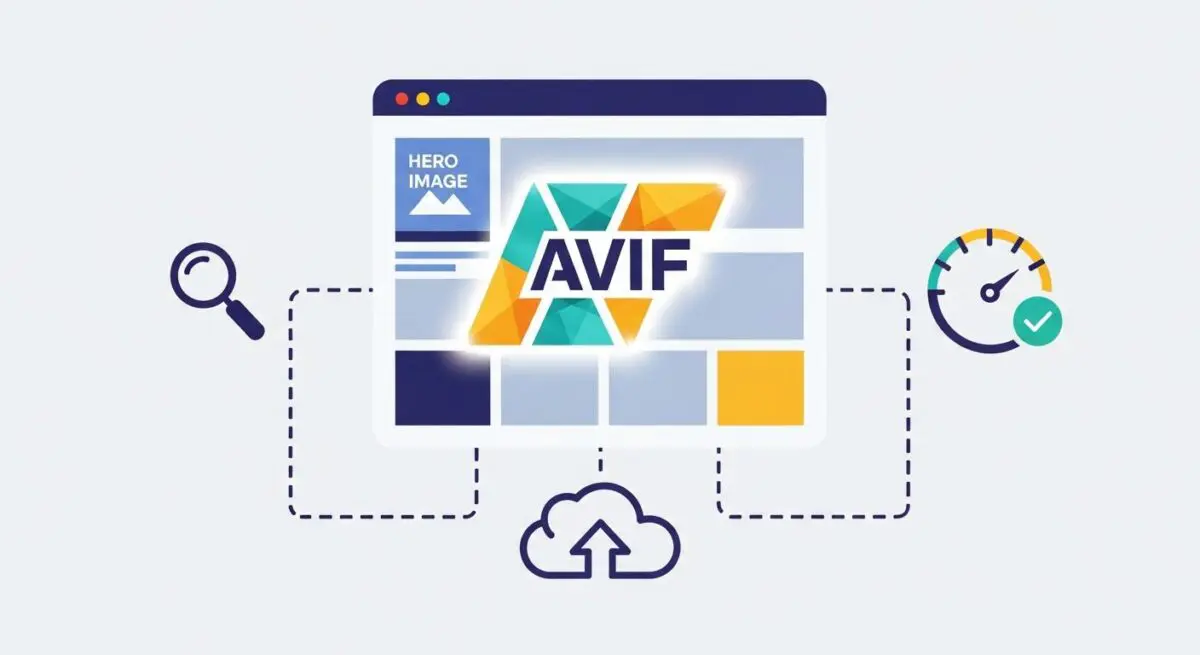
- Adopting AVIF directly optimizes the Largest Contentful Paint (LCP) metric by significantly reducing the byte-weight of hero images.
What is AVIF?
AVIF (AV1 Image File Format) is a high-performance, royalty-free image format derived from the keyframes of the AV1 video codec. Developed by the Alliance for Open Media (AOMedia), it utilizes advanced intra-frame compression techniques to deliver significantly smaller file sizes compared to legacy formats like JPEG, PNG, and even WebP, while maintaining or improving visual quality. It is designed to provide the highest possible compression efficiency for web-based visual assets.
Technically, AVIF supports a wide range of features essential for modern web development, including high dynamic range (HDR), wide color gamut (WCG), and 10-bit or 12-bit color depth. It employs sophisticated coding tools such as chroma subsampling and spatial prediction to eliminate redundancies within image data, making it the current gold standard for lossy and lossless image compression in the web performance ecosystem.
The Real-World Analogy
Imagine you are packing a suitcase for a trip. A standard JPEG is like folding your clothes neatly; it saves some space, but the bag is still heavy. WebP is like using a standard vacuum bag to suck out some air. AVIF, however, is like using a high-tech molecular compressor that shrinks the physical fibers of the clothing themselves without damaging the fabric. You can fit an entire wardrobe into a small carry-on bag, and when you unpack, the clothes look exactly as they did before—pristine and unwrinkled—but the effort required to carry that bag through the airport (the network) is drastically reduced.
Why is AVIF Critical for Website Performance and Speed Engineering?
In the context of Core Web Vitals, AVIF is a primary lever for optimizing the Largest Contentful Paint (LCP). Since images often constitute the largest byte-weight of a webpage, reducing their size directly accelerates the download phase of the critical rendering path. By migrating from JPEG to AVIF, engineers can often achieve 50% to 80% reduction in file size, which translates to faster Time to First Byte (TTFB) for the resource and quicker visual completion.
Furthermore, AVIF reduces the overall Total Byte Weight of a page, which is a critical factor for mobile users on constrained or high-latency networks. Lower data consumption improves the user experience and can lead to better engagement metrics. From a server perspective, serving smaller files reduces egress bandwidth costs and lessens the load on Content Delivery Networks (CDNs), allowing for more efficient edge caching and faster global delivery.
Best Practices & Implementation
- Implement Progressive Enhancement: Use the HTML
<picture>element to provide AVIF as the primary source while maintaining WebP or JPEG as fallbacks for browsers that do not yet support the format. - Automate via Image CDNs: Utilize modern CDNs or image transformation services that perform automatic content negotiation via the
Acceptheader to serve AVIF only to compatible clients. - Fine-tune Compression Levels: Avoid over-compressing; AVIF maintains high quality at lower bitrates, so a quality setting of 60-70 often yields better results than a JPEG at 85.
- Leverage Lossless for Graphics: Use AVIF’s lossless mode for logos and icons that require transparency, as it often outperforms PNG in both size and rendering speed.
Common Mistakes to Avoid
One frequent error is failing to provide fallback formats, which results in broken images for users on older browser versions. Another mistake is ignoring the CPU decoding overhead; while AVIF files are smaller to download, they require more computational power to decode than JPEGs. Finally, some developers use automated tools that do not properly preserve metadata, which can lead to unintended color shifts or the loss of essential ICC profiles.
Conclusion
AVIF represents the most significant advancement in web image compression in over a decade, offering unparalleled efficiency that directly enhances Core Web Vitals and user experience. For enterprise-level performance, integrating AVIF into the automated build pipeline is a technical necessity.