Executive Summary
- Centralization of asynchronous communication via unique identifiers (UUIDs) for robust state management.
- Integration with LLMs for automated intent classification and sentiment analysis within the JSON payload.
- Optimization of API-driven routing to reduce latency in multi-agent autonomous support systems.
What is Customer Support Ticketing?
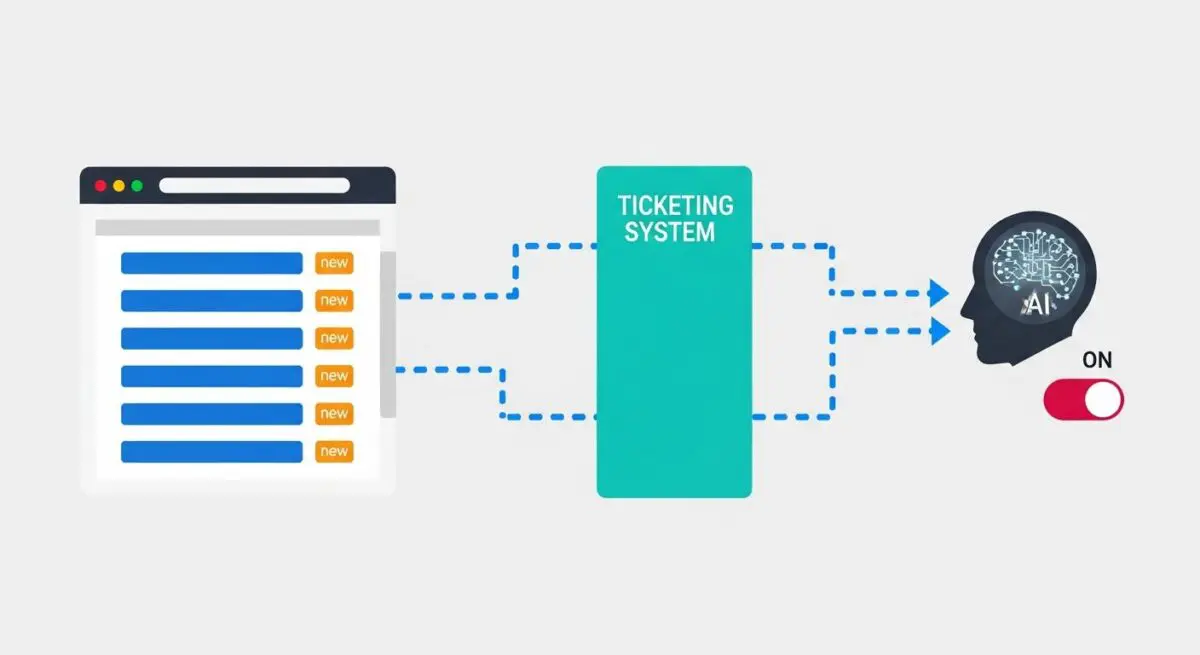
Customer Support Ticketing is a systematic framework for capturing, tracking, and resolving user inquiries through a centralized database of records. In the context of AI automations, a ticket functions as a structured data object—often a JSON payload—containing critical metadata such as unique identifiers (UUIDs), timestamps, user intent, and priority levels. This system transforms unstructured communication, such as emails or chats, into a stateful workflow that can be processed by both human agents and autonomous agents.
At its core, ticketing provides the infrastructure for asynchronous communication. By assigning a persistent ID to every interaction, organizations can maintain context across multiple sessions and channels. For AI-driven operations, this structured approach is essential for feeding Large Language Models (LLMs) with clean, contextual data, allowing for automated triage, sentiment analysis, and programmatic resolution without manual intervention.
The Real-World Analogy
Imagine a high-volume professional kitchen during peak hours. Instead of servers shouting orders at chefs, every request is printed on a standardized ticket and placed on a central rail. Each ticket specifies the table number, time of order, and specific dietary requirements. This rail allows the head chef—the orchestrator—to see the entire queue, prioritize urgent dishes, and assign tasks to specific stations. Once a dish is served, the ticket is stamped and filed, providing a permanent record. Customer Support Ticketing operates identically, ensuring no request is lost in the noise of a busy digital environment.
Why is Customer Support Ticketing Critical for Autonomous Workflows and AI Content Ops?
In modern AI Content Ops, Customer Support Ticketing serves as a primary data source for Programmatic SEO and knowledge base expansion. By analyzing ticket clusters, autonomous systems can identify recurring user pain points and automatically generate technical documentation or FAQ pages to address them. Furthermore, ticketing systems facilitate stateless automation; since the ticket object contains the entire history and context of an issue, AI agents can process requests independently without needing to maintain a constant server connection to the user.
From an engineering perspective, ticketing systems provide the necessary hooks for event-driven architectures. When a ticket status changes, it can trigger webhooks that initiate complex workflows, such as updating a CRM, notifying a Slack channel, or retraining a RAG (Retrieval-Augmented Generation) model. This ensures that the support ecosystem remains dynamic and responsive to real-time data inputs.
Best Practices & Implementation
- Standardize JSON Schemas: Ensure all ticket data follows a strict schema to facilitate seamless integration between the ticketing platform, middleware, and AI endpoints.
- Implement Webhook Triggers: Use real-time webhooks to push ticket updates to autonomous agents, reducing the latency associated with polling-based systems.
- Leverage RAG for Contextual Responses: Integrate Retrieval-Augmented Generation to allow AI agents to query internal documentation and provide accurate, technical solutions based on the ticket parameters.
- Maintain Data Hygiene: Regularly scrub and de-duplicate ticket data to ensure that the datasets used for fine-tuning AI models are accurate and high-quality.
Common Mistakes to Avoid
One frequent error is treating tickets as unstructured text blobs rather than structured data objects; failing to parse intent and sentiment at the point of ingestion limits the effectiveness of downstream automation. Another common mistake is the lack of rate limiting on automated responses, which can lead to recursive loops if two automated systems begin responding to one another within a single ticket thread.
Conclusion
Customer Support Ticketing is the foundational architecture for scalable, AI-driven user interactions, providing the structured data necessary for autonomous state management and programmatic content optimization.