



Executive Summary
- Establishment of topical authority through high-density, comprehensive information hubs that consolidate link equity.
- Optimization of Information Architecture (IA) using hub-and-spoke models to enhance crawl efficiency and semantic relevance.
- Improvement of long-term ROI by reducing Customer Acquisition Cost (CAC) through evergreen organic lead generation and assisted conversions.
What is Flagship Content?
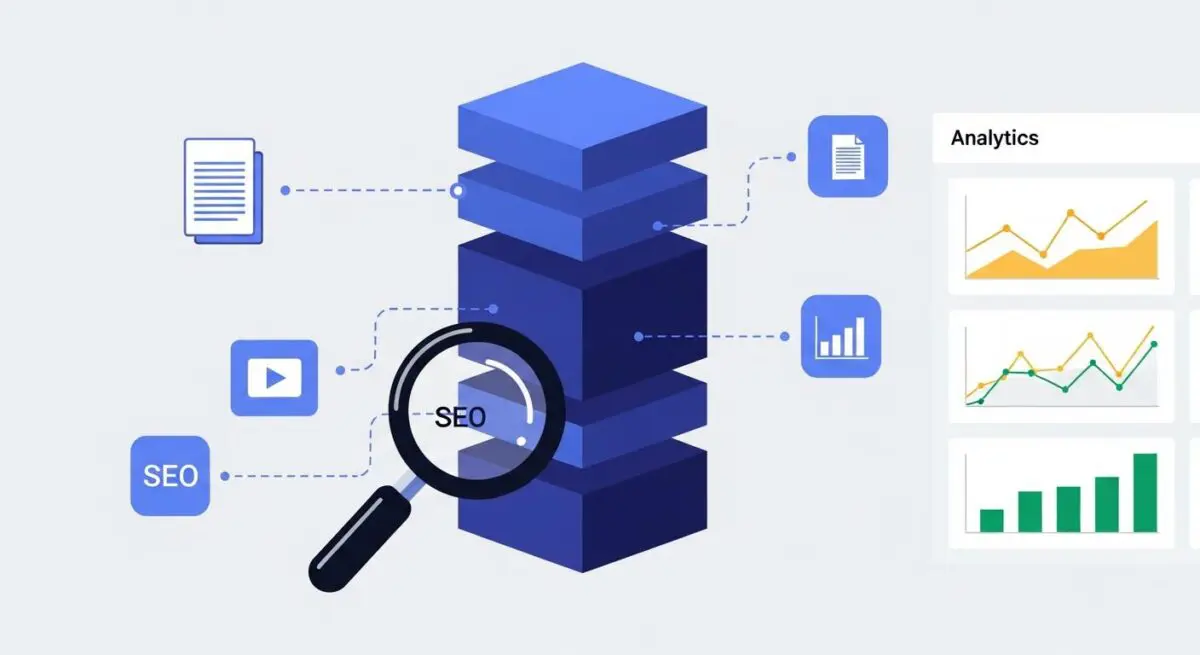
Flagship content, frequently categorized as cornerstone or pillar content, represents the most authoritative, comprehensive, and strategically significant assets within a digital marketing ecosystem. From a technical SEO and Information Architecture (IA) perspective, flagship content serves as the central node in a topic cluster. It is designed to be the definitive resource on a specific subject, synthesized to satisfy broad user intent while providing deep technical insights that smaller, auxiliary posts cannot cover. In the context of modern search algorithms, flagship content is a primary vehicle for demonstrating E-E-A-T (Experience, Expertise, Authoritativeness, and Trustworthiness), as it aggregates high-value data, original research, and expert synthesis into a single, high-performance URL.
Within a MarTech stack, flagship content functions as a foundational data asset. It is not merely a long-form article; it is a strategic tool used to capture high-volume head terms and mid-tail keywords. By consolidating information into a singular, robust entity, organizations can more effectively manage their internal link equity (PageRank). This technical consolidation prevents keyword cannibalization, where multiple weaker pages compete for the same search queries, and instead focuses the domain’s ranking power on a single, optimized destination. Furthermore, in the era of Generative Engine Optimization (GEO) and Large Language Models (LLMs), flagship content provides the dense, structured data necessary for AI agents to accurately crawl, index, and cite a brand as a primary source of truth.
The Real-World Analogy
To understand flagship content, consider the role of an “Anchor Store” in a high-end metropolitan shopping mall. While the mall contains dozens of smaller boutiques and specialized kiosks, the anchor store—typically a massive, well-known department store—is the primary reason consumers visit the location. It occupies the most significant square footage, offers the widest range of products, and generates the highest foot traffic. The smaller boutiques benefit from the overflow traffic and the prestige of being located near the anchor. In this analogy, the flagship content is the anchor store: it provides the massive value and authority that draws users to the domain, while your smaller, more specific blog posts are the boutiques that cater to niche interests and specific long-tail queries, all supported by the infrastructure and traffic generated by the central flagship asset.
How Flagship Content Impacts Marketing ROI & Data Attribution?
The impact of flagship content on Marketing ROI is multifaceted, primarily driven by its ability to lower long-term Customer Acquisition Costs (CAC). Unlike paid search campaigns that require continuous capital injection to maintain visibility, flagship content is an evergreen asset that compounds in value over time. Once the initial investment in research, production, and technical optimization is complete, the asset continues to generate organic traffic and leads with minimal maintenance. This shift from a variable cost model to a fixed-asset model significantly improves the Lifetime Value (LTV) to CAC ratio, a critical metric for enterprise scalability.
From a data attribution and analytics engineering perspective, flagship content plays a vital role in the multi-touch conversion path. Using advanced attribution models—such as linear or position-based models in Google Analytics 4 (GA4)—marketers often find that flagship assets serve as the “First Touch” or “Middle Touch” in a user’s journey. A user may discover the brand through a technical flagship guide, exit the site, and later return via a branded search or direct visit to convert. Without the flagship asset, the initial discovery phase is lost. By tracking metrics such as “Assisted Conversions” and “Scroll Depth,” data scientists can quantify how these deep-dive resources nurture prospects through the funnel, providing the necessary education to move them from the awareness stage to the decision stage without additional ad spend.
Strategic Implementation & Best Practices
- Topic Cluster Mapping: Before production, perform a comprehensive audit of your existing content to identify gaps in topical authority. Map out a hub-and-spoke model where the flagship content serves as the hub, and at least 5-10 supporting articles (spokes) link back to it using optimized, descriptive anchor text to signal semantic hierarchy to search engines.
- Technical Schema Integration: Implement advanced JSON-LD structured data, such as
Article,TechArticle, orGuideschema. This explicitly defines the entities, authors, and citations within the content, making it easier for search engines to include the asset in rich snippets, knowledge panels, and AI-generated summaries. - Performance-Driven UX Design: Given that flagship content is often media-rich and long-form, it is imperative to optimize for Core Web Vitals. Use lazy loading for images, minify CSS/JS, and implement a sticky Table of Contents (ToC) to improve navigation and reduce bounce rates, ensuring the page remains performant on mobile devices.
- Data-Backed Content Refresh Cycles: Flagship content must remain technically accurate to maintain its authority. Establish a quarterly review cadence to update statistics, refresh outdated links, and incorporate new industry developments. This signals to search crawlers that the content is “fresh,” which is a significant ranking factor for competitive head terms.
Common Pitfalls & Strategic Mistakes
A frequent error in enterprise content strategy is the “Set it and Forget it” mentality. Because flagship content requires significant initial effort, teams often neglect the necessary maintenance, leading to a gradual decay in rankings as competitors release more current data. Another critical mistake is failing to optimize for “Information Gain.” If a flagship piece merely aggregates existing information without providing unique insights, proprietary data, or a novel technical perspective, search algorithms—especially those utilizing helpful content updates—will prioritize original sources over derivative ones. Finally, many brands suffer from poor internal linking, leaving their flagship content as an “orphan page” that is not properly integrated into the site’s broader navigation, thereby wasting its potential to distribute link equity.
Conclusion
Flagship content is the cornerstone of a sophisticated, data-driven SEO strategy, acting as a high-authority hub that drives organic growth and supports the entire marketing funnel. By prioritizing technical depth, semantic structure, and regular maintenance, organizations can establish a dominant market position that scales efficiently and resists algorithmic volatility.