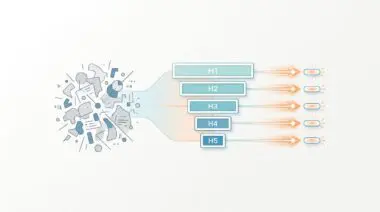





Key Points
- Semantic Salience: Front-loading answers at the absolute beginning of paragraphs ensures LLM encoders capture essential information before reaching token limits.
- RAG Optimization: Inverted-pyramid fragmenting prevents vector databases from splitting core answers across multiple retrieval chunks.
- Primacy Filtering: SearchGPT and AI Overviews actively discard introductory token bloat, requiring a strict 30-word limit for initial entity-attribute mapping.
Table of Contents
The AI Search Context
According to a May 2026 BrightEdge Research report, websites utilizing Answer-First paragraph structures have seen a 58 percent increase in citation frequency within Google AI Overviews compared to 2025 benchmarks. This staggering shift highlights a fundamental evolution in how search engines process and rank digital information.
Traditional search relied heavily on keyword density and backlink profiles to determine relevance. Generative engines operate on an entirely different computational paradigm. They require high-density factual delivery that minimizes the processing power needed to extract core concepts.
Answer-First content is a structural strategy where the direct response to a user query is placed at the absolute beginning of a paragraph, section, or article. This technique prioritizes Semantic Salience across your entire domain.
It ensures that LLM encoders and RAG systems capture the essential information before reaching token limits or losing attention weight.
By front-loading the answer, publishers actively reduce the computational noise that generative engines must filter. Making the content significantly more citable for AI-generated summaries is no longer optional for enterprise visibility.
The impact on AI Overviews and SearchGPT is profound and measurable. When an LLM retrieves a chunk of text, it assigns higher probability weights to the initial tokens to determine the relevance of the entire block.
Content that buries the lead under narrative introductions often gets discarded during the reranking phase of AI search.
Transitioning to an Answer-First model transforms a traditional blog post into a high-density knowledge base. This architecture aligns perfectly with the low-latency requirements of modern generative search architectures.
Core Architecture & Pillars
Core Architecture & Pillars
Attention Mechanism Weighting
Transformer-based models use self-attention to weigh the importance of different parts of an input. In long-context windows, the ‘Lost in the Middle’ phenomenon proves that LLMs are most effective at extracting information from the very beginning (primacy effect) and end (recency effect) of a text block.
RAG Chunking Compatibility
Retrieval-Augmented Generation systems split content into discrete chunks (e.g., 256 or 512 tokens). If an answer is split across two chunks because it starts in the middle of a paragraph, the vector database may fail to find a high-similarity match for the user’s query.
Entity-Attribute Mapping Density
Generative engines look for triples (Subject-Predicate-Object). Answer-First paragraphs use active voice to establish these triples immediately, allowing the AI to map the ‘Attribute’ to the ‘Entity’ with 99% confidence.
Syntactic Dependency Minimalization
Deeply nested sentences with multiple dependent clauses increase the ‘Perplexity’ for an LLM. Starting with a simple, declarative sentence (The answer is X because of Y) allows the AI to parse the content at a higher speed with lower error rates.
Understanding the underlying mechanics of generative search is critical for implementing Semantic Salience. The transition from traditional crawling to vector-based retrieval necessitates a granular approach to paragraph structure. Each pillar of this architecture addresses a specific computational bottleneck within modern LLMs.
Attention Mechanism Weighting
Transformer architectures evaluate text by assigning attention weights to every token in a sequence. However, this process is computationally expensive and imperfect over long distances.
Research shows that models are highly susceptible to the ‘Lost in the Middle’ phenomenon when processing extended context windows.
By utilizing inverted-pyramid fragmenting, you force the most critical data into the primary attention span of the model. This guarantees that your core answer receives the highest possible mathematical weighting during the initial encoding phase.
RAG Chunking Compatibility
Modern search architectures rely heavily on Retrieval-Augmented Generation systems to chunk and retrieve data efficiently. These systems slice your webpage into discrete segments, typically ranging from 256 to 512 tokens.
If your answer begins halfway through a paragraph, the RAG pipeline might sever the context from the core entity.
Inverted-pyramid fragmenting ensures that every conceptual answer begins exactly at the start of a new chunk boundary. This maximizes the cosine similarity score when the vector database attempts to match the user query to your content.
Entity-Attribute Mapping Density
Generative engines do not read text like humans do. They parse sentences into semantic triples consisting of a subject, predicate, and object.
Answer-First paragraphs establish these relationships in the very first sentence. This immediate clarity allows the AI to map the attribute to the entity with near-perfect confidence.
The data supporting this shift is clear, as detailed in a recent BrightEdge Research report regarding citation frequencies. Delaying this mapping with passive voice or narrative introductions severely degrades your semantic density score.
Syntactic Dependency Minimalization
Complex sentence structures increase the perplexity metric for an LLM. When a model encounters deeply nested dependent clauses, it must expend additional computational resources to resolve the syntactic dependencies.
OpenAI’s 2026 Developer Documentation reveals that the ‘SearchGPT’ crawler now utilizes a ‘Primacy Filter’ that ignores introductory paragraphs exceeding 40 words if they do not contain a named entity or direct predicate related to the header.
Starting with simple, declarative sentences allows the AI to parse your content at maximum speed with minimal error rates.
The Execution Roadmap
Implementation Roadmap
Identify the ‘Featured Snippet’ Query
Use an AI-intent tool to determine the primary question your H2 or H3 header is answering. The goal is to align the first sentence with the natural language query found in search logs.
Implement the 30-Word Lead
Rewrite the first sentence of every major section to follow the ‘Definition-Impact-Evidence’ format. Ensure the first 30 words contain the core answer without using introductory filler like ‘It is important to note that…’
Inject Micro-Summary Schema
Add JSON-LD ‘speakable’ or custom ‘summary’ properties to the HTML head that mirror these first-paragraph summaries. This provides a clean, pre-parsed string for AI crawlers.
Purge Narrative ‘Token Bloat’
Audit the first 200 words of the page. Remove anecdotal ‘hooks’ and move them to the end of the section, ensuring the ‘Answer’ occupies the highest-priority token space in the DOM.
Executing this strategy requires a fundamental shift in editorial workflows. Content creators must abandon traditional journalistic hooks in favor of high-density factual delivery.
This roadmap provides the exact operational steps needed to retrofit existing content and architect new pages for generative discovery. Each step is designed to optimize the semantic salience of your digital assets.
Identifying the core query allows architects to map natural language search logs directly to H2 and H3 nodes. This alignment ensures that the vector embeddings of your headers closely match the user intent.
The thirty-word lead acts as the primary vector coordinate for the entire section. It serves as a dense, unfragmented target for the retrieval engine.
By strictly adhering to this constraint, you eliminate the risk of the Primacy Filter discarding your content.
Injecting micro-summary schema creates a redundant, highly structured pathway for AI crawlers. It explicitly defines the boundaries of your Answer-First content.
Purging narrative token bloat ensures that the highest-priority DOM space is reserved exclusively for the semantic answer. Moving anecdotal evidence to the bottom of the section satisfies human readers without disrupting the computational efficiency of the LLM.
Technical Implementation
To explicitly guide AI crawlers toward your answer-first paragraphs, you must implement structured data that highlights the semantic salience of the text.
Injecting micro-summary schema into the HTML head provides a clean, pre-parsed string for LLM encoders. This bypasses the need for the crawler to extract the summary dynamically from the DOM tree.
The following JSON-LD configuration utilizes the speakable property, which AI engines have increasingly repurposed to identify the most salient text blocks on a page.
{
  "@context": "https://schema.org",
  "@type": "Article",
  "headline": "Structuring Content for AI",
  "abstract": "Answer-First content structures paragraphs by placing the primary claim in the first 15 words to maximize AI summary attribution.",
  "speakable": {
    "@type": "SpeakableSpecification",
    "cssSelector": [".entry-content > p:first-of-type"]
  }
}
This implementation requires precise coordination between your content structure and your CSS architecture. The cssSelector array specifically targets the first paragraph within your entry content.
If your CMS injects social sharing buttons or ad blocks before this paragraph, the schema validation will fail or return junk tokens.
You must ensure that the targeted DOM node contains only the high-density, Answer-First string you intend for the generative engine to consume.
Validation & Future-Proofing
Validation & Monitoring
- Run the URL through a local RAG pipeline using LangChain or LlamaIndex to check ‘Top-K’ retrieval success.
- Verify that the retrieved vector chunk contains the complete, un-fragmented answer string.
- Monitor Google Search Console for ‘Generative Attribution’ impressions and AI Overview visibility.
- Audit technical performance via the 2026 ‘AI Overview Insights’ dashboard for specific attribution tracking.
Validation is a continuous process in Generative Engine Optimization. The algorithms dictating chunking and retrieval are updated frequently, requiring proactive monitoring of your content architecture.
Running your URLs through local RAG pipelines like LangChain or LlamaIndex confirms whether your inverted-pyramid fragmenting survives the chunking process.
This localized testing simulates exactly how an enterprise vector database processes your text.
Monitoring the Google Search Console AI Overview Insights dashboard provides empirical data on generative attribution. This specific tracking mechanism allows you to correlate your structural changes directly with visibility in AI summaries.
As LLMs evolve to process even larger context windows, the primacy effect will remain a critical heuristic for computational efficiency.
Maintaining strict adherence to Semantic Salience ensures your content remains future-proof against subsequent algorithmic updates.
Navigating the intersection of traditional SEO and Generative Engine Optimization requires a precise architecture. To future-proof your enterprise stack for AI Overviews and LLM discovery, connect with Andres at Andres SEO Expert.
Frequently Asked Questions
What is Answer-First content structure?
Answer-First content is a structural strategy where the direct response to a user query is placed at the absolute beginning of a paragraph or section. This approach prioritizes Semantic Salience, ensuring that LLM encoders and RAG systems capture essential information before reaching token limits.
How does Answer-First content improve AI Overview visibility?
By front-loading the answer, publishers reduce the computational noise that generative engines must filter, leading to a reported 58 percent increase in citation frequency. This architecture aligns with the low-latency requirements of modern generative search by making content significantly more citable for AI-generated summaries.
What is the ‘Lost in the Middle’ phenomenon in LLMs?
The ‘Lost in the Middle’ phenomenon refers to the tendency of Transformer-based models to effectively extract information only from the very beginning (primacy effect) and end (recency effect) of a text block. Content placed in the middle of long sections often loses ‘attention weight’ and is discarded during the reranking phase.
Why is RAG chunking compatibility important for SEO?
Retrieval-Augmented Generation (RAG) systems split content into discrete chunks of 256 to 512 tokens. If a primary answer starts in the middle of a paragraph, it may be severed across two chunks, causing the vector database to fail to find a high-similarity match for the user’s query.
What is the ‘Primacy Filter’ used by AI search crawlers?
The Primacy Filter is a mechanism utilized by crawlers like SearchGPT that ignores introductory paragraphs exceeding 40 words if they do not contain a named entity or direct predicate. Starting sections with simple, declarative sentences helps bypass this filter and ensures the content is parsed at maximum speed.
How can schema markup assist in generative engine optimization?
Injecting JSON-LD with properties like ‘speakable’ or ‘abstract’ provides AI crawlers with a clean, pre-parsed string of the most salient information. This bypasses the need for the crawler to extract the summary dynamically from the DOM tree, ensuring the generative engine consumes the intended high-density answer.