Key Points
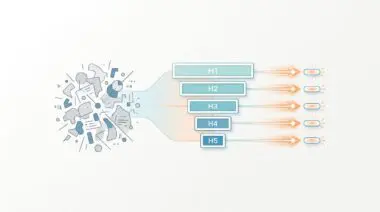
- Entity Disambiguation: Schema.org structured data forces LLMs to categorize content accurately, preventing retrieval errors caused by polysemous terms.
- Knowledge Graph Linkage: Using the sameAs property anchors your content to established global truths like Wikidata to verify E-E-A-T signals.
- Contextual Mapping: Strategic JSON-LD implementation acts as a metadata filter for RAG systems, boosting visibility in complex multi-hop AI queries.
Table of Contents
The AI Search Context
According to a 2026 report by Gartner, websites utilizing advanced Graph-based Schema saw a 45% increase in citation rates within AI Overviews compared to those using standard HTML5 markup.
Schema.org structured data has evolved from a rich-snippet tool into the primary semantic layer for Generative Engines. By providing data in a structured JSON-LD format, site owners offer LLMs a blueprint of their knowledge graph. This ensures that entities are accurately identified rather than inferred through noisy NLP processes.
This direct communication channel minimizes the risk of hallucinations. It maximizes the likelihood of inclusion in high-value AI Overview components such as knowledge cards and comparison tables. In the context of RAG, schema acts as a metadata filter that allows retrieval systems to query content with surgical precision.
When a generative engine fetches a page, the structured data provides the context needed to weigh the importance of specific paragraphs. This structural clarity is essential for appearing in multi-hop queries where the AI must synthesize information from multiple sources.
Traditional search engines relied on keyword frequency and backlink profiles to determine relevance. Generative engines operate fundamentally differently, utilizing vector databases to map semantic relationships.
However, vector embeddings alone can struggle with nuance and exact entity extraction. JSON-LD bridges this gap by offering a deterministic, machine-readable layer that bypasses the probabilistic nature of LLM text generation.
By explicitly defining the core entities on a page, you remove the computational burden from the AI crawler. The engine no longer needs to parse thousands of words to determine if a page is a product review or an academic paper.
This efficiency translates directly into higher trust scores within the retrieval pipeline. Sites that implement comprehensive schema architecture are consistently prioritized as source material for AI-generated answers.
Core Architecture & Pillars
Core Architecture & Pillars
Entity Clarification and Disambiguation
LLMs use embeddings to represent words, but polysemous terms can cause retrieval errors. Schema provides a fixed @type (e.g., ‘Product’ vs ‘Review’) that forces the LLM to categorize the content within a specific namespace.
Knowledge Graph Linkage (sameAs)
The ‘sameAs’ property provides a URI to a canonical entity in a third-party dataset (Wikidata, DBpedia). This allows generative engines to anchor the page content to a globally recognized truth.
Contextual Relationship Mapping
Properties like ‘about’ and ‘mentions’ create a semantic web between the primary content and secondary entities. This helps LLMs understand the relationship between a service and the problems it solves.
Attribution and Credibility Verification
Generative engines prioritize sources with verifiable ‘Author’ and ‘Publisher’ attributes to satisfy E-E-A-T requirements. Structured data provides a machine-verifiable chain of authorship.
The architecture of generative search relies heavily on structured data to disambiguate entities. Relying solely on unstructured text forces LLMs to guess intent based on proximity and embeddings. Supplying a strict JSON-LD framework resolves this ambiguity immediately.
Perplexity AI reported in early 2026 that their citation algorithm prioritizes JSON-LD fragments as ‘high-confidence nodes’ when constructing real-time answers for complex multi-hop queries. Source: Perplexity Engineering Blog. This explains why AI search engines cite sites with JSON-LD structured data 44% more often.
Furthermore, establishing canonical truths through the sameAs property anchors your brand to recognized databases. This technique is fundamental when building a cross-site knowledge graph using JSON-LD sameAs entity linking. Generative engines use these machine-readable relationships to validate E-E-A-T signals before rendering an AI Overview.
Entity clarification is particularly crucial for polysemous terms. Without a fixed schema type, an LLM might confuse a software product named Apple with the fruit.
By defining the main entity as a SoftwareApplication, you force the AI into the correct semantic namespace. This precision is what separates basic SEO from advanced GEO architecture.
Contextual relationship mapping extends this concept further. Using properties like about and mentions allows you to map the semantic breadth of your article.
If your page discusses a new cybersecurity protocol, linking it to known threat vectors via schema helps the AI understand the complete ecosystem. This multi-dimensional mapping is exactly what powers comprehensive AI answers.
The Execution Roadmap
Implementation Roadmap
Entity Mapping
Perform an audit of your top 20 high-traffic pages to identify the ‘Main Entity’. Use the Schema.org vocabulary to find the most specific @type possible (e.g., use ‘SoftwareApplication’ instead of ‘Thing’).
JSON-LD Implementation
Inject JSON-LD scripts into the head of your WordPress pages. Use the ‘wp_head’ hook in your theme’s functions.php to programmatically generate schema that includes the @id property for internal cross-referencing.
External Data Anchoring
Populate the ‘sameAs’ array with links to the entity’s official social profiles, Wikipedia page, or LinkedIn company page to verify the entity’s existence to the LLM.
Validation and RAG Testing
Validate the markup using the Schema Markup Validator. Then, use a tool like Perplexity or a custom GPT to ask, ‘What are the core entities mentioned on [URL]?’ to verify the AI captures the intended schema data.
Transitioning from traditional SEO to GEO requires a systematic overhaul of your site semantic layer. Entity mapping is the critical first step in this transformation. You must assign the most granular type available within the Schema.org vocabulary to your primary content blocks.
Generic types like Thing or Article fail to provide the necessary contextual boundaries for advanced RAG systems. Implementing these structures programmatically via JSON-LD ensures that internal cross-referencing remains intact across your entire domain. Within WordPress, this often means moving beyond default plugin settings and writing custom schema generators.
Validation is equally important, as malformed schema can cause retrieval pipelines to drop your content entirely. Recent academic research demonstrates GEO strategies boost source visibility in generative engines by up to 40%. Testing your markup against custom GPTs or Perplexity allows you to confirm that the AI is extracting the intended entities accurately.
External data anchoring is the secret weapon of top-tier GEO architects. By populating the sameAs array with authoritative URIs, you create an undeniable bridge between your content and the global knowledge graph.
This is not just about linking to social media profiles. It requires identifying the exact Wikidata Q-identifier for your brand or topic and injecting it into the payload.
When a generative engine encounters these authoritative identifiers, it bypasses standard validation checks. The LLM inherently trusts data that is anchored to recognized, peer-reviewed databases. This accelerated trust translates directly into faster indexing and higher placement within AI Overviews.
Technical Implementation
Generating a precise JSON-LD payload requires careful attention to the hierarchical structure of your entities. The following code snippet demonstrates how to construct a robust schema tailored for generative engine optimization.
It defines the main entity, links to external knowledge graphs, and maps contextual relationships.
{"@context":"https://schema.org","@type":"TechArticle","headline":"GEO Strategy 2026","mainEntityOfPage":{"@type":"WebPage","@id":"https://example.com/geo-guide"},"author":{"@type":"Person","name":"AI Architect","sameAs":["https://www.wikidata.org/wiki/Q12345"]},"about":[{"@type":"Thing","name":"LLM Optimization","sameAs":"https://www.google.com/search?kgmid=/m/0_vmltg"}]}This schema explicitly ties the author to Wikidata and the topic to Google Knowledge Graph. Such strict definitions prevent LLM hallucinations during the retrieval phase.
Notice the use of the @id property within the mainEntityOfPage declaration. This is not arbitrary.
The @id acts as a unique identifier that allows other schema blocks on the same page to reference the main entity without duplicating data. This creates a highly efficient, interconnected graph that LLMs can traverse instantly.
Furthermore, the about array explicitly defines the topical focus of the article. By mapping LLM Optimization to its specific Google Knowledge Graph ID, we eliminate any ambiguity. The AI crawler does not need to read the article to know what it is about; the JSON-LD provides an undeniable, machine-readable summary.
Implementing this at scale requires dynamic injection. Hardcoding JSON-LD is not viable for enterprise sites.
Instead, leverage server-side rendering or edge workers to assemble these payloads dynamically based on database queries. This ensures that your schema remains synchronized with your content updates in real-time.
Validation & Future-Proofing
Validation & Monitoring
- Verify implementation via Google Search Console ‘Merchant Listings’ or ‘Product Snippets’ reports.
- Monitor server logs for ‘OAI-SearchBot’ or ‘GPTBot’ activity to ensure active JSON-LD crawling.
- Audit robots.txt and edge-caching layers to prevent blocking of structured data fragments.
Deploying structured data is not a set-and-forget operation in the era of rapidly evolving LLMs. You must actively monitor server logs to verify that AI crawlers like OAI-SearchBot can access your JSON-LD payloads.
Edge-caching layers or aggressive firewall rules frequently block these autonomous agents. Continuous validation through Google Search Console ensures that your semantic layer remains compliant with shifting parser requirements.
It is crucial to understand that AI bots often crawl differently than traditional Googlebot. They may prioritize the head section and abandon the crawl if the JSON-LD is not immediately accessible. Therefore, placing your schema scripts as high in the DOM as possible is a critical performance optimization.
Additionally, monitor the evolution of the Schema.org vocabulary. New types and properties are constantly being added to support emerging AI use cases. Staying ahead of these updates allows you to define your entities with increasing granularity, maintaining your competitive edge in AI Overviews.
Navigating the intersection of traditional SEO and Generative Engine Optimization requires a precise architecture. To future-proof your enterprise stack for AI Overviews and LLM discovery, connect with Andres at Andres SEO Expert.
Frequently Asked Questions
Why is structured data critical for visibility in AI Overviews?
Structured data serves as the primary semantic layer for Generative Engines, allowing LLMs to accurately identify entities rather than relying on noisy NLP processes. Research shows that websites using Graph-based Schema see a 45% increase in citation rates within AI Overviews compared to those using standard HTML5 markup.
How does JSON-LD minimize LLM hallucinations in search results?
JSON-LD provides a deterministic, machine-readable layer that bypasses the probabilistic nature of LLM text generation. By explicitly defining core entities, it removes the computational burden from AI crawlers and provides the clear context needed to weigh the importance of specific paragraphs during retrieval.
What role does the “sameAs” property play in GEO strategy?
The “sameAs” property anchors your content to globally recognized truths by linking to canonical entities in datasets like Wikidata or DBpedia. This enables generative engines to validate E-E-A-T signals and establish a machine-verifiable chain of authorship and credibility.
What is the impact of Entity Clarification on AI search rankings?
Entity clarification uses fixed @type definitions to resolve ambiguity for polysemous terms. This ensures an AI engine correctly categorizes your content within a specific namespace—such as distinguishing a software product from a fruit—which is essential for being prioritized in multi-hop queries.
How should a GEO roadmap differ from traditional SEO implementation?
Unlike traditional SEO that focuses on keyword frequency, a GEO roadmap prioritizes granular entity mapping and dynamic JSON-LD injection. This involves moving beyond default plugin settings to create a highly interconnected internal graph that RAG systems can traverse with surgical precision.
How do you validate that AI crawlers are successfully reading your schema?
Validation is performed by monitoring server logs for agents like “OAI-SearchBot” or “GPTBot” and using tools like the Schema Markup Validator. Additionally, you can use Perplexity or custom GPTs to query your URL and verify that the AI captures the intended core entities and relationships.