Key Points
- Agentic Reasoning: Autonomous orchestrators utilize iterative thought-action loops to dynamically solve complex IT issues without static decision trees.
- Secure Orchestration: Deploying multi-agent frameworks and standardized context protocols ensures specialized, secure, and permissioned task execution.
- Enterprise Scalability: Transitioning Tier 1 support to AI-native platforms drastically reduces average handle times while liberating human talent for architectural projects.
Table of Contents
The AI Landscape
The enterprise IT environment is undergoing a massive shift driven by advanced Generative AI capabilities. By May 2026, AI-native platforms have driven a 65% resolution rate for Tier 1 tickets without human intervention. This drops the average handle time from 16 hours to under 3 minutes (Source: Lorikeet Research 2026).
This staggering metric highlights the obsolescence of traditional, human-centric helpdesk models. Organizations are no longer looking at AI as a mere assistive tool. They are fundamentally restructuring their IT operations around autonomous systems.
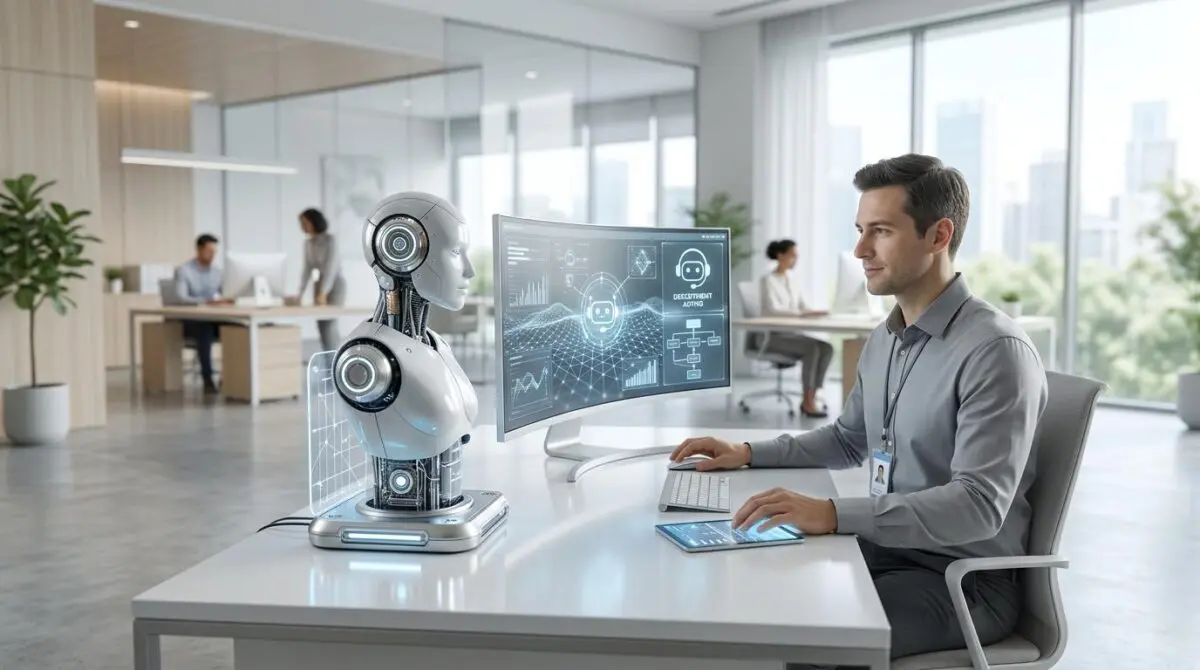
At the center of this revolution are Autonomous Agentic Helpdesk Orchestrators (AAHO). These systems represent a major shift from passive chatbots to active, goal-oriented digital workers.
Traditional chatbots rely on rigid decision trees and predefined conversational flows. In contrast, an AAHO leverages Large Language Models to interpret complex natural language requests dynamically. It can plan, execute, and validate multi-step technical workflows in real-time.
The integration of advanced agentic reasoning allows these orchestrators to operate with minimal human supervision. They are purpose-built to manage high-volume, repetitive requests across distributed enterprise environments.
Tasks such as password resets, software provisioning, and basic network troubleshooting are now fully automated. This automation fundamentally alters the operational economics of enterprise IT.
The impact on IT operations is profound and far-reaching. Helpdesks are rapidly transitioning from traditional cost centers into highly optimized efficiency hubs.
By automating the repetitive grunt work of Tier 1 support, organizations are unlocking immense value from their human workforce. Human technicians are liberated to focus on high-value Tier 2 and Tier 3 architectural projects.
Furthermore, the enterprise gains unparalleled 24/7 support scalability alongside absolute consistency in policy enforcement.
Core Concepts & Capabilities
Core Architecture & Pillars
Agentic Reasoning Loops (ReAct Pattern)
This involves the model alternating between ‘Thoughts’ and ‘Actions.’ At the server level, the LLM generates a reasoning trace, determines the necessary tool to call, and waits for the observation (tool output) before proceeding. This solves the conflict of static response trees which fail on dynamic technical issues.
Retrieval-Augmented Generation (RAG) Architecture
Instead of relying on internal weights, the agent queries a vector database (like Pinecone or Weaviate) containing indexed technical manuals and SOPs. This prevents the ‘technical conflict’ of hallucination by grounding the agent’s instructions in real-time, company-specific documentation.
Secure Function Calling and Tool Manifests
Agents are mapped to specific JSON-defined functions that interact with APIs. The conflict here is ‘Authorization Scoping’—ensuring an agent can only execute commands it is permissioned for. Technical execution relies on the Model Context Protocol (MCP) to provide a standard interface between the agent and IT tools.
Multi-Agent Orchestration (Specialization)
This architecture utilizes a ‘Master Agent’ that triages incoming tickets and delegates them to specialized ‘Worker Agents’ (e.g., Security Agent, DevOps Agent). This resolves the conflict of ‘Generalist Degradation,’ where a single model becomes less accurate as the complexity of its toolset increases.
The foundational technology powering an AAHO relies on a highly integrated stack of cognitive architectures. Gartner reports that 91% of customer service and support leaders are under active executive pressure to implement autonomous AI agents in 2026.
This push aims to combat rising labor costs and infrastructure complexity (Source: Gartner 2026). To meet this demand, understanding the underlying mechanics of these systems is non-negotiable. We must examine the specific pillars that enable autonomous operation.
Agentic Reasoning Loops
The core intelligence of an AAHO is driven by dynamic reasoning frameworks. The ReAct framework for synergizing reasoning and acting is critical to this operational capability.
By alternating between generating reasoning traces and executing task-specific actions, the model can navigate unpredictable IT environments. This cognitive loop allows the agent to observe the outcome of its actions and adjust its strategy accordingly.
At the server level, this translates to the LLM generating a specific thought process before making an API call. It evaluates the current state of the user’s issue against its available toolset.
If a diagnostic command returns an unexpected error, the agent does not simply fail. It ingests the error log as a new observation, formulates a new hypothesis, and attempts a secondary diagnostic route.
RAG Architecture
To operate effectively in an enterprise, an agent must possess highly specific contextual knowledge. Retrieval-Augmented Generation bridges the gap between a model’s foundational training and proprietary company data.
Instead of relying on static internal weights, the agent actively queries a vector database during its reasoning loop. This database contains semantically indexed technical manuals, standard operating procedures, and historical ticket resolutions.
This architecture effectively eliminates the risk of AI hallucination in technical support scenarios. When a user reports a specific software error, the agent retrieves the exact troubleshooting documentation relevant to that specific version.
The generated response and subsequent actions are strictly grounded in verified, real-time enterprise data.
Secure Function Calling
Intelligence without the ability to execute is useless in an IT helpdesk environment. Agents must interact directly with infrastructure through secure function calling.
This involves mapping the agent’s output to specific JSON-defined functions that trigger backend APIs. However, granting an AI access to enterprise systems introduces significant authorization scoping conflicts.
To mitigate these risks, modern deployments leverage standardized integration layers. Implementing Anthropic’s open-source Model Context Protocol provides a robust, secure interface between the cognitive agent and internal IT tools.
This protocol ensures that agents can only execute atomic, permissioned commands based on strict tool manifests.
Multi-Agent Orchestration
As the scope of Tier 1 support expands, a single generalized AI model quickly encounters performance degradation. The complexity of managing diverse toolsets across networking, security, and identity management overwhelms a singular context window.
The solution lies in deploying a supervisor-worker architectural topology. A master triage agent evaluates incoming requests and routes them to specialized worker models.
This approach dramatically increases the accuracy and efficiency of task execution. Utilizing a multi-agent orchestration framework for complex query resolution ensures that each sub-agent operates with a highly focused system prompt and a limited, specialized toolset.
A security agent handles suspicious login attempts, while a separate provisioning agent manages software license distribution simultaneously.
Strategic Implementation
Implementation Roadmap
Identify High-Frequency Ticket Archetypes
Perform a data audit of the last 12 months of helpdesk tickets. Map issues to ‘automation-ready’ categories such as account lockouts, VPN connectivity, and software license requests.
Construct the Agentic Knowledge Graph
Ingest all internal PDFs, Wiki pages, and WordPress documentation into a vector database. Implement a RAG pipeline using an LLM like GPT-4o or Claude 3.5 Sonnet to ensure the agent has access to current technical context.
Deploy Tooling via Model Context Protocol (MCP)
Connect the AI agent to your ITSM (e.g., ServiceNow or Jira) and identity providers (e.g., Azure AD) using API-first integrations. Define clear ‘tool manifests’ that restrict agent actions to safe, non-destructive commands.
Establish Human-in-the-Loop (HITL) Gateways
Configure the agent to automatically escalate to a human technician when ‘confidence scores’ drop below 85% or when the reasoning loop exceeds five iterations without a resolution.
Deploying an AAHO requires a calculated, phased approach to ensure seamless integration with existing IT Service Management workflows. Enterprises cannot simply turn on an LLM and expect it to resolve complex active directory issues.
The deployment strategy must begin with rigorous data auditing. Analyzing historical ticket data allows IT leaders to identify high-frequency, low-complexity ticket archetypes perfect for initial automation.
Once target workflows are identified, the focus shifts to constructing the agentic knowledge graph. This involves chunking and embedding enterprise documentation into a high-performance vector database.
The quality of the RAG pipeline directly correlates with the agent’s diagnostic accuracy. Poorly structured documentation will inevitably lead to flawed reasoning loops and failed task execution.
The integration phase requires strict adherence to API-first methodologies. Connecting the orchestrator to identity providers and ITSM platforms demands meticulous attention to tool manifests.
Every function exposed to the agent must be explicitly defined, constrained, and tested in a sandbox environment. Finally, establishing dynamic Human-in-the-Loop gateways ensures that the system fails gracefully.
This routes complex edge cases to senior human technicians without degrading the user experience.
Real-World Impact & Use Cases
The real-world implementation of AAHOs is aggressively reshaping the enterprise technology landscape. Organizations that successfully deploy these systems experience an immediate and drastic reduction in First Response Time.
Users no longer wait in digital queues for a human technician to become available. The orchestrator engages instantly, initiating diagnostic workflows the moment a ticket is submitted.
Ticket deflection rates soar as the agent resolves routine issues autonomously. This is particularly evident in identity and access management scenarios.
When a user requests a password reset or multi-factor authentication token sync, the AAHO verifies their identity via secure channels. It then executes the necessary backend commands in seconds, closing the ticket without human intervention.
Beyond simple resets, AAHOs excel in dynamic troubleshooting environments. Consider a user experiencing VPN connectivity issues.
The orchestrator can remotely query the user’s local network settings, analyze the VPN client logs, and cross-reference known outage databases. If it detects an outdated client version, it can automatically push the update via endpoint management tools.
This level of automation transforms the employee experience across the enterprise. Frictionless IT support leads to higher productivity and reduced operational downtime.
Furthermore, the data generated by the orchestrator provides IT leadership with unprecedented visibility into systemic infrastructure issues. Repeated agent interventions in a specific software module highlight underlying architectural flaws that human engineers can then proactively address.
Best Practices & Future Outlook
Strategic Best Practices
- Implement the Principle of Least Privilege (PoLP) for all agentic API keys to prevent unintended system-wide changes.
- Always disclose AI identity to end-users to maintain trust and manage expectations regarding empathy and judgment.
- Conduct weekly ‘Shadow Log’ audits where human leads review agent-resolved tickets to identify and correct emergent bias or logic drift.
- Maintain a strict versioning system for your Vector DB to allow for ‘knowledge rollbacks’ if incorrect technical documentation is accidentally indexed.
Navigating the deployment of autonomous systems requires strict adherence to cybersecurity and governance frameworks. The Principle of Least Privilege must be the foundational rule for all agentic API integrations.
An orchestrator should never possess global admin rights. Its permissions must be granularly scoped to the specific tasks outlined in its tool manifest.
Transparency is equally critical to successful enterprise adoption. End-users must be clearly informed when they are interacting with an autonomous agent.
This manages expectations regarding the system’s capabilities and limitations. It also builds trust, ensuring users are comfortable providing the necessary diagnostic information to the orchestrator.
Continuous monitoring and iterative improvement are vital for long-term success. Implementing weekly shadow log audits allows senior engineers to review the agent’s reasoning traces.
This proactive auditing identifies logic drift and ensures the agent remains aligned with evolving company policies. Furthermore, strict version control over the vector database guarantees that the agent’s knowledge base can be instantly rolled back if corrupted data is ingested.
Looking ahead, the capabilities of AAHOs will only expand as foundational models become more efficient at complex reasoning. The future of IT support is undeniably autonomous.
Organizations that master these orchestration frameworks today will possess a massive competitive advantage in operational agility and cost efficiency tomorrow.
Navigating the rapid evolution of Large Language Models and AI infrastructure requires a precise strategy. To stay ahead of the AI revolution and optimize your digital presence, connect with Andres at Andres SEO Expert.
Frequently Asked Questions
What are Autonomous Agentic Helpdesk Orchestrators (AAHO)?
Autonomous Agentic Helpdesk Orchestrators are AI-native systems that function as goal-oriented digital workers rather than passive chatbots. They utilize Large Language Models to interpret natural language requests and autonomously plan, execute, and validate complex technical workflows within an enterprise IT environment.
How does the ReAct pattern enhance AI helpdesk troubleshooting?
The ReAct (Reasoning and Acting) pattern allows AI agents to generate internal reasoning traces before executing API calls. By alternating between thinking and acting, the agent can observe the results of a command, adjust its strategy if it encounters an error, and navigate dynamic technical issues that rigid decision trees cannot handle.
What is the role of RAG in enterprise AI helpdesk support?
Retrieval-Augmented Generation (RAG) connects an AI agent to a vector database containing indexed technical manuals and company-specific SOPs. This architecture ensures that the agent’s instructions are grounded in real-time enterprise data, effectively eliminating the risk of technical hallucinations and inaccurate responses.
How does the Model Context Protocol (MCP) ensure secure tool integration?
The Model Context Protocol (MCP) provides a standardized, secure interface between AI agents and internal IT tools. It uses tool manifests to restrict agents to specific, permissioned, and non-destructive commands, ensuring that the AI operates within the Principle of Least Privilege (PoLP).
What are the benefits of multi-agent orchestration for IT support?
Multi-agent orchestration employs a supervisor-worker topology where a master agent triages tickets and delegates them to specialized worker agents (e.g., Security, DevOps). This avoids performance degradation by ensuring each agent uses a focused toolset and system prompt optimized for its specific domain.
What are the first steps in implementing an autonomous agentic helpdesk?
Strategic implementation begins with auditing historical ticket data to identify high-frequency archetypes for automation. Next, organizations must construct an agentic knowledge graph using a RAG pipeline, connect tools via secure protocols like MCP, and establish human-in-the-loop gateways for complex edge cases.