Key Points
- End-to-end AI orchestration is replacing fragmented automation, reducing time-to-hire by compressing initial response times to under 24 hours.
- The rise of personal AI agents has triggered a candidate integrity crisis, rendering traditional keyword filtering obsolete in favor of biometric interview intelligence.
- Smart capital is shifting toward predictive workforce planning and verifiable performance data, effectively eliminating the reliance on degree-based credentials.
Table of Contents
The Orchestration Imperative
Data from MSH Talent in May 2026 reveals a startling reality for modern enterprises competing for top-tier talent. While a staggering 87% of companies have integrated artificial intelligence into their hiring stack, only 1 in 5 large employers have successfully achieved end-to-end AI orchestration across the full hiring process.
This massive execution gap represents a critical market friction that is quietly draining corporate resources. We are witnessing a fundamental shift in how organizations acquire and deploy human capital globally.
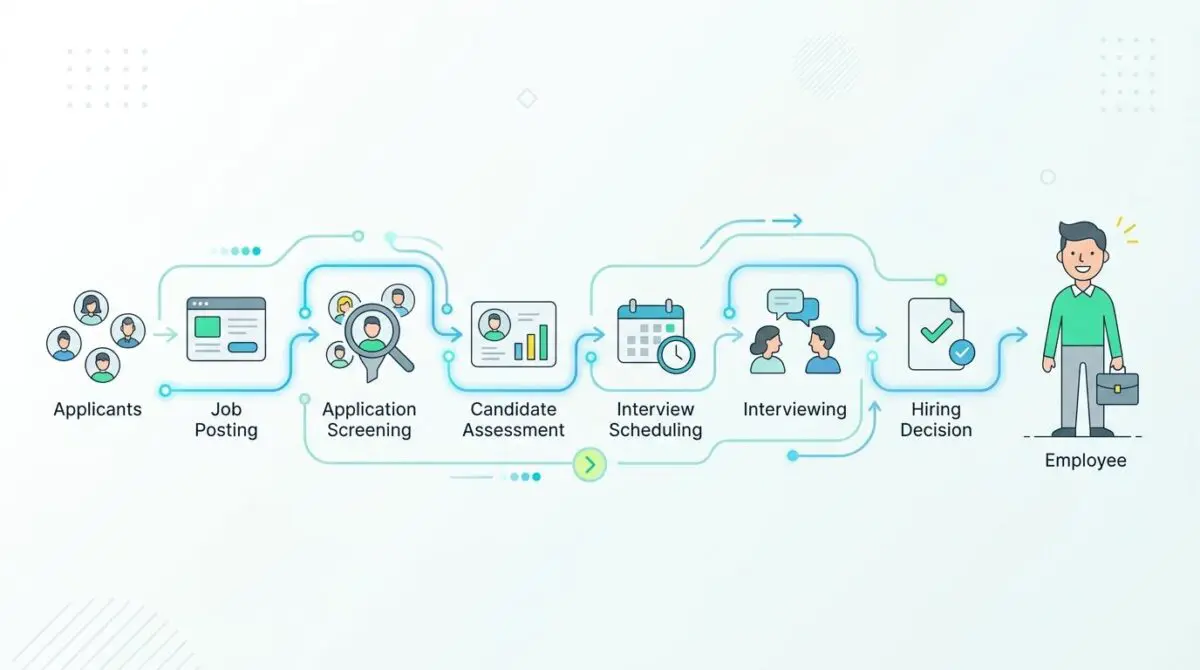
The transition toward AI-native recruitment orchestration is no longer a futuristic concept but a baseline requirement for enterprise survival. It is the definitive method to streamline your hiring process from sourcing to offer without sacrificing candidate quality.
Founders and executives must recognize that fragmented automation is actively harming their talent pipelines. Piecemeal software solutions create dangerous data silos, slow down executive decision-making, and frustrate high-caliber candidates who demand seamless digital experiences.
True orchestration requires a unified, autonomous ecosystem that operates continuously in the background. By treating talent acquisition as an interconnected supply chain, smart organizations are eliminating administrative bloat entirely.
This seamless coordination is what separates market leaders from laggards who are perpetually struggling to fill critical technical roles in a highly competitive landscape.
Market Intelligence and Capital Allocation
The institutional shift toward autonomous digital coworkers is fundamentally rewiring the HR technology landscape from the ground up. Smart capital is heavily concentrated in multi-agent systems that coordinate complex workflows across the entire talent ecosystem.
Industry giants like LinkedIn Talent Solutions and Eightfold AI are facing intense competition from agile, agentic pure-plays. Companies such as Paradox, via its Olivia agent, and Phenom are capturing massive market share by offering self-improving hiring loops that learn from every candidate interaction.
Top-tier enterprises are aggressively moving beyond rigid Applicant Tracking Systems (ATS) toward these dynamic, predictive platforms. The ultimate goal is to deploy digital coworkers that handle sourcing, screening, and scheduling without human prompting or intervention.
Market Intelligence & Data
Agentic Market Cap
The dedicated market for autonomous AI and recruitment agent software is projected to reach this valuation by the end of 2026 according to Second Talent research.
Time-to-Hire Reduction
Enterprise teams using AI-native sourcing and automated scheduling see their hiring timelines compressed by up to 70% compared to manual workflows, per SHRM 2026 benchmarks.
Vacancy Productivity Loss
Deloitte’s 2026 Recruitment Efficiency Report calculates that every day a technical role remains unfilled costs the organization this amount in lost productivity and project delays.
Skills-First Adoption
According to Mercer’s Global Talent Trends, the vast majority of employers are now prioritizing skills-based hiring over traditional degree requirements to combat the deepening labor shortage.
The data clearly illustrates a massive reallocation of enterprise budgets toward intelligent automation. The projected $11.79 billion agentic market cap by the close of 2026 signals a permanent departure from manual administrative layers that have historically slowed down growth.
A staggering 282% jump in enterprise AI adoption proves that the market is prioritizing speed, precision, and verifiable data over legacy processes. The $500 per day cost of vacancy is a bleeding wound that executive boards are no longer willing to tolerate in a tight macroeconomic environment.
This capital movement indicates that investors view recruitment orchestration not as a simple cost center, but as a primary driver of operational alpha. Organizations that fail to secure this infrastructure will simply be priced out of top-tier talent as faster competitors sweep the market.
The Strategic Deep Dive
Understanding the underlying mechanics of this disruption requires looking past the surface-level software layer. We must deeply examine the psychology of the modern candidate and the economic pressures forcing this rapid evolution in talent acquisition.
Overcoming Talent Leakage
Recruitment orchestration directly solves the crippling delays plaguing specialized sectors and technical departments. In the current economic climate, the average time-to-hire has climbed to 44 days across the United States.
This delay creates a hidden tax of recruitment that silently drains corporate resources and stalls critical product roadmaps. Top-tier candidates are highly liquid assets, typically completely off the market within 10 days of beginning their professional search.
By automating the complex coordination layer, AI agents are compressing initial response times from seven days to under twenty-four hours. This unprecedented velocity effectively prevents the talent leakage that occurs when highly sought-after professionals are lost to faster-moving competitors.
The new gold standard involves deploying real-time skill-verification agents alongside biometric interview intelligence. These advanced systems can assess soft skills and cognitive load during live interactions, providing unparalleled predictive validity for hiring managers.
The Candidate Integrity Arms Race
As enterprises deploy increasingly sophisticated AI to filter candidates, a fascinating counter-movement has materialized on the applicant side of the equation. A massive candidate integrity crisis has emerged in 2026, forcing a high-stakes arms race in AI-powered proctoring.
According to exclusive data from MSH Talent, 64% of recruiters are reporting an unprecedented surge in look-alike applications. Candidates are now weaponizing their own personal AI agents to hyper-optimize resumes specifically to bypass digital gatekeepers.
This adversarial dynamic means traditional keyword filtering is completely obsolete and highly dangerous to rely upon. Resumes are now perfectly tailored by machines, rendering them virtually useless as a reliable signal of true candidate capability or cultural fit.
Consequently, recruitment orchestration platforms are aggressively pivoting toward verifiable, real-world performance data. Digital trial periods and autonomous assessment loops are rapidly replacing self-reported credentials as the ultimate source of truth in the hiring ecosystem.
The Executive Action Plan
For founders and C-level executives, the strategic mandate is incredibly clear and urgent. You must build resilient internal talent supply chains powered by end-to-end AI orchestration or risk systemic, long-term talent shortages.
The future belongs entirely to organizations that adopt predictive workforce planning models. Reactive job postings must be permanently replaced with proactive, skills-based advancement strategies that forecast needs years in advance.
Strategic Trajectory
- Adopt ‘Just-in-Time’ hiring models where predictive workforce planning replaces reactive job postings.
- Focus on ‘Skills-Based Advancement’ to forecast internal skills gaps up to three years in advance.
- Build resilient internal talent supply chains powered by AI orchestration.
- Transition away from degree-based credentials toward verifiable AI-assessed performance data.
- Implement digital ‘trial periods’ managed by autonomous systems to validate candidate competency.
Implementing these strategic directives requires a fundamental, ground-up restructuring of your HR architecture. You must ruthlessly audit your existing tech stack and aggressively deprecate legacy systems that rely on manual data entry.
Focus your capital allocation strictly on platforms that offer true multi-agent coordination and interoperability. Your digital coworkers must be able to seamlessly hand off tasks from initial sourcing to final offer generation without dropping context.
Finally, prepare your organizational culture for a total, permanent decline in degree-based credentials. The future of enterprise hiring is entirely dependent on verifiable, AI-assessed performance data and continuous skill validation.
Conclusion
The integration of AI-native recruitment orchestration is unequivocally the defining operational challenge of this decade. It is the only viable mechanism to streamline your hiring process from sourcing to offer in an increasingly complex, high-velocity labor market.
Those who master this orchestration will secure an insurmountable, compounding advantage in global talent acquisition. They will drastically reduce their cost of vacancy while simultaneously elevating the quality, retention, and output of their human capital.
Navigating the intersection of technology, capital, and market psychology requires a sharp strategy. To future-proof your business architecture and scale with precision, connect with Andres at Andres SEO Expert.
Frequently Asked Questions
What is AI-native recruitment orchestration?
AI-native recruitment orchestration is a unified, autonomous ecosystem that synchronizes the entire talent acquisition lifecycle—from sourcing and screening to scheduling and offer generation. Unlike fragmented automation, orchestration eliminates data silos and administrative bloat by utilizing multi-agent systems that operate continuously without human intervention.
How does AI orchestration impact the time-to-hire for enterprise teams?
Enterprise teams utilizing AI-native sourcing and automated scheduling can reduce their time-to-hire by up to 70%. By compressing initial response times from several days to under twenty-four hours, organizations can effectively secure top-tier talent who are typically off the market within 10 days.
What is the financial cost of unfilled technical roles in 2026?
According to the 2026 Recruitment Efficiency Report, the cost of vacancy for a technical role is approximately $500 per day in lost productivity and project delays. This significant financial drain is driving corporate boards to prioritize intelligent recruitment automation as a primary driver of operational alpha.
How can organizations combat the 2026 Candidate Integrity Crisis?
To address the surge in AI-optimized resumes and look-alike applications, enterprises are moving away from traditional keyword filtering. Modern recruitment orchestration platforms now utilize biometric interview intelligence and autonomous digital trial periods to validate candidate competency through verifiable, real-world performance data.
What is a skills-first hiring strategy?
A skills-first strategy prioritizes verifiable AI-assessed performance and specific technical capabilities over traditional degree-based credentials. With an 81% adoption rate among major employers, this approach uses predictive workforce planning to forecast and fill internal skills gaps up to three years in advance.
Which technologies are replacing legacy Applicant Tracking Systems (ATS)?
Top-tier enterprises are transitioning from rigid ATS platforms to dynamic, agentic pure-play systems. These multi-agent platforms, such as Paradox’s Olivia or Phenom, offer self-improving hiring loops that learn from candidate interactions and provide predictive validity for hiring managers.