




Key Points
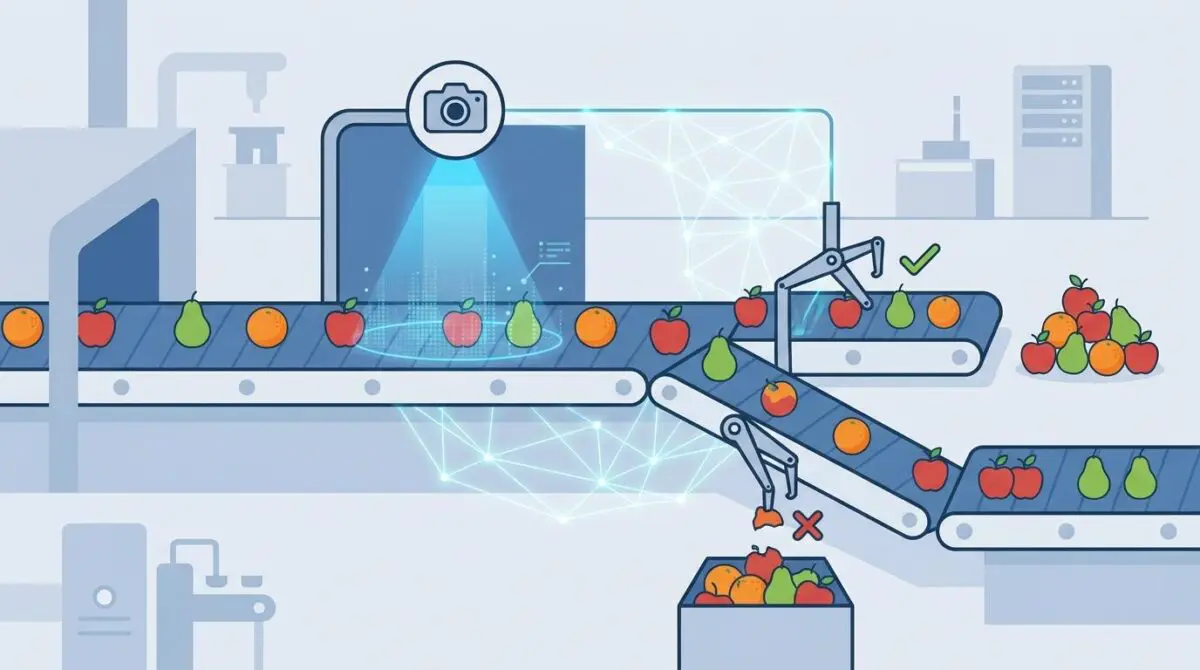
- Instantaneous Processing: High-speed hyperspectral vision systems process defects in under 10 milliseconds to eliminate manual sorting bottlenecks.
- Zero-Shot Detection: Vision-Language Models enable instant defect recognition without requiring months of manual crop data labeling.
- Margin Protection: Automated sorting lines achieve 99% purity and drastically reduce operational costs amidst rising agricultural labor wages.
Table of Contents
- The Invisible Drain on the Sorting Line
- The Data Driving the Vision Revolution
- Overcoming Cumulative Blur on the Belt
- Prompting the Conveyor with Cognitive Agents
- Stabilizing the Line Against Inference Drift
- Training Digital Twins Before the Harvest
- Outpacing the Labor Shortage with High-Speed ROI
- Pixel-Level Traceability for Food Safety
- The Edge-to-Field Horizon
The Invisible Drain on the Sorting Line
The hidden tax of manual produce sorting extends far beyond hourly wages. It is the silent, compounding cost of human fatigue that lets a single rotting apple slip past the line and spoil an entire export pallet.
Specialty crop growers face a critical labor-price disconnect that threatens their survival. Labor costs are rising independently of softening produce market prices, driven by a staggering 24% to 30% increase in Adverse Effect Wage Rates expected by 2025.
This creates an unsustainable environment where margins are squeezed from both ends. You cannot simply hire more people to solve the problem when labor represents your highest variable cost.
The traditional approach of throwing temporary harvest workers at a high-volume sorting belt is fundamentally broken.
To reclaim operational control and protect profit margins, facilities must transition to AI-powered optical sorters and hyperspectral vision systems.
These high-speed computer vision platforms do not get tired, they do not blink, and they never ask for overtime.
By integrating these advanced sensors, packing houses can instantly reject defects in real time. This transforms a chaotic manual process into a precise, automated workflow.
The Data Driving the Vision Revolution
Market Intelligence & Data
Optical Sorter Market Growth
According to a 2025 Grand View Research report, the optical sorter market is surging toward a $5.7 billion valuation by 2033 driven by precision food safety demands.
Inference Latency Threshold
A 2026 analysis by Mordor Intelligence confirms that integrated AI-on-chip systems have pushed defect detection latency below 10ms for high-speed industrial lines.
Labor Cost Inflation
Specialty crop growers in Florida saw a 30% cumulative increase in labor costs through 2025, as reported by the International Fresh Produce Association (IFPA).
Computer Vision Market 2026
Fortune Business Insights projects the global computer vision market will reach $24.14 billion in 2026 as manufacturing and agriculture convert to AI-powered inspection.
The agricultural processing sector is undergoing a massive financial restructuring. According to a 2025 Grand View Research report, the optical sorter market is surging toward a $5.7 billion valuation by 2033.
This rapid growth is driven by precision food safety demands and signifies a permanent shift away from manual sorting lines. Facilities are actively replacing human visual inspection with automated systems to protect their shrinking margins.
Speed is the ultimate currency on a modern sorting conveyor. A 2026 analysis by Mordor Intelligence confirms that integrated AI-on-chip systems have pushed defect detection latency below 10 milliseconds.
At this microscopic latency, pneumatic rejection arms can blast defective produce off a belt moving at several meters per second. This eliminates the traditional bottleneck where machines had to slow down for computers to process complex images.
The push for automation is a direct response to a breaking point in agricultural economics. Specialty crop growers in Florida saw a 30% cumulative increase in labor costs through 2025, as reported by the International Fresh Produce Association.
When you combine massive wage rate increases with softening market prices, growers are caught in a severe financial trap. Automation is no longer a luxury upgrade, but a basic survival mechanism.
The scale of this technological adoption is reshaping global infrastructure. Fortune Business Insights projects the global computer vision market will reach $24.14 billion in 2026.
This massive influx of capital is funding the next generation of hyperspectral sensors and neural networks. As these systems become more accessible, even mid-sized packing houses can deploy enterprise-grade visual AI.
Overcoming Cumulative Blur on the Belt

Manual sorting is plagued by a phenomenon known as cumulative blur. As thousands of fruits and vegetables rush past on a high-speed conveyor, the human eye naturally fatigues.
This optical exhaustion leads to highly inconsistent defect rejection as the shift wears on. Human visual fatigue, combined with the inability to see beneath the skin, results in high food waste and potential regulatory recalls.
A worker might spot a surface blemish, but they cannot detect internal rot or chemical imbalances. This is where industrial facilities are stepping in with advanced hardware deployments.
Platforms like the Specim GX17 are now being deployed to handle real-world lighting shifts that traditional RGB cameras fail to process.
A major technical shift in 2026 is the displacement of traditional pushbroom scanners by snapshot hyperspectral cameras. These modern cameras use on-chip neural networks to achieve instant 2D spectral mapping without linear movement constraints.
Prompting the Conveyor with Cognitive Agents

Historically, teaching a machine to recognize a bad piece of fruit was a grueling process. The traditional bottleneck required months of manual data labeling for each new crop variety or defect type.
If a new type of fungal rot appeared during a wet season, the AI was essentially blind until humans manually tagged thousands of new images.
By 2026, workflows are actively integrating Vision-Language Models and Vision Transformers into sorting software. These cognitive agents allow for zero-shot defect detection right on the factory floor.
Instead of retraining a model from scratch, operators can simply prompt the system with text commands. You can now instruct the AI agent to reject bruised skin or flag irregular color patterns using natural language.
The system understands the context of the prompt and immediately applies it to the live video feed. This flexibility turns rigid sorting machines into highly adaptable assets that pivot instantly to new quality standards.
Stabilizing the Line Against Inference Drift
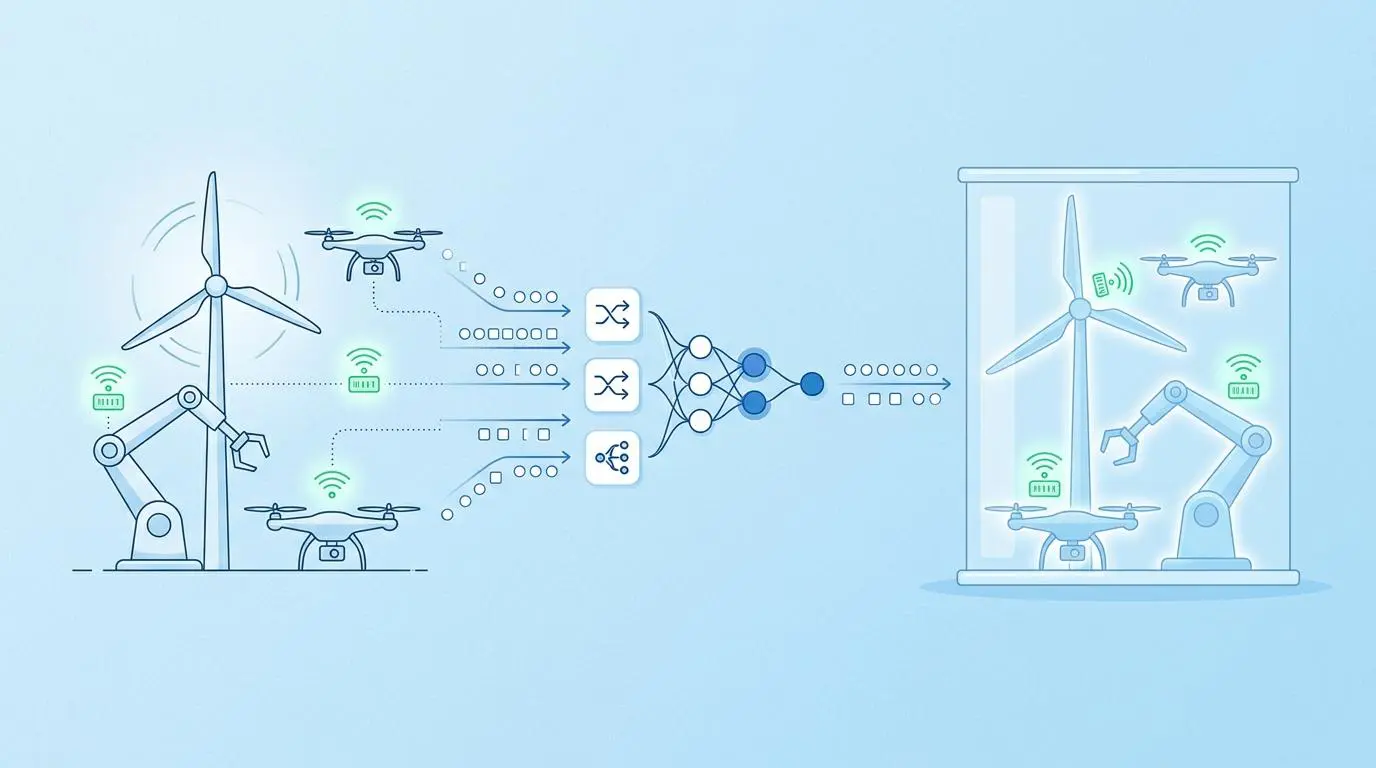
Even the most advanced AI models will fail if the physical environment works against them. Hardware audits reveal that most vision projects miss their ROI targets due to data quality issues rather than model architecture flaws.
A brilliant algorithm simply cannot process a blurry, shaking image. The real-world friction lies in industrial vibrations and dust found in harvest environments.
Heavy machinery creates micro-tremors that destabilize camera localization, while airborne dirt obscures the lenses. This causes inference drift, a scenario where the AI miscalculates the exact coordinates of a defective item.
When inference drift occurs, the high-speed pneumatic rejection arms fire at the wrong millisecond and miss the target produce entirely.
To solve this, modern optical sorters utilize heavy-duty dampening mounts and automated air-knife lens cleaners. Ensuring pristine data capture at the hardware level is the only way to keep the software running accurately.
Training Digital Twins Before the Harvest

Testing a brand new sorting algorithm on a live batch of perishable harvest is incredibly risky. If the AI is too aggressive, it throws away perfectly good produce.
If the system is too lenient, bad produce makes it to the grocery store. The high cost and physical risk of live testing has always slowed down innovation.
To bypass this, modern facilities use digital twins of optical sensors to simulate millions of defect scenarios. Managers can create a flawless virtual replica of their exact conveyor belt setup.
They can then generate synthetic data of rotting, bruised, or misshapen crops. This allows human operators to train and refine the AI in a completely virtual space.
By the time the algorithm is deployed to the physical sorting lines, it has already seen and categorized every possible defect. This simulation guarantees a smooth transition during chaotic peak harvest windows.
Outpacing the Labor Shortage with High-Speed ROI
The inability to scale labor during short, peak harvest windows is a massive liability. Crops do not wait for you to hire enough workers.
When perishability is at its highest, you need maximum throughput immediately. Relying on temporary labor pools leaves facilities vulnerable to sudden walkouts or staffing shortages.
Automated sorting lines completely eliminate this vulnerability by achieving massive throughputs at 99% purity. Large-scale processors are seeing a significant reduction in operational costs by replacing manual shifts with 24/7 AI vision.
The machines run flawlessly through the night, processing massive volumes without a drop in accuracy. This shift from variable labor costs to fixed technological investments provides immense financial stability.
Facility owners can finally predict their processing costs down to the penny, regardless of how tight the local labor market becomes.
Pixel-Level Traceability for Food Safety
Manual tracking systems are fundamentally incapable of providing the immediate, high-resolution audit trails required by modern food safety regulations.
Using clipboards and batch numbers is no longer sufficient when an outbreak occurs. Regulators expect instant answers and precise origin data.
Automated vision systems are now being integrated directly with compliance software. Because the optical sorter scans every single item that passes the belt, it can generate a unique digital footprint for the entire batch.
This provides pixel-level traceability from the harvest bin all the way to the consumer package. If a defect or contamination is flagged downstream, managers can instantly trace the exact origin of that specific item.
This level of granular security prevents massive, brand-destroying recalls by isolating the exact source of the problem in seconds.
The Edge-to-Field Horizon
The industry is rapidly pivoting toward a revolutionary edge-to-field sorting model. Instead of waiting until the crops reach the processing facility, hyperspectral snapshot cameras will be mounted directly on mechanical harvesters.
These ruggedized AI units will cull defective produce right in the dirt. This intercepts the problem before it even enters the transport chain.
By rejecting bad crops in the field, farms eliminate the massive energy and logistics costs associated with moving rejected biomass across the country. The future of automation is not just sorting faster; it is sorting earlier.
Navigating the intersection of technology, workflows, and operational efficiency requires a sharp strategy. To future-proof your business architecture and scale with precision, connect with Andres at Andres SEO Expert.
Frequently Asked Questions
Why are labor costs for specialty crop growers rising so rapidly?
Labor costs are being driven by a staggering 24% to 30% increase in Adverse Effect Wage Rates (AEWR) expected by 2025. In regions like Florida, growers have already seen a 30% cumulative increase in labor expenses, creating a critical disconnect between rising production costs and softening market prices.
How does AI-on-chip technology improve produce sorting speed?
Integrated AI-on-chip systems have pushed defect detection latency below 10ms. This ultra-low latency allows pneumatic rejection arms to accurately remove defective produce from high-speed belts moving at several meters per second, eliminating the throughput bottlenecks associated with manual inspection.
What is the benefit of using Vision-Language Models in agricultural sorting?
Vision-Language Models (VLMs) enable zero-shot defect detection, allowing operators to use natural language text prompts to update sorting criteria. This eliminates the traditional 6-to-12-month manual data labeling process, making sorting systems instantly adaptable to new crop varieties or seasonal defects.
How do hyperspectral sensors differ from traditional RGB cameras?
Unlike RGB cameras that only see surface color, hyperspectral sensors like the Specim GX17 can detect internal rot and chemical imbalances beneath the skin. They can also process 2D spectral mapping without the linear movement constraints of older pushbroom scanners.
What is Edge-to-Field sorting and why is it significant?
Edge-to-Field sorting involves mounting ruggedized AI vision units directly on mechanical harvesters. By culling defective produce in the field, farms can eliminate the energy and logistics costs of transporting up to 20% rejected biomass to a processing facility.
How does automated sorting assist with FSMA 204 compliance?
Automated vision systems generate a unique digital footprint for every item scanned on the belt. This provides pixel-level traceability from the harvest bin to the package, allowing for instant, granular audits that meet 2026 food safety regulations and help prevent large-scale recalls.