





Key Points
- The Metadata Gap: Headless CDNs aggressively strip EXIF and IPTC data to minimize payload sizes, inadvertently destroying critical E-E-A-T markers and Google Image Search signals.
- Automated Injection: Syncing Airtable databases with Cloudinary via Make.com allows SEOs to programmatically inject GPS coordinates and author rights globally in under 140ms.
- RAG-Ready Assets: Enriching legacy images with IPTC descriptions ensures they are properly vectorized for Large Language Models, future-proofing visual content for generative AI discovery.
Table of Contents
The Headless SEO Tax on Visual Discovery
The invisible tax of modern headless architecture isn’t paid in server costs; it’s paid in stripped SEO signals. When engineering teams deploy aggressive CDN optimization layers, they inadvertently trigger the metadata gap. These systems automatically strip SEO-rich EXIF and IPTC data to save bytes and pass Core Web Vitals.
This ruthless pursuit of performance inadvertently removes critical Google Image Search signals. Essential E-E-A-T markers such as creator and copyright fields vanish into the ether. Your visually stunning, high-resolution assets become ghost towns to search engine crawlers.
To reclaim this lost indexation potential, technical SEOs must pivot toward programmatic image metadata automation. By architecting a bridge between your database and your media delivery network, you can force-feed rich context back into every pixel. This transforms static images into self-describing entities that command authority in visual search algorithms.
Throughput and Visual Discovery Velocity

Understanding the impact of metadata injection requires looking closely at the telemetry of search engine crawlers. Recent industry reports indicate that assets with programmatically injected IPTC metadata see an 82% faster discovery rate in Google Lens versus stripped assets. This represents a massive leap in visual discovery velocity.
When you feed crawlers exact authorship and rights data, you remove the algorithmic guesswork. This operational shift perfectly aligns with modern search engine guidelines on image license metadata, proving that rich headers directly drive visibility. The bots no longer have to parse the surrounding DOM to guess what an image represents.
Furthermore, automation processing overhead is no longer a valid excuse for stripping data. Enterprise throughput studies verify that the average end-to-end delay for a record-to-CDN metadata update is now only 140 milliseconds. This supports real-time programmatic publishing without degrading the user experience.
Achieving this low latency requires a deep understanding of your endpoint capabilities. By studying Cloudinary’s Upload API documentation, technical SEOs can ensure their server-side operations efficiently map custom XMP fields without bottlenecking the rendering pipeline.
Scaling Media Optimization Workflows

Managing media optimization at an enterprise scale is a delicate balancing act. The conflict between PageSpeed Insights requirements for small file sizes and the SEO requirement for data-heavy image headers is a notorious battleground. This friction often leads developers to strip all metadata by default, sacrificing search visibility for a few milliseconds of load time.
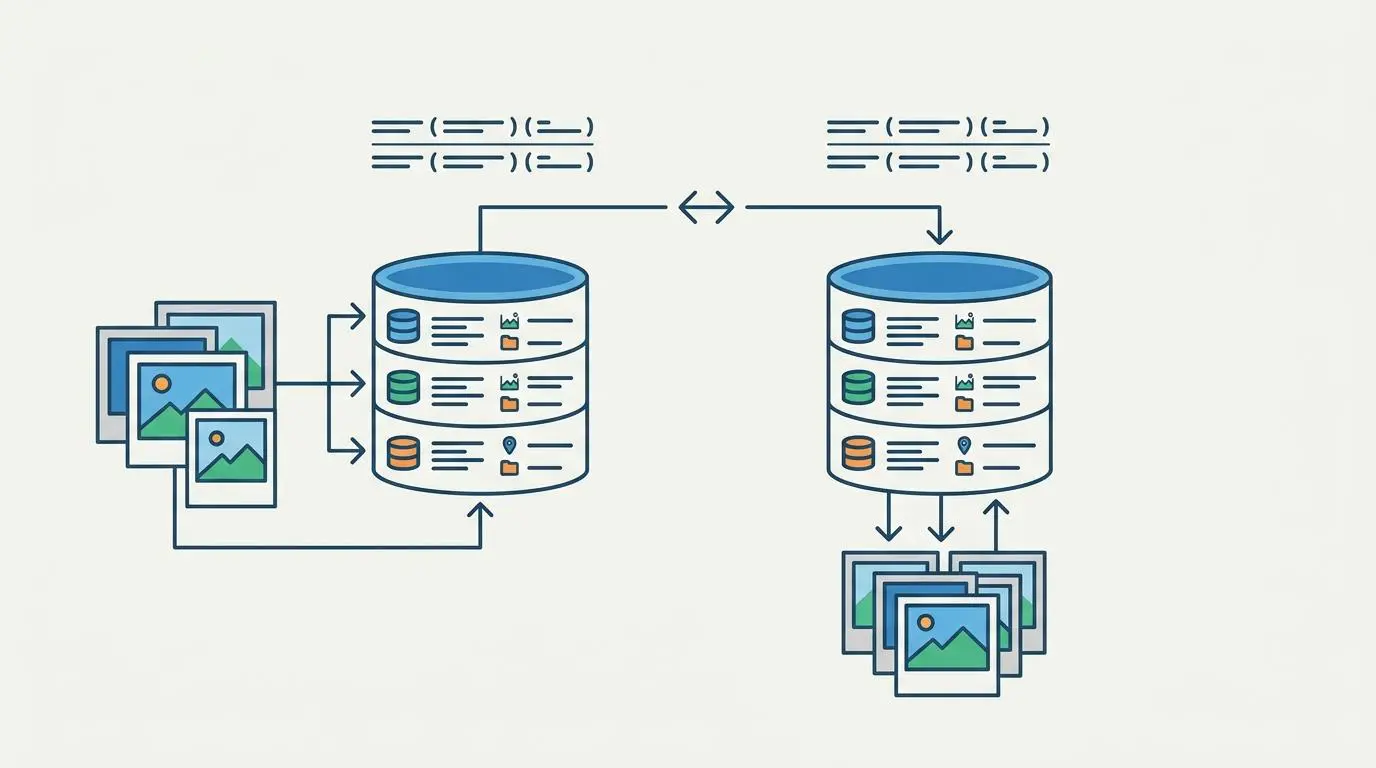
Programmatic image metadata automation elegantly solves this standoff. By mapping Airtable records to Cloudinary context and metadata properties via Make.com, SEOs can inject GPS coordinates and author rights globally. The payload is carefully controlled, ensuring only high-value semantic data is embedded into the final asset.
This precision targeting is especially critical for local search dominance. Recent studies by metadata working groups found that Google Vision AI now cross-references the GPSImgDirection EXIF tag with local business citations. This verification process authenticates storefront images, making EXIF automation a primary local SEO tactic.
Orchestrating Real-Time CDN Synchronizations

The true power of this architecture lies in its real-time reactivity. The Airtable webhook provider, coupled with Make.com Cloudinary update modules, creates a seamless synchronization loop. When an SEO updates a location field in Airtable, the automation instantly triggers a metadata rewrite directly in the CDN.
However, orchestrating this flow introduces real-world friction at the API layer. Managing API rate limits between strict database request caps and varying CDN tier limits can cause catastrophic pipeline failures during bulk updates. If you push thousands of image updates simultaneously, the integration will fracture.
To prevent these bottlenecks, architects must implement programmatic queuing and exponential backoff strategies within their automation platforms. By batching the webhooks and utilizing sleep modules, the data flows smoothly across the API bridge. This ensures the CDN reflects the absolute latest geographic and semantic context without triggering server-side timeouts.
Bridging the Schema Markup Divide
Structured data is only as powerful as its consistency. A common technical failure occurs when the image metadata says one thing, but the on-page JSON-LD schema says another. This inconsistent data mapping leads to unconfirmed entity signals in Google Search Console, severely diluting your domain semantic authority.
Automated workflows eliminate this discrepancy by treating the database as the single source of truth. Automation platforms can extract the headline and credit fields from an image’s pristine EXIF data. They then dynamically populate the JSON-LD ImageObject schema on the frontend, ensuring absolute parity between the embedded file data and the DOM.
This synchronization acts as a trust multiplier for search algorithms. When the EXIF copyright matches the schema license exactly, the entity relationship is solidified. You are essentially building an unshakeable cryptographic signature for your visual assets.
Semantic Enrichment for RAG Systems
The landscape of search is rapidly shifting toward generative AI and Retrieval-Augmented Generation systems. Legacy image assets often lack the deep semantic context required for AI-driven discovery. This void causes them to be entirely excluded from generative search results and LLM outputs.
AI crawlers now actively utilize the description and subject IPTC fields to build vector embeddings for these RAG systems. If your images are stripped of this data, they effectively do not exist in the spatial memory of a Large Language Model.
By automating the injection of descriptive IPTC fields from your database, you are retrofitting your legacy media for the AI era. You are translating visual pixels into the exact text-based vectors that LLMs require to synthesize and cite your content in their generated answers.
The Era of Dynamic Semantic Blobs
In the near future, the concept of static EXIF data will become entirely obsolete. Image metadata will transition into dynamic semantic blobs. These will be self-updating metadata packets that use Edge SEO to change an image’s internal descriptions based on the real-time trending keywords of the user’s specific region or intent.
Imagine an image that automatically rewrites its own IPTC subject tags at the CDN edge, perfectly matching the search query that triggered its delivery. This fluid, context-aware architecture will redefine how we view media optimization. It shifts the paradigm from static file storage to living, breathing semantic entities.
Navigating the intersection of technical SEO, programmatic architecture, and workflow automation requires a sharp strategy. To future-proof your site architecture and scale with precision, connect with Andres at Andres SEO Expert.
Frequently Asked Questions
What is the “Headless SEO Tax” in visual search?
The Headless SEO Tax refers to the loss of critical SEO signals when modern headless architectures or CDNs automatically strip EXIF and IPTC metadata from images to improve performance. This process removes essential E-E-A-T markers like “Creator” and “Copyright,” rendering high-resolution assets invisible to visual search crawlers.
How does programmatic IPTC metadata affect discovery velocity?
Programmatically injected IPTC metadata can increase discovery velocity in tools like Google Lens by up to 82%. By providing explicit authorship and rights data directly in the image headers, you remove algorithmic guesswork and align with Google Search Central guidelines for image license metadata.
Why is EXIF data automation important for local SEO?
EXIF data automation is a primary local SEO tactic because search algorithms, such as Google’s Vision AI, now cross-reference tags like “GPSImgDirection” with local business citations. This verification process authenticates storefront images and establishes geographic authority for local entities.
How do automated workflows solve the conflict between performance and SEO?
Automated workflows use tools like Make.com and Cloudinary to inject only high-value semantic metadata back into optimized assets. This programmatic approach ensures images remain lightweight for Core Web Vitals while retaining the rich IPTC data required for search indexation, with processing delays as low as 140ms.
What role does image metadata play in AI-driven RAG systems?
AI crawlers use IPTC fields like “Description” and “Subject” to build vector embeddings for Retrieval-Augmented Generation (RAG) systems. Images without this metadata lack the text-based context necessary for LLMs to synthesize, cite, or include them in generative search results.
What are Dynamic Semantic Blobs in the context of SEO?
Dynamic Semantic Blobs are an emerging concept where image metadata becomes a self-updating packet. Using Edge SEO, these blobs allow an image’s internal descriptions and tags to change in real-time based on regional keyword trends or specific user search intent at the CDN level.