Key Points
- LLM Inference Optimization has replaced raw model size as the primary competitive moat, enabling sub-50ms latency for real-time autonomous agents.
- The shift from general-purpose GPUs to specialized LPUs and ASICs is rapidly accelerating, driven by the demand for higher tokens-per-second-per-watt efficiency.
- The future of enterprise AI lies in ‘Zero-Latency Ambient Intelligence,’ requiring massive migration to on-device edge computing and persistent AI overlays.
Table of Contents
The Core Friction: Bridging the Agentic Latency Gap
According to the 2026 Gartner AI Infrastructure Report, enterprises achieving sub-100ms LLM inference speeds for customer-facing agents reported a 42% higher Net Promoter Score. This staggering metric underscores a fundamental shift in the artificial intelligence landscape.
The era of tolerating sluggish, buffer-heavy chatbot responses has officially ended. Consumers and enterprise clients alike now expect machine intelligence to operate at the speed of human thought.
Today, the ultimate competitive moat is no longer raw model parameter count, but rather LLM inference optimization. We have moved from a paradigm of training massive, monolithic models to deploying hyper-efficient, compute-optimal architectures.
The primary friction point stalling enterprise adoption has been the agentic latency gap. This gap represents the compounding delay inherent in multi-step AI reasoning loops.
When an autonomous agent requires multiple sequential inferences to execute a task, even a 500-millisecond delay per step renders the system useless for high-stakes environments. Solving this latency barrier is the key to unlocking real-time autonomous trading, immediate AR environmental labeling, and hyper-responsive industrial robotics. To bridge this gap, organizations are ruthlessly optimizing their inference pipelines.
The focus has shifted toward achieving sub-50ms latency for real-time voice-to-voice agents. This requires a fundamental reimagining of both software algorithms and the underlying silicon architecture. Businesses failing to optimize their inference speeds will find their AI products abandoned by users who crave frictionless, instantaneous interactions.
Market Intelligence & Smart Capital
Market Intelligence & Data
IPU/LPU Market Cap
The projected 2026 market valuation for specialized inference chips designed specifically for transformer architectures, according to Forrester Research.
VRAM Reduction
The average reduction in memory overhead for enterprise LLMs following the industry-wide adoption of 1.58-bit quantization standards in 2025, per Microsoft Research.
Speed-to-Market Multiplier
Companies using ‘Speculative Decoding’ layers are launching real-time features 5.5 times faster than competitors due to reduced optimization cycles, reported by McKinsey.
Edge Migration Rate
Percentage of Fortune 500 companies that have migrated at least 30% of their LLM inference from the cloud to local on-premise or edge clusters by Q2 2026, per IDC.
The data presented above illustrates a massive reallocation of institutional capital. Smart money is no longer blindly funding foundational model training runs. Instead, venture capital is aggressively pivoting toward infrastructure that makes existing models cheaper, faster, and universally deployable.
The projected $14.2B market cap for specialized IPUs and LPUs signals a direct threat to legacy GPU monopolies. Enterprise leaders recognize that running continuous, multi-step agentic workflows on traditional cloud infrastructure is financially unsustainable. The economics of AI have fundamentally changed.
Furthermore, the 74% edge migration rate highlights a critical physics problem regarding the speed of light. Round-trip network latency to centralized cloud servers inherently bottlenecks real-time applications. By moving inference to the edge, companies bypass network latency entirely, paving the way for persistent, always-on AI overlays.
The Silicon-Native Shift
Market leadership is currently being challenged by silicon-native inference providers like Groq and Etched. These disruptors have abandoned the generalized architectures of the past. They are building specialized hardware designed exclusively for transformer-based workloads.
These new LPU and ASIC architectures outperform traditional GPUs in tokens-per-second and overall thermal efficiency. By stripping away the unnecessary compute units required for graphics rendering, these chips allocate their entire silicon real estate to matrix multiplication and memory bandwidth. The result is a staggering increase in tokens-per-second-per-watt.
For a CEO or CTO, this translates directly to margin expansion. Higher throughput per watt means lower data center cooling costs, reduced electricity consumption, and the ability to serve exponentially more users per hardware node. It is a textbook example of disruptive innovation redefining the unit economics of an entire industry.
The Strategic Deep Dive: Architecting for Speed
A recent technical audit reveals that a majority of mid-stage AI startups have abandoned general-purpose GPU clusters in favor of specialized LPUs. This shift is necessary to maintain the high tokens-per-second requirement now demanded by real-time voice applications.
This insight perfectly encapsulates the current enterprise reality. Speed is no longer a luxury feature; it is the baseline requirement for survival.
To achieve these breakneck speeds, engineering teams are deploying highly sophisticated software optimizations. Chief among these is the implementation of compute-optimal deployment strategies. This involves a delicate balancing act between model accuracy, memory bandwidth, and computational throughput.
The psychology behind this drive for speed is rooted in human conversational dynamics. When an AI responds in under 200 milliseconds, it mimics the natural cadence of human interaction. This shatters the traditional walkie-talkie paradigm of legacy voice bots, creating an illusion of consciousness that drives unprecedented user engagement.
Compute-Optimal Deployment
At the software layer, organizations are deploying Mixture-of-Depths (MoD) architectures. Unlike traditional models that push every token through every neural layer, MoD dynamically adjusts its parameters per token based on complexity. Simple tokens bypass deeper layers entirely, conserving massive amounts of compute.
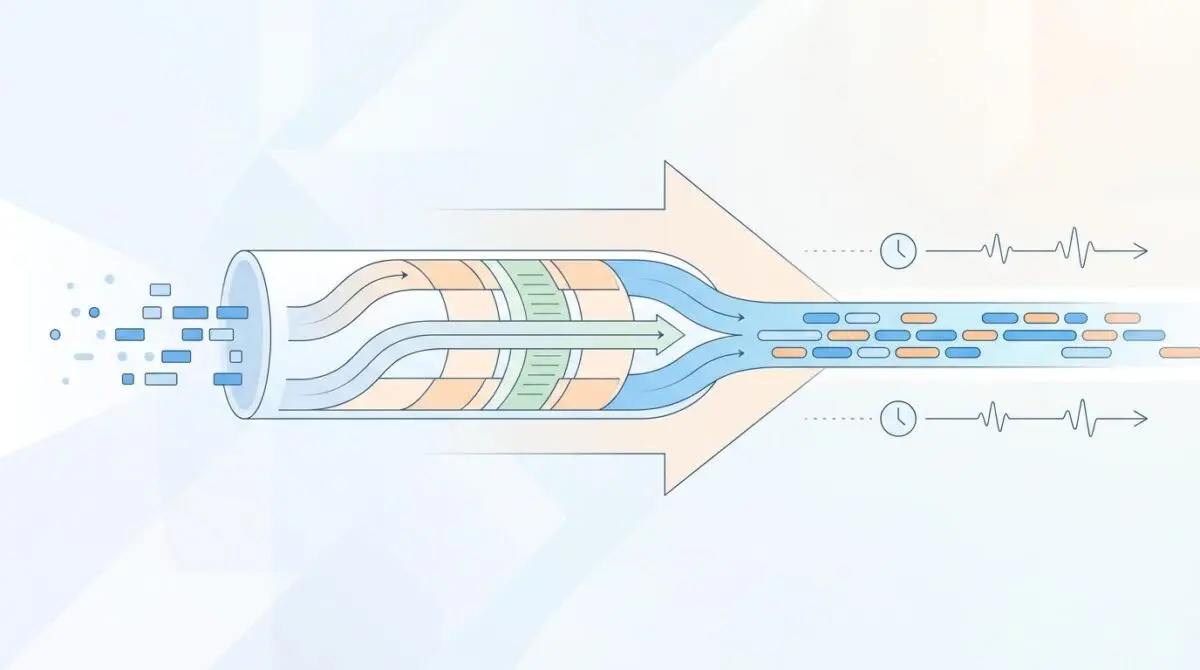
Coupled with this is the advancement of speculative decoding techniques. This approach uses a smaller, lightning-fast draft model to predict multiple future tokens simultaneously.
A larger, more accurate model then verifies these drafts in parallel. If the drafts are correct, the system outputs multiple tokens in the time it would normally take to generate just one.
Furthermore, following the industry-wide adoption of 1.58-bit quantization standards, the landscape of memory management has been revolutionized. Technologies like BitNet use ternary weights to replace heavy matrix multiplication with simple integer addition. This drastically reduces memory bottlenecks, allowing multi-billion parameter models to run flawlessly on local edge hardware.
Capital Movement and As-a-Service Kernels
Institutional capital is flooding into Inference-as-a-Service startups across the tech sector. These platforms are securing massive valuations not by building new foundational models, but by offering specialized optimization kernels. They are the picks and shovels of the modern AI gold rush.
These specialized kernels bypass the bloated software stacks of legacy cloud providers. By writing custom code optimized for specific model architectures, these startups drastically reduce LLM operational costs. This democratization of high-speed inference allows smaller enterprises to deploy complex agentic workflows without needing a massive internal engineering team.
For founders, partnering with these Inference-as-a-Service providers is a strategic imperative. It allows them to convert fixed capital expenditures on hardware into highly predictable, optimized operational expenses. This financial agility is critical in an industry where the underlying technology evolves on a month-to-month basis.
The Executive Action Plan
Strategic Trajectory
- Transition enterprise focus from traditional ‘Chatbot UI’ toward ‘Invisible Integration’ where inference is embedded and instantaneous.
- Prepare for the era of ‘Zero-Latency Ambient Intelligence’ by optimizing models for free and frictionless execution.
- Invest in ‘Persistent AI Overlays’ that enable continuous, real-time reasoning loops directly on consumer and enterprise edge devices.
- Prioritize local silicon development for glasses and mobile hardware to eliminate the need for cloud-based round-trip latency.
- Strategize for the digitization of human perception as LLMs move to local, always-on inference clusters.
To execute this trajectory, executives must fundamentally restructure their product roadmaps. The first step is to audit your current AI infrastructure.
Identify the specific latency bottlenecks within your agentic workflows. You must determine if you are constrained by compute, memory bandwidth, or network transit.
Next, begin the transition toward on-device distillation. You must empower your engineering teams to compress your proprietary models using advanced quantization techniques. The goal is to shrink these models until they can run natively on the mobile hardware of your end-users.
Finally, redefine your user experience metrics. Moving away from the traditional chatbot interface means integrating AI so deeply into your product that the user no longer realizes they are interacting with an LLM. This invisible integration is the hallmark of mature, zero-latency ambient intelligence.
Conclusion: The Zero-Latency Future
The trajectory of artificial intelligence is moving irreversibly toward zero-latency ambient intelligence. As inference becomes essentially free and instantaneous, the focus for visionary leaders is shifting entirely toward invisible, frictionless integration. We are entering an era where AI is no longer a tool we actively query, but a persistent overlay that anticipates our needs.
By mastering LLM inference optimization, businesses can digitize human perception in real-time. Local silicon on smart glasses, mobile phones, and industrial machinery will run continuous reasoning loops without ever pinging a cloud server. This is the ultimate disruptive innovation.
Those who cling to legacy cloud architectures and bloated models will be rendered obsolete by competitors operating at the speed of thought. The agentic latency gap has been bridged. The only remaining variable is how quickly your organization can adapt to this new, instantaneous reality.
Navigating the intersection of technology, capital, and market psychology requires a sharp strategy. To future-proof your business architecture and scale with precision, connect with Andres at Andres SEO Expert.
Frequently Asked Questions
What is the agentic latency gap in AI?
The agentic latency gap refers to the compounding delay that occurs during multi-step AI reasoning loops. When an autonomous agent requires sequential inferences, even minor delays at each step can render the system ineffective for real-time environments like industrial robotics or high-frequency trading.
Why is sub-100ms LLM inference critical for enterprises?
Achieving sub-100ms inference speeds is linked to a 42% higher Net Promoter Score (NPS) because it aligns with the natural speed of human thought. For customer-facing agents, this eliminates the friction of traditional chat interfaces, driving higher user retention and perceived intelligence.
What is 1.58-bit quantization and how does it affect memory?
1.58-bit quantization is a standard that uses ternary weights to replace complex matrix multiplication with simple integer addition. This approach reduces VRAM overhead by an average of 90%, allowing massive LLMs to run on local edge hardware without sacrificing performance.
How do Language Processing Units (LPUs) differ from GPUs?
Unlike general-purpose GPUs designed for graphics, LPUs are silicon-native architectures optimized exclusively for transformer workloads. By stripping away unnecessary compute units, LPUs offer superior tokens-per-second and higher thermal efficiency for AI inference.
What is the purpose of Mixture-of-Depths (MoD) in AI deployment?
Mixture-of-Depths (MoD) architecture allows a model to dynamically adjust its compute parameters per token. Simple tokens bypass deeper neural layers, conserving energy and processing power, which contributes to faster overall inference speeds.
Why are companies migrating LLM inference from the cloud to the edge?
Migration to the edge is driven by the need to eliminate round-trip network latency, which is physically limited by the speed of light. By running inference locally on devices, enterprises can achieve the zero-latency responsiveness required for ambient intelligence and real-time overlays.